

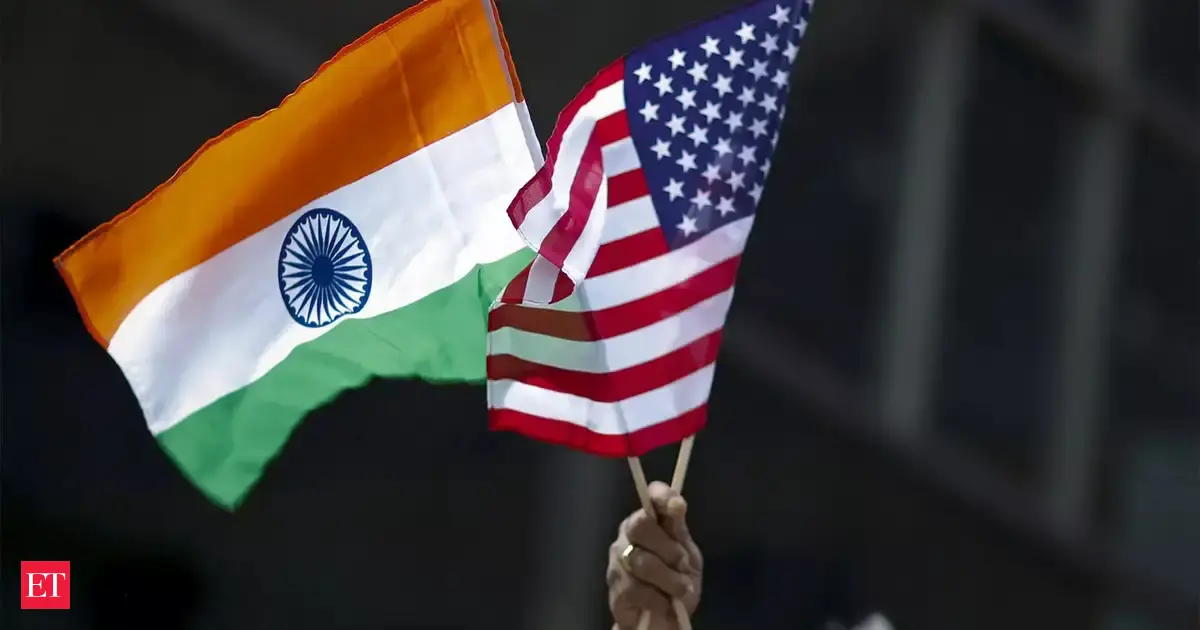
India has signed a major trade deal with the United States.
GK and monthly revision
US India Trade Deal: Tariff cut to 18%, access to $30-trillion market, 0% duty on key agri exports — what the numbers show
India has signed a significant trade deal with the United States, featuring a substantial tariff cut to 18% and granting Indian businesses access to a vast $30-trillion market. This agreement includes a crucial provision for 0% duty on key agricultural exports, aiming to significantly boost India's export growth. The deal is vital for strengthening bilateral economic ties and fostering export-led development, making it a key topic for competitive exam preparation on international trade and economy.
Revision structure
Monthly events and exam calendar context
Static GK and one-liner notes
Quiz and mock-test revision path
Key points
Exam-ready takeaways
The agreement includes a substantial tariff cut to 18% for Indian exports to the US.
Indian businesses gain access to a vast $30-trillion market in the United States.
The deal provides for 0% duty on key agricultural exports from India to the US.
Key Indian sectors like textiles, machinery, and agriculture are set to benefit greatly from this agreement.
Detailed analysis
Full exam-oriented breakdown
The recent trade deal between India and the United States marks a significant milestone in their evolving economic partnership, signaling a renewed commitment to fostering deeper commercial ties. This agreement, characterized by a substantial tariff cut to 18% and guaranteed 0% duty on key agricultural exports, opens up the vast $30-trillion US market for Indian businesses, promising a considerable boost to India's export growth. **Background Context:** The relationship between India and the US has historically been complex, characterized by periods of alignment and divergence. Economically, while both nations are major trading partners, their trade relationship has often been punctuated by disputes over tariffs, market access, and intellectual property rights. For years, both sides have engaged in negotiations for a comprehensive Free Trade Agreement (FTA), but progress has been slow due to differences on various issues, including agricultural subsidies, medical device pricing, and data localization. The US had previously withdrawn India's Generalized System of Preferences (GSP) benefits in June 2019, which allowed duty-free entry for certain Indian products, citing lack of reciprocal market access. This particular deal, while not a full FTA, appears to be a 'mini-deal' or a 'limited trade package' designed to resolve some long-standing irritants and pave the way for broader cooperation. **What Happened:** As per the details, this agreement significantly reduces tariffs for Indian exports to the US, bringing the general tariff down to 18%. Crucially, it provides 0% duty on specific, key agricultural exports, which is a major win for India's agrarian sector. Sectors such as textiles, machinery, and agriculture are explicitly identified as primary beneficiaries. This means Indian manufacturers and farmers can now access the American market more competitively, potentially increasing their export volumes and revenues. The agreement aims to streamline trade, reduce transaction costs, and provide a more predictable trade environment for businesses on both sides. **Key Stakeholders Involved:** On the Indian side, the Ministry of Commerce and Industry, led by the Commerce Minister, plays a pivotal role in negotiating and finalizing such deals. Indian exporters, particularly those in the textile, machinery, and agriculture sectors, are direct beneficiaries. Farmers, especially those involved in exporting key agricultural products, stand to gain from the 0% duty provision. Consumers might indirectly benefit from increased economic activity and potentially diverse product availability. In the United States, the Office of the United States Trade Representative (USTR) is the primary negotiating body. American businesses, while not direct beneficiaries of these specific tariff cuts on Indian goods, are stakeholders looking for reciprocal market access in India for their products (e.g., dairy, medical devices, high-tech goods), which are often part of broader trade discussions. The deal also serves the strategic interests of both governments in strengthening bilateral ties. **Significance for India:** This trade deal holds immense significance for India. Economically, it is expected to provide a substantial impetus to India's 'Make in India' and 'Atmanirbhar Bharat' initiatives by boosting export-led manufacturing and agricultural production. Increased exports will lead to higher foreign exchange earnings, potentially help in managing the current account deficit, and create employment opportunities across various sectors. Access to a $30-trillion market is a game-changer for Indian businesses looking to expand their global footprint. Politically, the deal reinforces the growing strategic partnership between India and the US, which is crucial in the current geopolitical landscape, particularly in the Indo-Pacific region. This economic alignment complements the existing security and diplomatic cooperation, strengthening India's position as a key global player and a counterweight to rising regional influences. **Historical Context and Broader Themes:** India's trade policy has evolved significantly since the economic reforms of 1991. From a relatively closed economy, India has progressively integrated into the global trading system, engaging in numerous bilateral and multilateral trade agreements. The pursuit of this deal with the US aligns with India's broader strategy of diversifying its trade relationships and reducing reliance on specific regions. The US has been a crucial partner in this journey, and efforts to resolve trade frictions have been ongoing for several administrations. This deal can be seen as a step forward in operationalizing the 'Quad' partnership (Quadrilateral Security Dialogue) beyond security cooperation, extending it into economic collaboration. The agreement also reflects the global trend of countries prioritizing bilateral deals when multilateral trade negotiations (like those at the WTO) face roadblocks. **Future Implications:** While this deal is a positive step, it is likely just the beginning. The ultimate goal for both nations remains a comprehensive Free Trade Agreement (FTA). This limited deal could build trust and momentum for future, more extensive negotiations covering a wider range of goods, services, and investment. Future discussions will likely address contentious areas such as intellectual property rights, digital trade, labor standards, and environmental regulations. The success of this current agreement in boosting Indian exports will also influence India's approach to other trade blocs, such as the Indo-Pacific Economic Framework for Prosperity (IPEF), where India is a participant. The implementation of this deal will require robust monitoring to ensure that the benefits reach the intended sectors and that any new disputes are resolved efficiently. For India, leveraging this access effectively will be key to realizing its ambition of becoming a $5 trillion economy. **Related Constitutional Articles, Acts, or Policies:** The power to enter into and implement international treaties and agreements primarily rests with the Union Government. **Article 253** of the Indian Constitution empowers Parliament to make any law for implementing any treaty, agreement, or convention with any other country or any decision made at any international conference, association, or other body. This provides the constitutional backing for legislative actions required to operationalize such trade deals. Furthermore, **Entry 14 of the Union List (Seventh Schedule)** grants the Union Parliament exclusive power to legislate on 'entering into treaties and agreements with foreign countries and implementing of treaties, agreements and conventions with foreign countries.' The **Foreign Trade (Development and Regulation) Act, 1992**, provides the legal framework for the development and regulation of foreign trade in India, enabling the government to formulate and implement the Foreign Trade Policy (FTP). The specific provisions of this deal will be integrated into India's existing Foreign Trade Policy and relevant customs notifications.
How to study
Turn news into exam marks
Revise monthly events by exam family instead of reading random updates.
Pair one-liners with mock tests so mistakes become the next revision list.
Keep state job pages, calendar pages and GK packs connected in one path.