

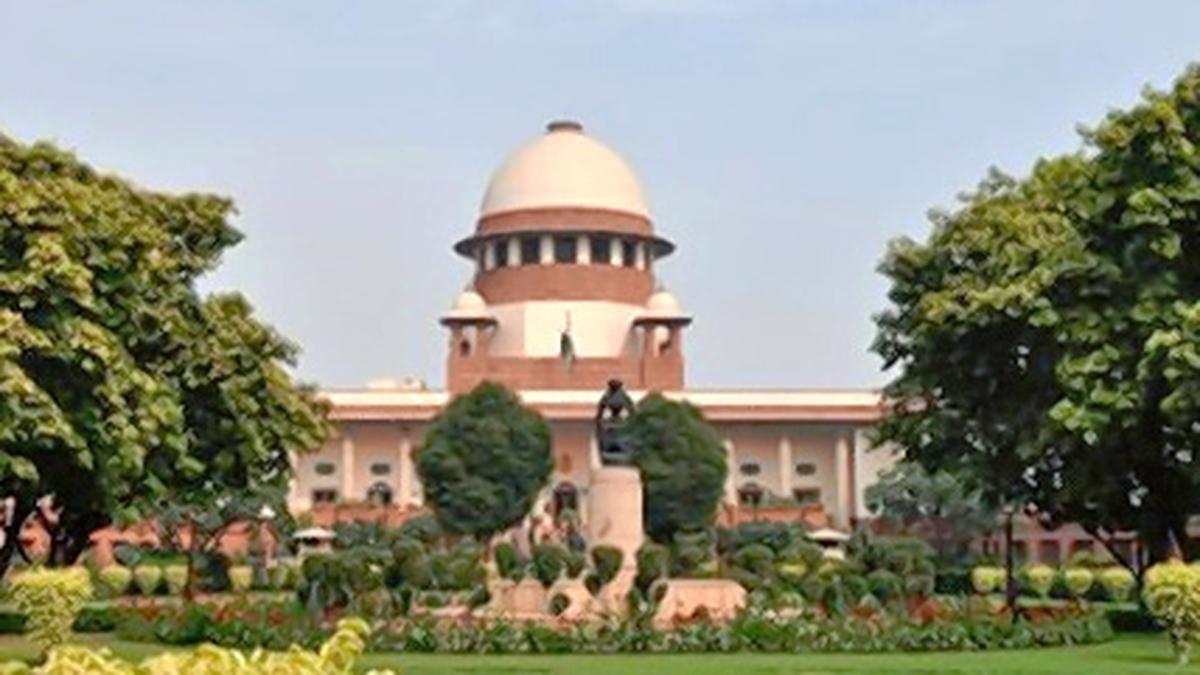
The Supreme Court adjourned the hearing of appeals by Meta Platforms and WhatsApp regarding their privacy policy.
GK and monthly revision
Supreme Court adjourns WhatsApp-Meta privacy policy case to Feb. 23
The Supreme Court has adjourned the hearing of appeals filed by Meta Platforms and WhatsApp against a Competition Commission of India (CCI) order. The CCI had imposed a significant penalty of ₹213.14 crore on the tech giants over their privacy policy. This case is crucial for competitive exams as it highlights regulatory oversight on data privacy by bodies like CCI and the judiciary's role in tech policy.
Revision structure
Monthly events and exam calendar context
Static GK and one-liner notes
Quiz and mock-test revision path
Key points
Exam-ready takeaways
The next hearing date for the WhatsApp-Meta privacy policy case is scheduled for February 23.
The appeals challenge an order issued by the Competition Commission of India (CCI).
The CCI had imposed a penalty of ₹213.14 crore on Meta Platforms and WhatsApp.
The core issue under contention is the privacy policy implemented by WhatsApp and Meta Platforms.
Detailed analysis
Full exam-oriented breakdown
The Supreme Court's adjournment of the WhatsApp-Meta privacy policy case to February 23 marks another critical juncture in India's evolving digital regulatory landscape. This case is not merely about a hefty fine but delves deep into the fundamental principles of data privacy, market competition, and the extent of regulatory oversight over global tech giants operating in India. For competitive exam aspirants, understanding this issue requires a comprehensive grasp of legal, economic, and constitutional aspects. **The Genesis of the Controversy: WhatsApp's 2021 Privacy Policy Update** The roots of this legal battle trace back to early 2021, when WhatsApp, owned by Meta Platforms (formerly Facebook), announced a controversial update to its privacy policy. The new policy mandated users to accept new terms, which included sharing certain metadata with its parent company, Meta, or face service termination. This move sparked widespread outrage among users, privacy advocates, and even government bodies, who viewed it as a coercive tactic that compromised user data privacy. Critics argued that the update essentially forced users to consent to data sharing with Meta, blurring the lines between the two platforms and potentially giving Meta access to a vast trove of user data for targeted advertising and other commercial purposes. **The Role of the Competition Commission of India (CCI)** Amidst the public outcry, the Competition Commission of India (CCI) took suo motu cognizance of the matter. The CCI, established under the Competition Act, 2002, is India's primary competition regulator, tasked with preventing practices having an adverse effect on competition, promoting and sustaining competition in markets, protecting the interests of consumers, and ensuring freedom of trade. In March 2021, the CCI initiated an investigation into WhatsApp's new privacy policy, reasoning that it prima facie amounted to an 'abuse of dominant position' under Section 4 of the Competition Act, 2002. The CCI's concern was that WhatsApp, with its dominant position in the messaging app market in India, was leveraging this dominance to impose unfair terms and conditions on its users, thereby stifling competition and harming consumer choice. After a thorough investigation, the CCI, in August 2022, imposed a penalty of ₹213.14 crore on Meta Platforms and WhatsApp, reiterating that the privacy policy update was exploitative and exclusionary. **Key Stakeholders and the Supreme Court's Intervention** The primary stakeholders in this case are **Meta Platforms and WhatsApp**, who are challenging the CCI's order, arguing that the CCI overstepped its jurisdiction and that their privacy policy does not violate competition laws. The **Competition Commission of India (CCI)** is defending its order, asserting its statutory mandate to ensure fair competition and protect consumer interests. The **Supreme Court of India** is the ultimate judicial authority hearing the appeals, playing a crucial role in interpreting laws and setting precedents. Beyond these direct parties, **Indian citizens and consumers** are significant stakeholders, as the outcome directly impacts their data privacy rights and choices in the digital space. The **Government of India**, through its various ministries, also has an indirect stake, particularly as it has recently enacted the Digital Personal Data Protection Act (DPDP Act), 2023. **Why This Matters for India: A Multifaceted Impact** This case holds profound significance for India. Firstly, it underscores the growing tension between **data privacy and market competition** in the digital era. India, with its massive internet user base, is a critical market for global tech companies. The Supreme Court's decision will set a crucial precedent for how data-rich platforms can operate and how their policies are scrutinised. Secondly, it strengthens the hand of Indian regulatory bodies like the CCI in asserting their authority over global tech giants, ensuring that foreign companies adhere to Indian laws and consumer protection standards. This is vital for **maintaining a level playing field** for domestic startups and fostering a fair digital economy. Thirdly, it is closely intertwined with the **fundamental Right to Privacy**, enshrined under Article 21 of the Indian Constitution, as affirmed by the landmark *K.S. Puttaswamy v. Union of India* judgment in 2017. The court's interpretation will clarify the scope of this right in the context of commercial data sharing. Lastly, the case's outcome will influence the implementation and effectiveness of the newly enacted **Digital Personal Data Protection Act (DPDP Act), 2023**, providing judicial clarity on data fiduciary responsibilities and user consent mechanisms. **Future Implications** The Supreme Court's eventual ruling will have far-reaching implications. It could redefine the boundaries of regulatory oversight by bodies like the CCI in the digital market, impacting how other tech companies design their privacy policies and terms of service. A ruling upholding the CCI's penalty would signal a strong stance against anti-competitive practices and coercive data collection. Conversely, a reversal could lead to questions about the extent of regulatory power. Furthermore, the decision will significantly influence the evolving framework of data governance in India, particularly as the DPDP Act, 2023, comes into full effect. It will shape the balance between fostering innovation and safeguarding individual privacy, a critical challenge for India's rapidly expanding digital economy.
How to study
Turn news into exam marks
Revise monthly events by exam family instead of reading random updates.
Pair one-liners with mock tests so mistakes become the next revision list.
Keep state job pages, calendar pages and GK packs connected in one path.