

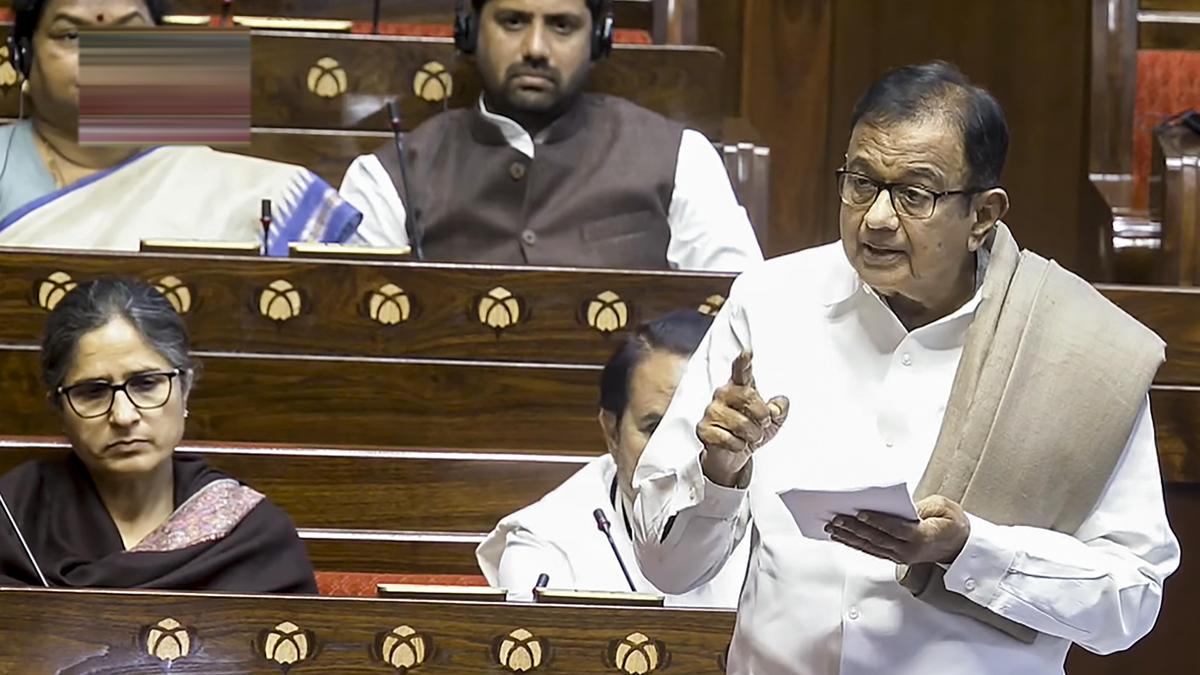
Senior Congress leader P. Chidambaram criticized the Union Budget during a discussion in the Rajya Sabha.
GK and monthly revision
Opposition corners Centre over unemployment, farmers’ woes during discussion on Budget in Rajya Sabha
During a Rajya Sabha discussion on the Union Budget, senior Congress leader P. Chidambaram criticized it as 'forgettable', highlighting pressing issues of unemployment and farmers' woes. He specifically noted that fewer than 2 crore people are employed in factories out of India's 144 crore population and questioned the efficacy of the PM's internship scheme. This parliamentary critique is important for understanding political discourse, economic challenges, and government accountability, relevant for polity and economy sections in competitive exams.
Revision structure
Monthly events and exam calendar context
Static GK and one-liner notes
Quiz and mock-test revision path
Key points
Exam-ready takeaways
Chidambaram labeled the Union Budget as 'forgettable' and attributed its preparation to a 'Finance Minister who forgot her promises'.
He raised concerns about widespread unemployment and the challenges faced by farmers in the country.
Chidambaram stated that less than 2 crore people are employed in factories out of India's total population of 144 crore.
He also flagged the poor outcomes and effectiveness of the Prime Minister's internship scheme.
Detailed analysis
Full exam-oriented breakdown
The recent parliamentary discussion in the Rajya Sabha, where senior Congress leader P. Chidambaram sharply criticized the Union Budget, brings to the forefront critical economic and governance challenges facing India. His characterization of the budget as 'forgettable' and his pointed remarks about the Finance Minister's unfulfilled promises highlight the intense political scrutiny that accompanies the annual financial statement. This event serves as a crucial lens through which to understand India's economic landscape, parliamentary democracy, and the government's accountability. **Background Context:** The Union Budget, presented annually by the Finance Minister, is the government's financial blueprint for the upcoming fiscal year. It outlines revenue and expenditure, fiscal policies, and economic priorities. As per Article 112 of the Indian Constitution, it is referred to as the 'Annual Financial Statement'. The period leading up to and following the budget presentation is typically marked by vigorous debate, as it reflects the government's economic philosophy and its proposed solutions to national challenges. In recent years, India has grappled with the economic aftermath of the COVID-19 pandemic, global inflationary pressures, and persistent structural issues like unemployment and agricultural distress. The opposition's critique, therefore, is rooted in these ongoing socio-economic realities and aims to hold the government accountable for its performance and promises. **What Happened:** P. Chidambaram, a former Union Finance Minister himself, launched a scathing attack on the budget during its discussion in the Rajya Sabha. His primary points of contention were the perceived failure of the budget to address widespread unemployment and the deep-seated woes of the farming community. He specifically cited a stark statistic: out of India's 144 crore population, fewer than 2 crore were employed in factories, indicating a significant deficit in formal sector job creation. Furthermore, he questioned the efficacy and outcomes of the Prime Minister's internship scheme, suggesting it had not delivered its intended results in skill development and employment generation. This critique is a standard parliamentary practice where the opposition uses the budget discussion to highlight governmental shortcomings and propose alternative approaches. **Key Stakeholders Involved:** 1. **The Government (Union Finance Ministry and the ruling party):** Responsible for formulating and defending the budget, articulating its vision for economic growth, and demonstrating its commitment to public welfare. The Finance Minister, in particular, is the direct target of such critiques. 2. **The Opposition (Congress and P. Chidambaram):** Their constitutional role is to scrutinize government policies, raise public concerns, and hold the executive accountable. By highlighting issues like unemployment and farmer distress, they aim to represent the grievances of specific sections of society and challenge the government's narrative of economic progress. 3. **Farmers:** A critical demographic in India, often facing challenges related to market access, minimum support prices (MSP), climate change impacts, and debt. Their concerns are central to India's rural economy and political discourse. 4. **Unemployed Youth:** This segment of the population is directly affected by job creation policies, skill development initiatives, and the overall economic growth trajectory. High unemployment can lead to social unrest and economic stagnation. 5. **General Public:** The ultimate beneficiaries or sufferers of economic policies, whose livelihoods and well-being are directly impacted by budget allocations and policy outcomes. **Significance for India:** This debate holds immense significance for India. Economically, it underscores the persistent challenges of job creation and agricultural sustainability, which are crucial for inclusive growth. Politically, it showcases the vibrant nature of India's parliamentary democracy, where the opposition plays a vital role in checks and balances. Such discussions are essential for government accountability and transparency. Socially, addressing unemployment and farmer distress is paramount for maintaining social stability and reducing inequality. Failure to tackle these issues effectively can lead to increased poverty, rural-urban migration, and social unrest. **Historical Context:** India has historically grappled with both unemployment and agrarian distress. Post-independence, various governments have implemented schemes like the Green Revolution to boost agriculture and industrial policies to create jobs. However, structural unemployment, disguised unemployment in agriculture, and the challenge of skilling a large workforce have remained persistent. Budget debates have always been platforms for discussing these issues, reflecting the continuous efforts and varying degrees of success in tackling them across different administrations. **Future Implications:** The opposition's critique, especially on issues as sensitive as unemployment and farmer welfare, could influence future policy decisions. The government might be compelled to re-evaluate existing schemes (like the PM's internship scheme) or introduce new initiatives to demonstrate its commitment to these sectors. Politically, with general elections on the horizon, these issues are likely to become central to electoral campaigns, shaping public perception and voting patterns. The government's ability to show tangible progress on job creation and rural development will be crucial for its political fortunes. **Related Constitutional Articles, Acts, or Policies:** * **Article 112 (Annual Financial Statement):** Defines the Union Budget. The entire discussion takes place under the framework of this article. * **Article 110 (Money Bills):** Relevant as the Finance Bill, which gives effect to the financial proposals of the government for the next financial year, is a Money Bill. * **Directive Principles of State Policy (DPSP):** Articles like **Article 38** (State to secure a social order for the promotion of welfare of the people), **Article 39(a)** (right to an adequate means of livelihood), **Article 41** (right to work, to education and to public assistance in certain cases), and **Article 43** (living wage for workers) provide the constitutional bedrock for government's responsibility towards employment and welfare. The criticism implies a failure to adequately uphold these principles. * **Policies related to employment:** Schemes like the Pradhan Mantri Kaushal Vikas Yojana (PMKVY), Skill India Mission, National Rural Employment Guarantee Act (MGNREGA). The PM's internship scheme likely falls under the broader skill development initiatives. * **Policies related to farmers:** Pradhan Mantri Kisan Samman Nidhi (PM-KISAN), Pradhan Mantri Fasal Bima Yojana (PMFBY), e-NAM (National Agriculture Market). This parliamentary exchange highlights the dynamic interplay between policy, politics, and public welfare in India, reminding us that economic figures must translate into tangible improvements in people's lives.
How to study
Turn news into exam marks
Revise monthly events by exam family instead of reading random updates.
Pair one-liners with mock tests so mistakes become the next revision list.
Keep state job pages, calendar pages and GK packs connected in one path.