

India and the United States have agreed on a framework for an interim trade deal.
GK and monthly revision
India–US Trade Deal: Big promises, quiet protections — what really happens to agriculture?
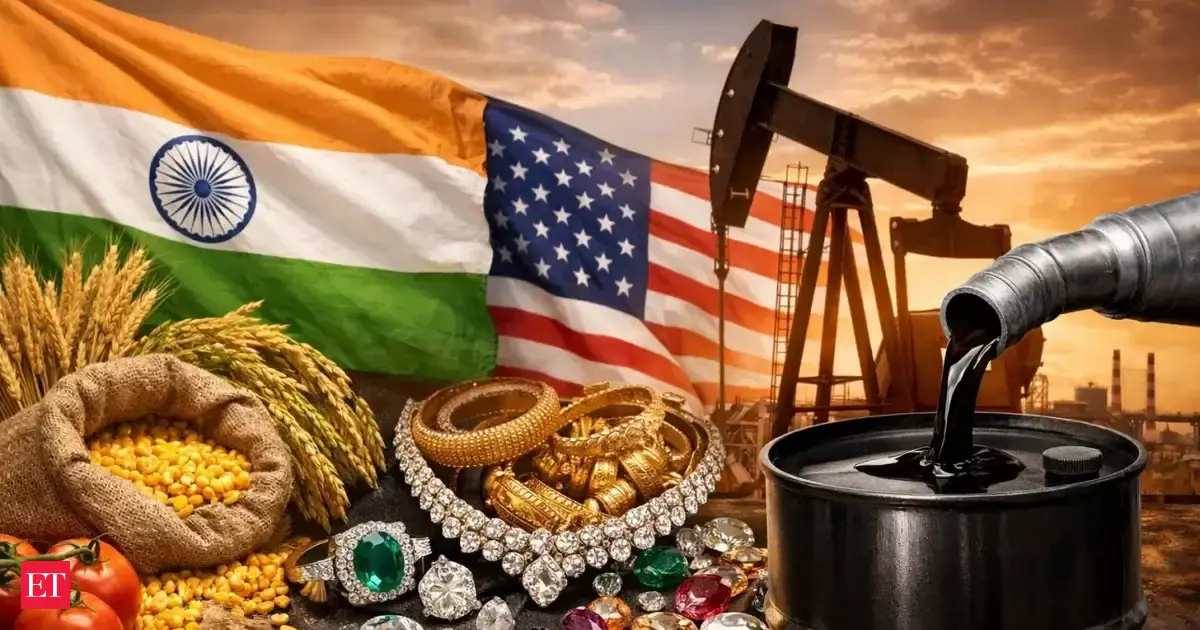
India and the United States have agreed on a framework for an interim trade deal, with agriculture placed at the forefront. This agreement aims to provide greater market access for US farm products in India, while simultaneously ensuring protection for India's crucial agricultural sectors like dairy, grains, and vegetables. This development is significant for understanding bilateral economic relations and trade policy for competitive exams.
Revision structure
Monthly events and exam calendar context
Static GK and one-liner notes
Quiz and mock-test revision path
Key points
Exam-ready takeaways
The core focus of this interim trade agreement is the agriculture sector.
The United States anticipates securing greater access for its farm products in the Indian market.
India has assured protection for its crucial domestic agricultural sectors under the deal.
Specific Indian agricultural sectors guaranteed protection include dairy, grains, and vegetables.
Detailed analysis
Full exam-oriented breakdown
The recent agreement on a framework for an interim trade deal between India and the United States, with a significant focus on agriculture, marks a crucial development in bilateral economic relations. This deal, while aiming to facilitate greater market access for US farm products in India, simultaneously assures protection for India's vital agricultural sectors such as dairy, grains, and vegetables. Understanding the nuances of this agreement requires delving into its historical context, identifying key stakeholders, and assessing its multifaceted implications for India. **Background Context and What Happened:** India and the US have long been strategic partners, but their trade relationship has often been characterized by both opportunities and points of contention. While bilateral trade has grown significantly, reaching over $191 billion in goods and services in 2022, a comprehensive Free Trade Agreement (FTA) has remained elusive. Past disagreements included issues like tariffs on steel and aluminum imposed by the US, India's retaliatory tariffs, and the US withdrawal of Generalized System of Preferences (GSP) benefits for India in 2019, impacting Indian exports. These tensions underscored the need for a structured framework to address trade imbalances and enhance cooperation. This interim deal emerges from sustained negotiations, aimed at resolving immediate trade irritants and building trust before a more expansive agreement can be pursued. The core of this agreement is a delicate balance: the US seeks increased access for its agricultural produce, driven by its highly mechanized and subsidized farm sector, while India, with its vast agrarian population and food security concerns, prioritizes safeguarding its domestic farmers from potential market disruptions. The 'quiet protections' imply that while some concessions might be made for US products, India will maintain robust non-tariff barriers, sanitary and phytosanitary measures, or specific tariff lines to shield its sensitive sectors. **Key Stakeholders Involved:** On the Indian side, the **Ministry of Commerce and Industry** and the **Ministry of Agriculture & Farmers Welfare** are the primary government agencies involved in negotiating and implementing such a deal. Crucially, **Indian farmers** and **domestic agricultural industries** (dairy cooperatives, grain producers, vegetable growers) are major stakeholders, as their livelihoods and market stability are directly impacted. Their concerns often revolve around price stability, fair competition, and the potential influx of cheaper imports. For the United States, the **United States Trade Representative (USTR)** and the **US Department of Agriculture** spearhead negotiations. **American farmers**, particularly those in dairy, almonds, apples, and poultry sectors, are key stakeholders pushing for greater market access in India to expand their export base. Large **American corporations** also seek broader market access for their products and services. **Significance for India:** This interim trade deal holds profound significance for India across economic, political, and social dimensions. **Economically**, it could potentially open new avenues for Indian exports to the US market in other sectors, contributing to economic growth and job creation. However, the agricultural component necessitates careful management. While increased competition could spur efficiency in some Indian farm sectors, an unchecked influx of US agricultural products, particularly subsidized ones, could adversely affect the incomes of millions of Indian farmers and challenge India's food security goals. The deal also aligns with India's broader Foreign Trade Policy, which seeks to diversify trade partners and reduce reliance on specific markets. **Politically**, the agreement strengthens the India-US strategic partnership, signaling a willingness to resolve trade disputes and deepen economic ties, which is crucial in the evolving geopolitical landscape, particularly in the Indo-Pacific region. Socially, the impact on the agricultural sector, which employs a significant portion of India's workforce, will be closely watched. Ensuring the 'quiet protections' are effective is paramount for rural stability and livelihoods. **Constitutional and Policy References:** Agriculture and trade fall under the legislative purview of both the Union and State governments in India. **Article 246** of the Indian Constitution, read with the **Seventh Schedule**, delineates these powers. **Entry 41 of the Union List** grants the Parliament exclusive power over 'Trade and commerce with foreign countries; import and export across customs frontiers'. Conversely, **Entry 14 of the State List** covers 'Agriculture, including agricultural education and research, protection against pests and prevention of plant diseases'. The **Concurrent List, Entry 33**, allows both Union and State governments to legislate on 'Trade and commerce in, and the production, supply and distribution of, food stuffs'. This constitutional framework highlights the complex interplay of federal powers in shaping agricultural trade policy. Furthermore, policies like the **National Agriculture Policy**, the **Minimum Support Price (MSP)** regime, and the **'Atmanirbhar Bharat' Abhiyan** (Self-Reliant India initiative) underscore India's commitment to protecting its farmers and ensuring food security. The **Foreign Trade (Development and Regulation) Act, 1992**, provides the legal framework for governing foreign trade in India. **Future Implications:** This interim deal is likely a precursor to a more comprehensive Free Trade Agreement between India and the US. Its success will determine the pace and scope of future negotiations. Challenges will persist in balancing the US demand for further market liberalization with India's need to protect its sensitive sectors and millions of small and marginal farmers. The experience gained from this interim framework will inform India's strategy in multilateral trade forums like the World Trade Organization (WTO), particularly concerning agricultural subsidies and market access debates. The deal's implementation will also be a test for India's 'Atmanirbhar Bharat' vision, demonstrating how self-reliance can be pursued alongside global economic integration. Continuous monitoring and agile policy responses will be essential to ensure that the benefits of increased trade are realized without compromising the interests of India's crucial agricultural base.
How to study
Turn news into exam marks
Revise monthly events by exam family instead of reading random updates.
Pair one-liners with mock tests so mistakes become the next revision list.
Keep state job pages, calendar pages and GK packs connected in one path.