

The initiative is named 'Amaravati Quantum Valley', located in Amaravati, Andhra Pradesh.
GK and monthly revision
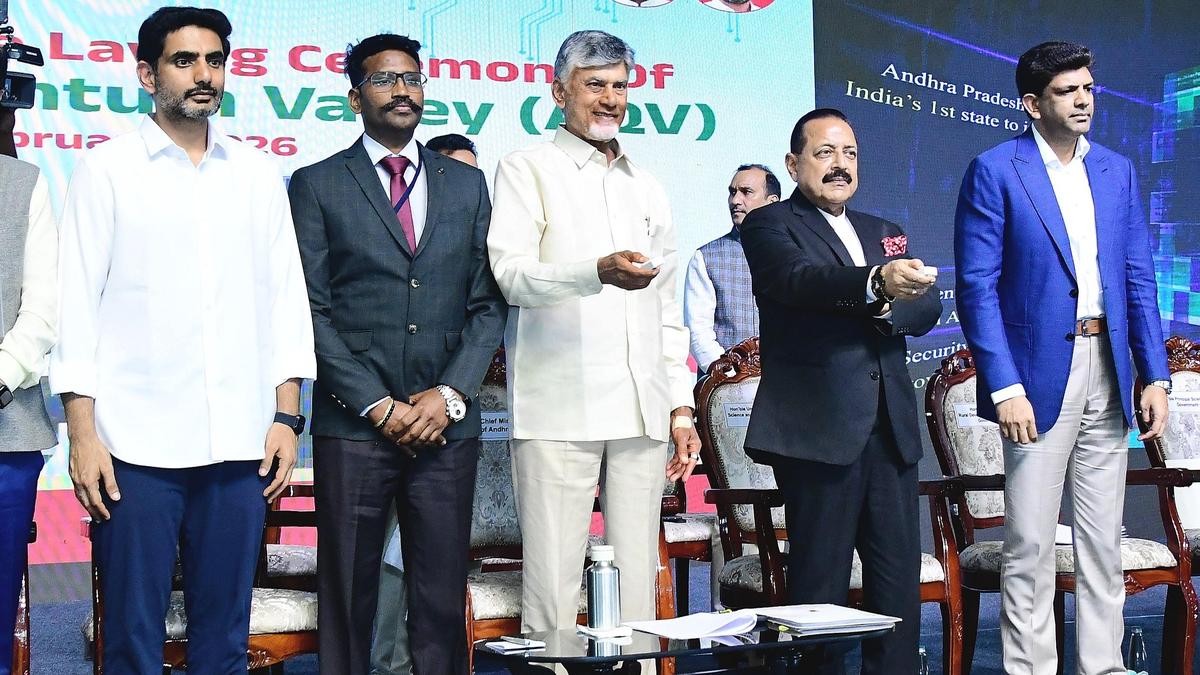
Amaravati Quantum Valley a game-changing initiative, says Andhra Pradesh Chief Minister Chandrababu Naidu
Andhra Pradesh Chief Minister Chandrababu Naidu has highlighted the Amaravati Quantum Valley as a game-changing initiative. This project aims to establish a robust global talent base, crucial for driving the quantum transition in the coming decades. Its significance lies in positioning India at the forefront of the global quantum revolution, making it a key development in science and technology policy for competitive exams.
Revision structure
Monthly events and exam calendar context
Static GK and one-liner notes
Quiz and mock-test revision path
Key points
Exam-ready takeaways
Andhra Pradesh Chief Minister Chandrababu Naidu made the statement regarding the initiative.
The primary goal of the Quantum Valley is to create a strong base of global talent in quantum technology.
It is envisioned to drive the 'quantum transition' in the decades to come.
CM Naidu stated the initiative would place India at the forefront of the global quantum revolution.
Detailed analysis
Full exam-oriented breakdown
The announcement of the 'Amaravati Quantum Valley' by Andhra Pradesh Chief Minister Chandrababu Naidu represents a forward-looking strategy aimed at positioning India at the forefront of the global quantum technology revolution. This initiative, while specific to Andhra Pradesh, aligns with India's broader national ambitions in science and technology. **Background Context and What Happened:** In recent years, quantum technology has emerged as a disruptive force with the potential to revolutionize computing, communication, sensing, and material science. Globally, nations are racing to develop capabilities in this domain. Recognizing this, India launched the National Quantum Mission (NQM) in 2023, with a substantial outlay of over ₹6,000 crores for 2023-2031. The NQM aims to nurture and scale up scientific and industrial R&D in quantum technologies. Against this backdrop, CM Naidu’s vision for an 'Amaravati Quantum Valley' is a strategic move by a state government to tap into this nascent yet highly promising field. The statement emphasizes creating a robust base of global talent to drive the 'quantum transition' in the coming decades, effectively making Amaravati a hub for quantum research, development, and application. Andhra Pradesh, particularly after its bifurcation in 2014, has been keen on attracting high-tech industries and establishing itself as an innovation hub. Amaravati, envisioned as the new capital, has been planned with modern infrastructure and a focus on knowledge-based industries. The idea of a 'Quantum Valley' is an extension of this ambition, aiming to create a specialized ecosystem akin to Silicon Valley for IT or various biotechnology clusters globally. It signifies a proactive approach from the state government to align with national priorities while simultaneously fostering regional economic growth and job creation in cutting-edge sectors. **Key Stakeholders Involved:** Several stakeholders are crucial for the success of such an ambitious project. The **Andhra Pradesh Government**, led by CM Chandrababu Naidu, is the primary driver, providing policy support, infrastructure, and an enabling environment. Their role includes attracting investments, facilitating land acquisition, and offering incentives. The **Central Government of India**, through ministries like Science & Technology, Electronics & Information Technology, and even Defence, is a critical partner, especially given the National Quantum Mission. Central funding, regulatory clarity, and national policy alignment are vital. **Academic and Research Institutions** (both national and international) will form the bedrock for talent development, fundamental research, and applied science. Universities and specialized research centers will be instrumental in generating the skilled workforce and intellectual property. The **Private Sector and Industry** will play a crucial role in commercializing quantum technologies, investing in R&D, and creating employment opportunities. This includes both large corporations and start-ups. Finally, **International Collaborators** (governments, universities, and companies from leading quantum nations) could bring expertise, joint research opportunities, and global market access. **Significance for India:** The Amaravati Quantum Valley, if successfully implemented, holds immense significance for India. Economically, it promises to create high-value jobs, attract foreign direct investment (FDI) in advanced technology sectors, and stimulate a new wave of entrepreneurship. It could position India as a global leader in quantum computing, quantum communication (e.g., quantum key distribution for secure communication), quantum sensing, and advanced materials. Strategically, quantum technologies have profound implications for national security, particularly in cryptography (developing quantum-safe algorithms) and advanced defense applications. By building indigenous capabilities, India can reduce its reliance on foreign technology and enhance its strategic autonomy. Socially, breakthroughs in quantum technology could impact various sectors, from healthcare (drug discovery, advanced diagnostics) to finance (optimized trading algorithms) and logistics. This initiative directly contributes to the 'Make in India' and 'Digital India' visions by fostering indigenous innovation and high-tech manufacturing. **Historical Context and Future Implications:** India has a long history of investing in strategic scientific endeavors, from its atomic energy program initiated in the 1940s to its successful space program. The push for quantum technology is a natural progression, building on this foundation of scientific ambition. The NQM, launched in April 2023, is a testament to the nation's commitment. The Amaravati Quantum Valley fits into this national narrative by providing a dedicated geographical hub for this advanced research. The success of this initiative will depend on sustained funding, robust industry-academia collaboration, and a clear regulatory framework. Challenges include attracting top global talent, ensuring adequate infrastructure, and navigating the highly competitive global landscape of quantum research. In the future, such quantum valleys could become crucial nodes in India's innovation ecosystem, potentially leading to breakthroughs that redefine industries and bolster India's position as a technological powerhouse. It also sets a precedent for other states to specialize in emerging technologies, fostering competitive federalism in innovation. **Related Constitutional Articles, Acts, or Policies:** While there isn't a specific 'Quantum Technology Act' yet, several constitutional provisions and policies underpin such initiatives. **Article 51A(h)** of the Indian Constitution mandates citizens to 'develop the scientific temper, humanism and the spirit of inquiry and reform.' Government initiatives like the Quantum Valley directly support this by fostering scientific research and innovation. The **Directive Principles of State Policy (Part IV)**, particularly those related to promoting economic welfare and raising the standard of living, indirectly support state investments in advanced technologies for societal benefit. The **National Quantum Mission (NQM)** itself is the overarching policy framework guiding these efforts. The **Information Technology Act, 2000**, and its future amendments will be crucial for regulating the ethical and security aspects of quantum communication and computing. Furthermore, the **National Education Policy (NEP) 2020** emphasizes skill development and interdisciplinary research, which is vital for building the talent pipeline required for quantum technologies.
How to study
Turn news into exam marks
Revise monthly events by exam family instead of reading random updates.
Pair one-liners with mock tests so mistakes become the next revision list.
Keep state job pages, calendar pages and GK packs connected in one path.