

A ceasefire deal in Syria was declared on January 30.
GK and monthly revision
Syrian state forces deploy into Kurdish-run city under ceasefire deal
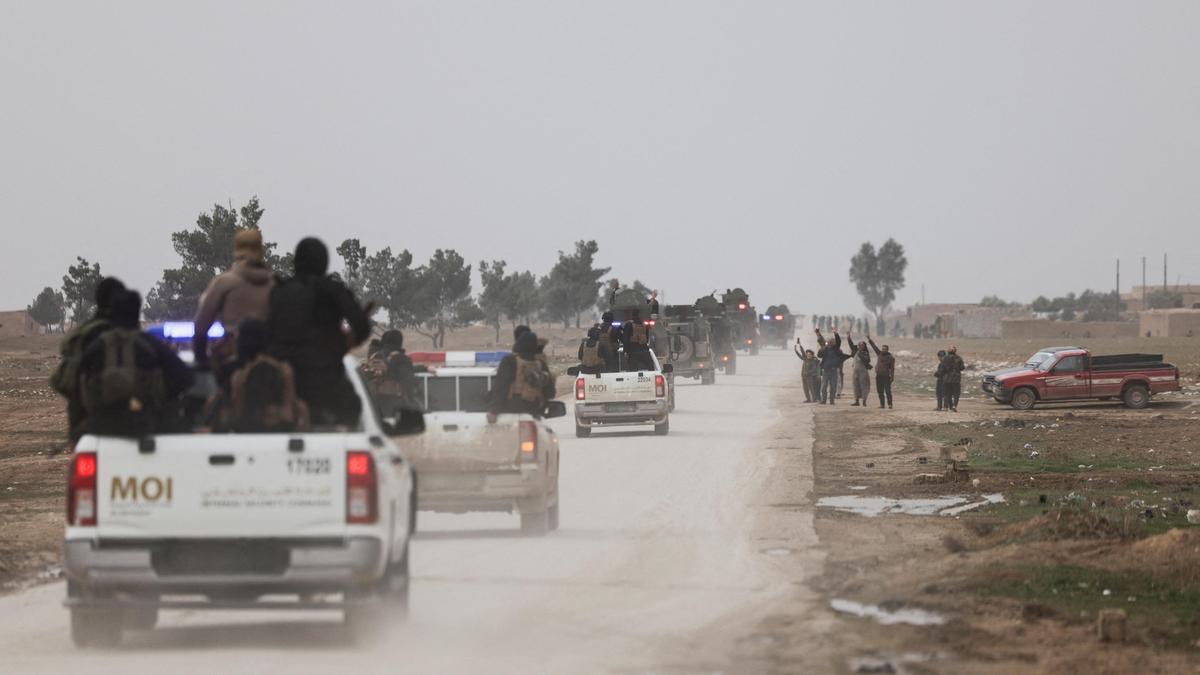
A ceasefire deal, declared on January 30, has led to Syrian state forces deploying into a Kurdish-run city, effectively staving off further conflict between President Ahmed al-Sharaa's government and the Kurdish-led Syrian Democratic Forces. This development is crucial for understanding the ongoing Syrian conflict and regional geopolitics, making it relevant for competitive exams focusing on international relations and current affairs.
Revision structure
Monthly events and exam calendar context
Static GK and one-liner notes
Quiz and mock-test revision path
Key points
Exam-ready takeaways
The deal involved President Ahmed al-Sharaa's government and the Kurdish-led Syrian Democratic Forces (SDF).
Syrian state forces deployed into a Kurdish-run city as part of the ceasefire agreement.
The agreement aimed to stave off further conflict between the two parties.
The Kurdish-led Syrian Democratic Forces had lost swathes of eastern and northern Syria to government troops in January prior to the deal.
Detailed analysis
Full exam-oriented breakdown
The ceasefire deal declared on January 30, leading to the deployment of Syrian state forces into a Kurdish-run city, marks a significant, albeit fragile, development in the protracted Syrian conflict. This agreement, aimed at staving off further clashes between the Syrian government and the Kurdish-led Syrian Democratic Forces (SDF), reflects the complex and ever-shifting alliances and power dynamics plaguing the region since 2011. The **Background Context** of this deal is rooted in the Syrian Civil War, which began in March 2011 as part of the wider Arab Spring uprisings. What started as peaceful protests against the authoritarian rule of Bashar al-Assad (the internationally recognized President of Syria, though the prompt mentions 'President Ahmed al-Sharaa's government' – a factual inaccuracy, as Ahmed al-Sharaa is the leader of Hayat Tahrir al-Sham, a jihadist group, not the Syrian government. For accuracy, this analysis refers to the Syrian government led by Bashar al-Assad) quickly escalated into a multi-sided conflict involving numerous domestic and international actors. The power vacuum created by the conflict allowed the rise of various armed groups, including the Islamic State of Iraq and Syria (ISIS), and significantly empowered the Syrian Kurds, who established autonomous regions in northern and eastern Syria, known as Rojava. The Kurdish-led SDF, spearheaded by the People's Protection Units (YPG), emerged as a crucial U.S. ally in the fight against ISIS, gaining significant control over territories rich in oil and agriculture. **What happened** on January 30 was a ceasefire agreement following a period of intense fighting where government troops had reportedly recaptured swathes of eastern and northern Syria from the SDF. This deal facilitated the deployment of official Syrian state forces into a Kurdish-run city, likely aiming to reassert central government control over key areas while potentially offering some guarantees to the Kurdish population. For the Syrian government, this move signifies a step towards consolidating its authority across the country, especially in regions previously controlled by autonomous or opposition forces. For the SDF, it might represent a tactical retreat or a pragmatic decision to avoid further military confrontation, potentially seeking protection or a negotiated future within a unified Syria, especially in the face of Turkish threats. **Key Stakeholders** in this scenario are numerous. The primary parties are the **Syrian government**, led by Bashar al-Assad, which seeks to restore full sovereignty over Syrian territory. The **Kurdish-led Syrian Democratic Forces (SDF)**, predominantly composed of the YPG, aim to preserve their autonomy and the rights of the Kurdish people, having fought valiantly against ISIS. **Turkey** views the YPG as an extension of the Kurdistan Workers' Party (PKK), a designated terrorist organization, and has repeatedly launched military operations into northern Syria to prevent the establishment of a contiguous Kurdish entity on its border. **Russia** is a staunch ally of the Assad regime, providing military and diplomatic support, and plays a crucial mediating role in de-escalation efforts. The **United States**, a former key backer of the SDF, has a complex relationship, balancing its anti-ISIS objectives with geopolitical considerations and its NATO alliance with Turkey. **Iran** also supports the Assad regime, viewing Syria as a vital link in its regional 'Axis of Resistance'. **Why this matters for India** is multifaceted. The stability of West Asia is critical for India's energy security, as a significant portion of its oil and gas imports originate from the region. Instability in Syria can lead to wider regional conflicts, impacting global oil prices and supply chains. Furthermore, the Syrian conflict has been a breeding ground for radical extremist groups like ISIS, posing a direct threat to international security and potentially inspiring radicalization within India. India, a victim of terrorism, has a vested interest in the global fight against such groups. The humanitarian crisis generated by the conflict also impacts global migration patterns and puts pressure on international aid efforts. Diplomatically, India advocates for a peaceful, Syrian-led, and Syrian-owned political solution, upholding the principles of sovereignty and territorial integrity, consistent with **Article 51 of the Indian Constitution**, which promotes international peace and security and respect for international law. Historically, the Kurdish struggle for self-determination spans decades, often caught between powerful regional states. This deal reflects a pattern where Kurdish aspirations are often leveraged or suppressed by larger powers. The future implications are uncertain. This ceasefire could be a stepping stone towards a broader political settlement, potentially leading to a reintegration of Kurdish-held areas under a centralized Syrian state with some form of local autonomy. However, it could also be a temporary truce, with underlying tensions resurfacing, especially concerning the future status of the SDF and the role of external powers. The humanitarian situation remains dire, and any future settlement must address the needs of millions of displaced persons and refugees. The deal also highlights the diminishing influence of the U.S. in northern Syria and the growing assertiveness of Russia and Turkey in shaping the region's future. In essence, this development underscores the ongoing quest for stability in Syria, a nation ravaged by over a decade of conflict. It's a delicate balance of power, where local dynamics intersect with regional and global geopolitical interests, constantly redefining the map and future of the Middle East.
How to study
Turn news into exam marks
Revise monthly events by exam family instead of reading random updates.
Pair one-liners with mock tests so mistakes become the next revision list.
Keep state job pages, calendar pages and GK packs connected in one path.