

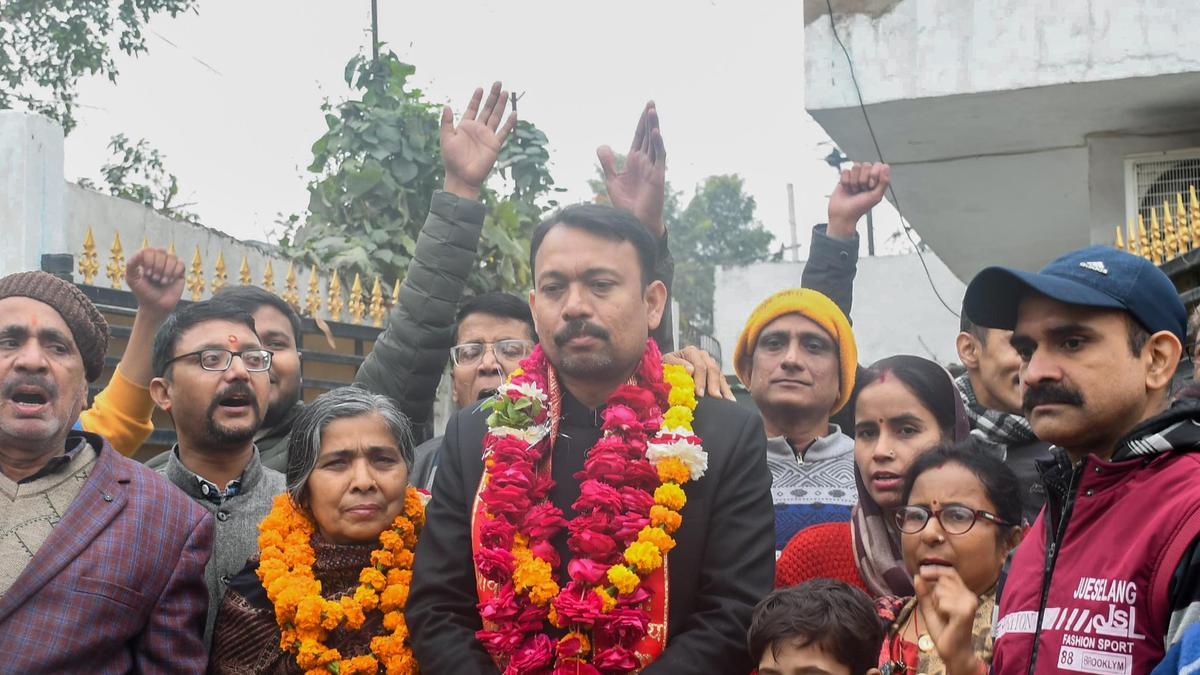
The individual threatening the stir is Alankar Agnihotri, a suspended magistrate from Bareilly.
GK and monthly revision
Suspended Bareilly magistrate threatens Delhi stir from February 7 over SC/ST Act
Suspended Bareilly magistrate Alankar Agnihotri has threatened a Delhi protest from February 7, challenging the Scheduled Castes and the Scheduled Tribes (Prevention of Atrocities) Act. He alleges 95% of cases under the Act are false and claims 85% of the population is affected. This news highlights ongoing debates around the SC/ST Act, making its provisions and constitutional background crucial for competitive exam preparation, particularly for Polity and Social Justice sections.
Revision structure
Monthly events and exam calendar context
Static GK and one-liner notes
Quiz and mock-test revision path
Key points
Exam-ready takeaways
The protest is specifically against the Scheduled Castes and the Scheduled Tribes (Prevention of Atrocities) Act.
Agnihotri alleges that 95% of cases registered under the SC/ST Act are false.
He claims 85% of the population is affected by the provisions of the SC/ST Act.
The proposed Delhi stir is scheduled to commence from February 7.
Detailed analysis
Full exam-oriented breakdown
The threat of a protest by a suspended Bareilly magistrate, Alankar Agnihotri, against the Scheduled Castes and the Scheduled Tribes (Prevention of Atrocities) Act, 1989 (SC/ST Act), highlights a persistent and often contentious debate in India surrounding social justice legislation. This event is not merely an isolated protest but reflects deeper societal fault lines concerning caste, affirmative action, and the perceived misuse of protective laws. **Background Context and Historical Roots:** India's constitutional framework, adopted in 1950, was built upon the recognition of historical injustices, particularly against Scheduled Castes (SCs) and Scheduled Tribes (STs). Centuries of discrimination, untouchability, and socio-economic marginalization necessitated special provisions to ensure their upliftment and protection. Article 17 of the Constitution explicitly abolishes 'untouchability' and forbids its practice in any form. Further, Article 15 prohibits discrimination on grounds of religion, race, caste, sex, or place of birth, with clauses allowing the state to make special provisions for the advancement of any socially and educationally backward classes of citizens or for the SCs and STs. To give teeth to these constitutional mandates, Parliament enacted the Protection of Civil Rights Act, 1955, primarily addressing untouchability. However, its scope was limited, often failing to address the more severe forms of atrocities and discrimination. This led to the enactment of the more stringent Scheduled Castes and the Scheduled Tribes (Prevention of Atrocities) Act in 1989. The PoA Act aimed to prevent atrocities against members of SCs and STs, provide for special courts for the trial of such offences, and for the relief and rehabilitation of victims. **What Happened and Key Stakeholders:** Alankar Agnihotri, a suspended magistrate, has announced a protest in Delhi from February 7, alleging that 85% of the population is 'affected' by the SC/ST Act and that a staggering 95% of cases registered under it are 'false'. He claims support from 'upper-caste organisations' across the country. The key stakeholders in this issue are multi-faceted: 1. **Scheduled Caste and Scheduled Tribe Communities:** These are the primary beneficiaries and intended protectors of the Act, often victims of caste-based discrimination and violence. 2. **Individuals Accused under the Act:** Many argue that the Act is misused, leading to false accusations and harassment, particularly against individuals from dominant castes. 3. **The Judiciary:** The Supreme Court has played a crucial role. In its 2018 judgment in *Dr. Subhash Kashinath Mahajan v. The State of Maharashtra*, the Supreme Court introduced safeguards, including a preliminary inquiry before registration of an FIR and the requirement of prior approval before arrest of a public servant. This was to prevent 'misuse' of the Act. 4. **The Legislature (Parliament):** Responding to widespread protests from SC/ST organizations who argued the judgment diluted the Act, Parliament swiftly passed the Scheduled Castes and the Scheduled Tribes (Prevention of Atrocities) Amendment Act, 2018, effectively nullifying the Supreme Court's safeguards and restoring the original stringent provisions, including the immediate arrest of the accused without a preliminary inquiry. 5. **Civil Society and Activist Groups:** Both pro- and anti-Act groups, including those supporting Agnihotri's stand and those advocating for stronger implementation of the Act, are active stakeholders. 6. **The Executive (Police and Administration):** They are responsible for the implementation, investigation, and enforcement of the Act, often facing pressure from various sides. **Significance for India and Future Implications:** This issue holds immense significance for India's social fabric, rule of law, and political landscape. It brings to the forefront the enduring challenge of caste discrimination and the difficulties in balancing protective legislation with principles of due process and preventing misuse. Agnihotri's allegations, while yet to be substantiated by official data, resonate with a segment of the population that feels aggrieved by the Act's stringent provisions. The 2018 amendment, a direct legislative override of a Supreme Court judgment, underscored the political sensitivity and the power of social movements in shaping policy. The debate highlights the tension between protective discrimination (affirmative action) designed to uplift marginalized communities and the principle of equality before the law (Article 14). While the intent of the SC/ST Act is noble – to create a casteless society by punishing atrocities – concerns about its application and potential for misuse cannot be entirely dismissed. The National Crime Records Bureau (NCRB) data does show a high rate of acquittals in SC/ST Act cases, which some interpret as evidence of false cases, while others attribute it to poor investigation and lack of victim support. Future implications include the potential for increased social polarization, sustained political pressure for further amendments, and continued judicial scrutiny. The government faces the challenge of ensuring effective implementation of the Act to protect vulnerable communities while also addressing legitimate concerns about due process and preventing its misuse. A balanced approach, focusing on robust investigation, awareness campaigns, and victim support, is crucial to uphold the spirit of the Act without unduly penalizing the innocent. **Related Constitutional Articles, Acts, and Policies:** * **The Constitution of India:** Article 14 (Equality before law), Article 15 (Prohibition of discrimination), Article 17 (Abolition of Untouchability), Article 21 (Protection of life and personal liberty), Article 46 (Promotion of educational and economic interests of Scheduled Castes, Scheduled Tribes and other weaker sections), Article 338 (National Commission for Scheduled Castes), Article 338A (National Commission for Scheduled Tribes). * **Scheduled Castes and the Scheduled Tribes (Prevention of Atrocities) Act, 1989:** The central legislation under discussion, with its key provisions on offences, special courts, and victim relief. * **Scheduled Castes and the Scheduled Tribes (Prevention of Atrocities) Amendment Act, 2018:** The amendment that restored the stringent provisions after the 2018 Supreme Court judgment. * **Protection of Civil Rights Act, 1955:** The precursor legislation to the PoA Act, dealing specifically with untouchability. * **Indian Penal Code (IPC) and Code of Criminal Procedure (CrPC):** Provisions governing criminal offences, investigation, and arrest procedures, which are often modified or supplemented by special laws like the SC/ST Act. This ongoing discourse underscores the complexities of social justice in a diverse society like India and the continuous effort required to bridge historical divides and ensure dignity and equality for all citizens.
How to study
Turn news into exam marks
Revise monthly events by exam family instead of reading random updates.
Pair one-liners with mock tests so mistakes become the next revision list.
Keep state job pages, calendar pages and GK packs connected in one path.