

The Supreme Court of India issued notices to the Centre and 12 states.
GK and monthly revision
Supreme Court issues notices to Centre, 12 states on PIL by Christian body against anti-conversion laws
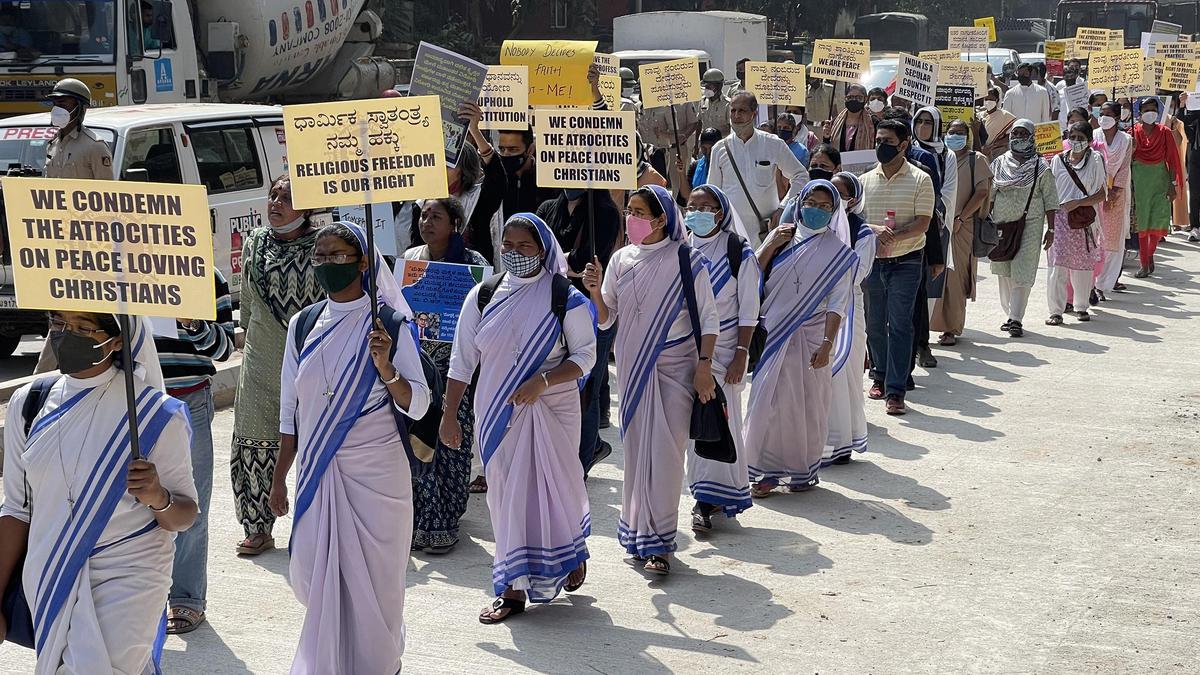
The Supreme Court has issued notices to the Centre and 12 states in response to a Public Interest Litigation (PIL) filed by a Christian body. The PIL challenges certain anti-conversion laws, arguing they incentivize vigilante groups to file complaints, potentially infringing upon fundamental rights. This development is crucial for competitive exams, highlighting the interplay between religious freedom, state legislation, and judicial scrutiny under the Indian Constitution.
Revision structure
Monthly events and exam calendar context
Static GK and one-liner notes
Quiz and mock-test revision path
Key points
Exam-ready takeaways
The notices were in response to a Public Interest Litigation (PIL) filed by a Christian body.
The PIL challenges the constitutional validity of anti-conversion laws enacted by various states.
The counsel for the Christian body argued that some state laws 'incentivise vigilante groups to complain' against alleged conversions.
This case involves fundamental rights, particularly freedom of religion (Article 25) and the legislative competence of states.
Detailed analysis
Full exam-oriented breakdown
The Supreme Court's decision to issue notices to the Centre and 12 states regarding the constitutional validity of anti-conversion laws marks a significant moment in India's ongoing discourse on religious freedom, secularism, and state power. This development stems from a Public Interest Litigation (PIL) filed by a Christian body, which argues that certain state-level anti-conversion statutes not only infringe upon fundamental rights but also 'incentivise vigilante groups' to lodge complaints, leading to potential harassment and misuse. Historically, the debate around religious conversion in India is not new. While the Indian Constitution, under Article 25, guarantees freedom of conscience and the right to freely profess, practice, and propagate religion, this right is not absolute and is subject to public order, morality, and health. The first anti-conversion laws emerged in the post-independence era, with states like Odisha enacting the Freedom of Religion Act in 1967 and Madhya Pradesh following suit in 1968. These early laws primarily aimed to prevent conversions achieved through force, fraud, or inducement. Over the decades, several other states, including Chhattisgarh, Gujarat, Himachal Pradesh, Jharkhand, Uttarakhand, Uttar Pradesh, and Karnataka, have adopted similar legislations, often with varying degrees of stringency and definitions of 'inducement' or 'coercion'. More recently, some states have broadened the scope of these laws to specifically address inter-faith marriages, particularly in the context of the controversial 'love jihad' narrative, requiring prior notice to district authorities for conversions and placing the burden of proof on the accused. What precisely happened is that the Supreme Court, acknowledging the gravity of the issues raised, has sought responses from the Union government and the governments of 12 states that have enacted such laws. The petitioner's core contention is that these laws, particularly those requiring individuals to notify authorities of their intention to convert or placing the burden of proof on the convert, create an environment ripe for vigilantism. This, they argue, violates not only Article 25 but also Article 21 (Right to Life and Personal Liberty) and Article 14 (Equality before Law), as it restricts an individual's autonomy and choice, and can lead to discrimination and harassment against religious minorities. Key stakeholders in this legal battle include the Supreme Court, acting as the guardian of the Constitution and fundamental rights; the Centre, which represents the Union government and has a role in ensuring constitutional compliance; the 12 state governments, which will defend their legislative competence and the stated objectives of their laws (i.e., preventing forced conversions); and the Christian body (the petitioner), advocating for the rights of religious minorities and the protection of individual liberties. Beyond these direct parties, religious organizations, civil society groups, and individuals concerned with religious freedom and minority rights are also significant stakeholders, closely watching the proceedings. This case holds immense significance for India's constitutional democracy and social fabric. Firstly, it tests the delicate balance between the state's power to maintain public order and an individual's fundamental right to religious freedom. A ruling could clarify the permissible limits of state intervention in matters of faith and personal choice. Secondly, it has profound implications for India's secular character, as enshrined in the Preamble. The interpretation of 'propagation' of religion under Article 25 and what constitutes 'force' or 'inducement' will be crucial. The outcome could either reinforce protections for religious minorities or further embolden groups that seek to restrict conversions. Thirdly, the case touches upon federalism, examining the extent of state legislative power in matters that significantly impact fundamental rights, which are often subjects of the Concurrent List (like marriage) or directly protected by the Union's constitutional framework. Future implications are far-reaching. A favorable ruling for the petitioners could lead to the striking down or significant modification of stringent anti-conversion laws, potentially reducing instances of harassment and restoring greater autonomy in religious choices. Conversely, if the laws are upheld, it could set a precedent that further empowers states to regulate religious conversions more strictly, potentially leading to increased social friction and legal challenges. The Supreme Court's judgment will undoubtedly shape the future trajectory of religious freedom and minority rights in India, influencing public discourse and legislative actions for years to come. It underscores the judiciary's vital role in upholding constitutional principles amidst complex social and political dynamics.
How to study
Turn news into exam marks
Revise monthly events by exam family instead of reading random updates.
Pair one-liners with mock tests so mistakes become the next revision list.
Keep state job pages, calendar pages and GK packs connected in one path.