

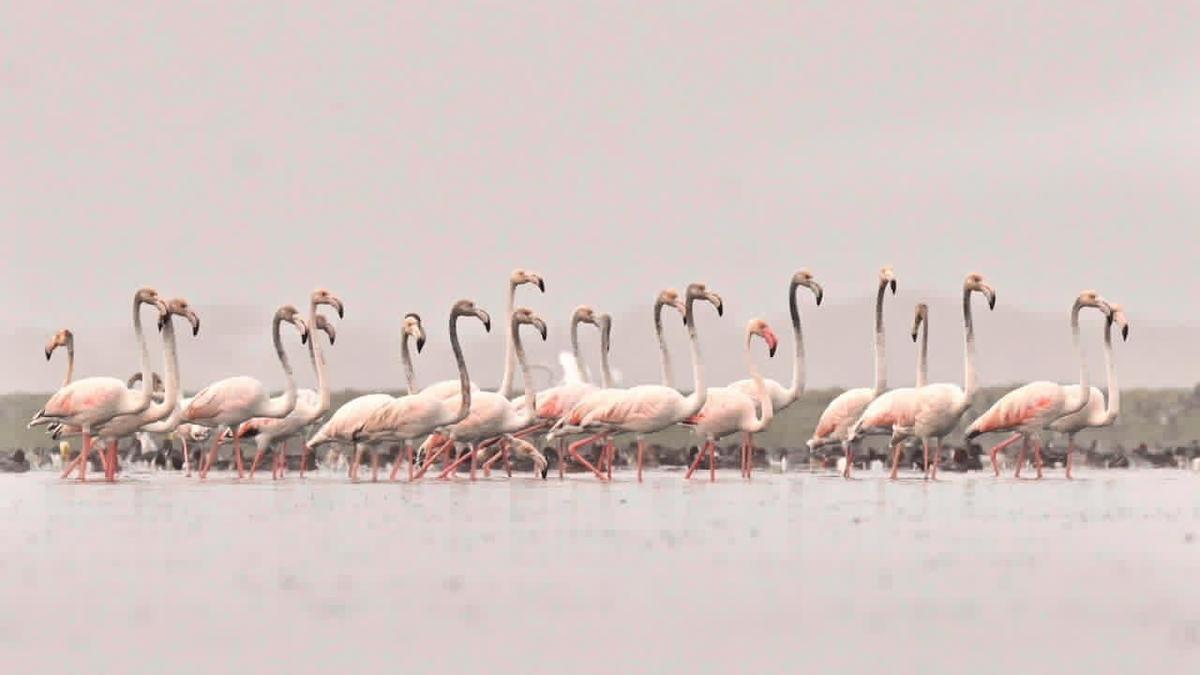
Kolleru Lake is experiencing an ecological revival, indicated by the arrival of flamingos and other migratory birds.
GK and monthly revision
Arrival of flamingos, migratory birds ‘signal’ Kolleru’s revival
The arrival of flamingos and various migratory birds at Kolleru Lake signals its ecological revival, as confirmed by A.P. Forest department officials. This event is significant for environmental conservation, highlighting the improved health of one of India's largest freshwater wetlands. For competitive exams, it emphasizes the importance of wetland ecosystems, biodiversity, and the status of Kolleru Lake as a Ramsar site.
Revision structure
Monthly events and exam calendar context
Static GK and one-liner notes
Quiz and mock-test revision path
Key points
Exam-ready takeaways
A.P. Forest department officials confirmed the presence of 30 to 40 key bird species across the Kolleru landscape.
These bird species are identified as important indicators of wetland health.
Kolleru Lake is one of the largest freshwater lakes in India, located between the Krishna and Godavari deltas in Andhra Pradesh.
Kolleru Lake was designated as a Ramsar site (Wetland of International Importance) in November 2002.
Detailed analysis
Full exam-oriented breakdown
The recent sighting of flamingos and a diverse array of migratory birds at Kolleru Lake, as reported by A.P. Forest department officials, is a powerful testament to the success of ongoing conservation efforts. This event signals an ecological revival for one of India's largest freshwater wetlands, a development of immense significance for environmental health, biodiversity, and sustainable development. **Background Context and Ecological Importance:** Kolleru Lake, nestled between the Krishna and Godavari river deltas in Andhra Pradesh, is a natural freshwater lake of immense ecological importance. Historically, it served as a critical habitat for millions of resident and migratory birds, supporting a rich diversity of flora and fauna. Its strategic location makes it a crucial stopover point for birds migrating along the Central Asian Flyway. However, over several decades, Kolleru faced severe degradation due to a multitude of factors, including encroachment for aquaculture, agricultural run-off leading to eutrophication, pollution from industrial effluents, and unchecked human activities. These pressures led to a significant decline in its water quality, reduction in its area, and a drastic drop in bird populations, raising serious concerns about its future. Recognizing its international importance, Kolleru Lake was designated as a Ramsar site (Wetland of International Importance) in November 2002, underscoring its global ecological value and the need for its protection. **The Revival Story and Key Stakeholders:** What happened recently is a beacon of hope. The arrival of flamingos and 30 to 40 other key bird species, identified as important indicators of wetland health by the A.P. Forest department, demonstrates that the lake's ecosystem is recovering. This revival is not accidental but a direct result of concerted efforts by various stakeholders. The **A.P. Forest Department** has been at the forefront, implementing measures to remove encroachments, regulate fishing practices, monitor water quality, and protect bird habitats. The **Ministry of Environment, Forest and Climate Change (MoEFCC)**, at the central level, provides policy guidance, financial support, and oversight through various schemes like the National Wetland Conservation Programme. **Local communities**, particularly those dependent on the lake for fishing and agriculture, are crucial stakeholders. Their cooperation, often through awareness programs and alternative livelihood support, is vital for the long-term sustainability of conservation efforts. Environmental NGOs and research institutions also play a role in advocacy, scientific monitoring, and community engagement. The **Ramsar Convention Secretariat** provides an international framework and guidance for the management of such wetlands. **Significance for India and Broader Themes:** This revival holds profound significance for India. Firstly, it reaffirms India's commitment to biodiversity conservation and its international obligations under conventions like Ramsar. The return of migratory birds signifies improved ecological health, which in turn provides essential ecosystem services such as water purification, flood moderation, and climate regulation. Wetlands are often called 'kidneys of the landscape' due to their ability to filter pollutants. For local economies, a healthy Kolleru Lake can boost eco-tourism, providing sustainable livelihoods for communities and reducing pressure on natural resources. It also highlights the success of integrated environmental governance, where state and central agencies collaborate with local communities to achieve conservation goals. This success story serves as an inspiration and a model for the restoration of other degraded wetlands across the country. **Constitutional and Legal Framework:** India's commitment to environmental protection is enshrined in its Constitution. **Article 48A** of the Directive Principles of State Policy mandates that "the State shall endeavour to protect and improve the environment and to safeguard the forests and wildlife of the country." Furthermore, **Article 51A(g)** lists it as a Fundamental Duty of every citizen "to protect and improve the natural environment including forests, lakes, rivers and wildlife, and to have compassion for living creatures." These constitutional provisions provide the bedrock for legislative actions. Key laws governing wetland and wildlife protection include the **Wildlife (Protection) Act, 1972**, which provides for the declaration of wildlife sanctuaries and national parks (Kolleru is part of the Kolleru Wildlife Sanctuary), and the **Environment (Protection) Act, 1986**, an umbrella legislation for environmental protection. More specifically, the **Wetlands (Conservation and Management) Rules, 2017**, framed under the Environment (Protection) Act, provide a regulatory framework for the conservation and management of wetlands in India, including their identification, notification, and prohibition of certain activities. **Future Implications:** The challenge now lies in sustaining this ecological recovery. Future implications involve continued vigilance against encroachments, managing agricultural run-off, promoting sustainable fishing practices, and developing responsible eco-tourism initiatives. Climate change poses an overarching threat, with altered rainfall patterns and extreme weather events potentially impacting wetland health. Therefore, adaptive management strategies, based on scientific research and community participation, will be crucial. The success at Kolleru can inspire similar efforts for other wetlands in India, reinforcing the idea that with dedicated conservation efforts and robust policy implementation, ecological balance can be restored, ensuring a healthier future for both nature and humanity.
How to study
Turn news into exam marks
Revise monthly events by exam family instead of reading random updates.
Pair one-liners with mock tests so mistakes become the next revision list.
Keep state job pages, calendar pages and GK packs connected in one path.