

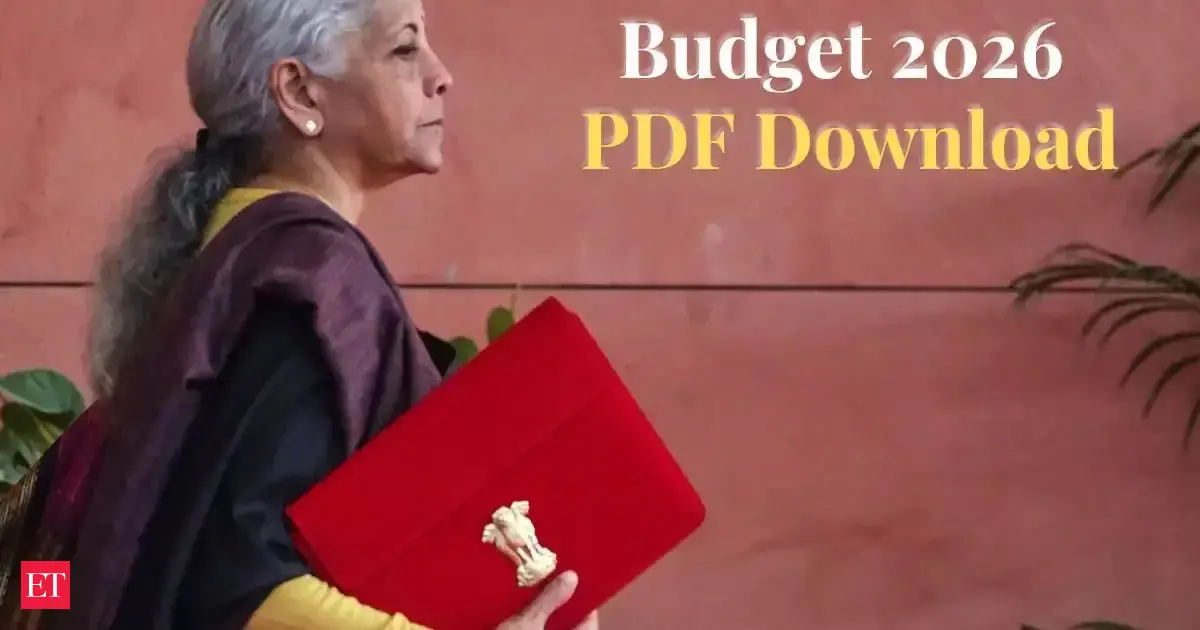
Union Budget 2026 was presented by Finance Minister Nirmala Sitharaman.
GK and monthly revision
Budget 2026 PDF in Hindi and English: Direct links to download the FM Sitharaman's speech and highlights
Finance Minister Nirmala Sitharaman presented the Union Budget 2026, keeping income tax rates and slabs unchanged. The budget introduced measures like extended deadlines for revising returns, staggered filing timelines, and targeted tax relief for individuals, NRIs, and small taxpayers. It also included lower TCS on foreign spending and higher STT on futures and options, making it crucial for understanding fiscal policy and taxation changes for competitive exams.
Revision structure
Monthly events and exam calendar context
Static GK and one-liner notes
Quiz and mock-test revision path
Key points
Exam-ready takeaways
A key announcement of Budget 2026 was the maintenance of unchanged income tax rates and slabs.
The budget included extended deadlines for revising returns and staggered filing timelines.
Targeted tax relief was provided for individuals, Non-Resident Indians (NRIs), and small taxpayers.
Specific market-related changes involved lower Tax Collected at Source (TCS) on foreign spending and higher Securities Transaction Tax (STT) on futures and options.
Detailed analysis
Full exam-oriented breakdown
The Union Budget, presented annually by the Finance Minister, is arguably the most significant economic event in India, laying down the government's financial blueprint for the upcoming fiscal year. The Budget 2026, presented by Finance Minister Nirmala Sitharaman, continued this tradition, offering a glimpse into the government's fiscal philosophy and economic priorities. Understanding this budget is crucial for competitive exam aspirants, as it touches upon various facets of governance, economy, and public policy. **Background Context and What Happened:** Every year, typically on February 1st, the Finance Minister presents the Union Budget to Parliament. This exercise is mandated by Article 112 of the Indian Constitution, which requires the government to lay before both Houses of Parliament an 'Annual Financial Statement'. This statement details the estimated receipts and expenditures of the Government of India for that particular financial year (April 1 to March 31). The Budget 2026 was presented against a backdrop of evolving global economic conditions, domestic growth imperatives, and the continuous effort to balance fiscal prudence with developmental expenditure. A key highlight of this budget was the decision to maintain **unchanged income tax rates and slabs**. This move signals the government's intent to provide stability and predictability in direct taxation, potentially aiming to boost taxpayer confidence and encourage compliance rather than introduce new tax burdens. This approach might also reflect a belief that the existing tax structure is optimal for revenue generation without stifling economic activity. Furthermore, the budget introduced administrative reforms such as **extended deadlines for revising returns and staggered filing timelines**. These measures aim to simplify the tax compliance process, reduce the burden on taxpayers, and potentially improve the efficiency of the tax administration system, aligning with the broader 'ease of doing business' agenda. **Key Stakeholders and Significance for India:** Several key stakeholders are directly impacted by the budget. The **Ministry of Finance**, led by the Finance Minister, is the primary architect. **Parliament** plays a crucial role in scrutinizing and approving the budget proposals. **Taxpayers**, including individuals, Non-Resident Indians (NRIs), and small taxpayers, are directly affected by tax rates and relief measures. The budget provided **targeted tax relief** for these groups, which could incentivize consumption, investment, and greater participation in the formal economy. For NRIs, such relief can encourage remittances and investments in India, contributing to foreign exchange reserves and capital formation. Small taxpayers, often the backbone of local economies, benefit from reduced tax burdens, fostering growth and job creation in the MSME sector. Beyond direct taxation, the budget also impacted financial markets. The **lower Tax Collected at Source (TCS) on foreign spending** is a significant change for individuals and businesses engaging in international transactions or foreign travel, potentially making such activities less burdensome. Conversely, **higher Securities Transaction Tax (STT) on futures and options** directly impacts investors and traders in the derivatives market. This measure could be aimed at curbing excessive speculation or generating additional revenue from high-volume trading activities, influencing market behavior and revenue streams from capital markets. The overall impact on India is profound: it steers fiscal policy, influences economic growth, manages inflation, and impacts social welfare through allocation of resources for various schemes and sectors. **Historical Context, Constitutional Provisions, and Future Implications:** Historically, India's budget-making has evolved significantly, from a colonial legacy to a more citizen-centric approach. Post-liberalization in 1991, budgets have increasingly focused on economic reforms, fiscal consolidation, and integration with the global economy. The Fiscal Responsibility and Budget Management (FRBM) Act, 2003, further institutionalized fiscal discipline, aiming to reduce fiscal deficit and public debt. The budget's proposals are given legal effect through the **Finance Bill**, which, once passed by both Houses of Parliament and assented to by the President, becomes the **Finance Act**. This bill is a 'Money Bill' under **Article 110** of the Constitution, giving the Lok Sabha a predominant role in its passage. The budget also aligns with broader themes of good governance by promoting transparency and accountability in public finance. Looking ahead, the budget's decisions have several implications. The stability in direct tax rates could provide a predictable environment for businesses and individuals, fostering long-term investment and consumption. The targeted relief measures could stimulate specific segments of the economy. However, the government will need to ensure that stable tax rates do not compromise revenue targets, especially if expenditure commitments rise. The changes in TCS and STT will continue to shape financial market dynamics and international spending patterns. The success of Budget 2026 will ultimately be measured by its ability to foster inclusive growth, maintain fiscal health, and enhance India's economic resilience in a dynamic global environment. It sets the stage for future policy directions, potentially paving the way for further reforms in tax administration and capital markets based on the outcomes observed in the coming year.
How to study
Turn news into exam marks
Revise monthly events by exam family instead of reading random updates.
Pair one-liners with mock tests so mistakes become the next revision list.
Keep state job pages, calendar pages and GK packs connected in one path.