

The Union Budget for the fiscal year 2026-27 was presented.
GK and monthly revision
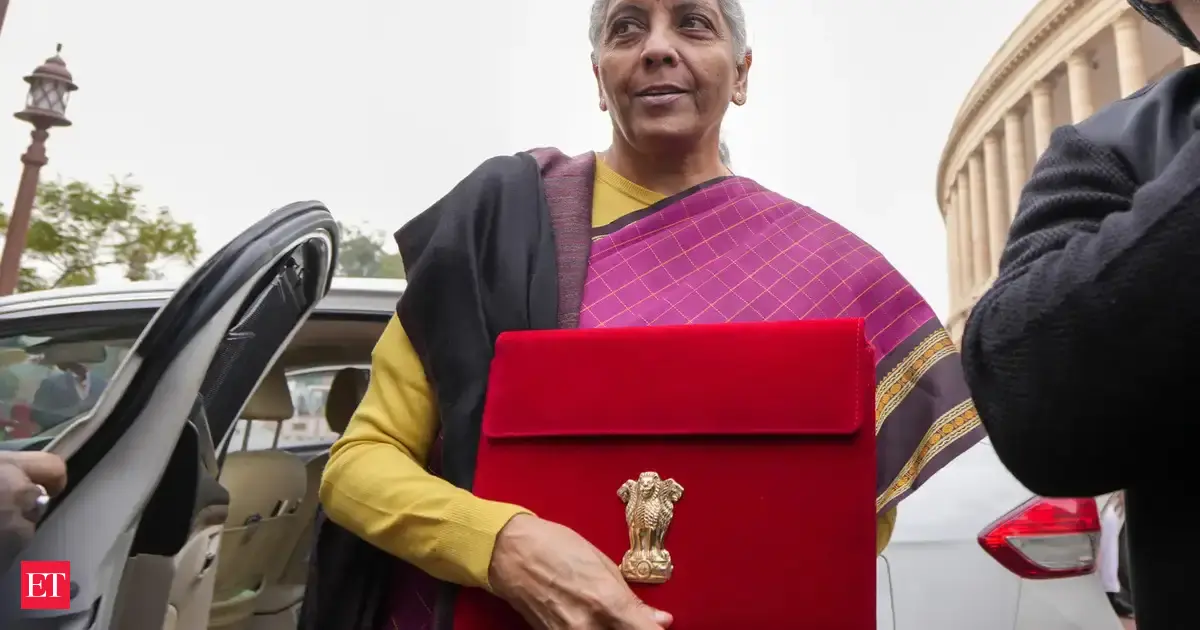
Budget 2026: Nirmala Sitharaman unveils plan to hit a sixer on a slippery global pitch
Finance Minister Nirmala Sitharaman unveiled a comprehensive industrial plan in the Union Budget 2026-27. This strategy focuses on six key sectors to boost domestic manufacturing and strengthen India's economy. It aims to capitalize on global supply chain shifts, making it crucial for understanding India's future economic direction and policy for competitive exams.
Revision structure
Monthly events and exam calendar context
Static GK and one-liner notes
Quiz and mock-test revision path
Key points
Exam-ready takeaways
Finance Minister Nirmala Sitharaman unveiled a comprehensive industrial plan.
The industrial plan focuses on six key sectors for economic growth.
The primary objective is to boost domestic manufacturing and strengthen India's economy.
The strategy aims to leverage global supply chain shifts for national economic growth.
Detailed analysis
Full exam-oriented breakdown
The Union Budget 2026-27, as outlined by Finance Minister Nirmala Sitharaman, signifies a crucial strategic pivot for India's economic trajectory. The unveiling of a comprehensive industrial plan, with a laser focus on six key sectors, is not merely an annual budgetary allocation but a reaffirmation and acceleration of India's long-term vision to become a global manufacturing powerhouse and a resilient economy. This plan is deeply rooted in the lessons learned from recent global disruptions and India's evolving geopolitical ambitions. **Background Context and Historical Trajectory:** India's journey towards industrialization has seen various phases. Post-independence, the Nehruvian era emphasized import substitution and public sector dominance, aiming for self-sufficiency. The economic reforms of 1991 liberalized the economy, opening doors to global trade and foreign investment. However, a significant push to revive and boost domestic manufacturing came with the launch of the 'Make in India' initiative in 2014. This campaign sought to attract foreign investment, foster innovation, enhance skill development, and build best-in-class manufacturing infrastructure. The subsequent COVID-19 pandemic exposed the vulnerabilities of global supply chains, heavily reliant on a few key regions. This crisis catalyzed the 'Atmanirbhar Bharat Abhiyan' (Self-Reliant India Campaign) in 2020, which broadened the 'Make in India' scope to encompass resilience, self-reliance across critical sectors, and an active role in global value chains. The Production Linked Incentive (PLI) schemes, launched across various sectors from electronics to pharmaceuticals and automobiles, are a direct outcome of this strategy, designed to incentivize domestic manufacturing and attract investments. **The Core Strategy and What Happened:** The Budget 2026-27's industrial plan is a progression of these efforts. While the article doesn't name the six specific sectors, based on current government thrust, these likely include sunrise sectors like semiconductors, advanced electronics, renewable energy components, electric vehicles, and traditional strengths like textiles and pharmaceuticals, alongside critical defense manufacturing. The core objectives are twofold: first, to significantly boost domestic manufacturing capabilities, reducing reliance on imports and creating jobs; second, to strategically leverage the ongoing shifts in global supply chains. Many multinational corporations are adopting a 'China Plus One' strategy, seeking to diversify their manufacturing bases. India aims to position itself as a viable and attractive alternative, offering a large domestic market, a growing skilled workforce, and an improving ease of doing business. **Key Stakeholders Involved:** The success of this ambitious plan hinges on the active participation of multiple stakeholders. The **Government of India**, particularly the **Finance Ministry**, **Ministry of Commerce and Industry**, and **NITI Aayog**, plays the central role in policy formulation, allocation of resources, and creating an enabling regulatory environment. **Domestic Industry**, encompassing both large corporates and Micro, Small, and Medium Enterprises (MSMEs), are the primary implementers, responsible for investment, production, and innovation. **Foreign Investors** are critical for bringing in capital, technology, and global best practices. **Consumers** will benefit from a wider array of domestically produced goods, potentially at competitive prices. Lastly, **International Trading Partners** will be impacted as India's role in global trade and manufacturing evolves. **Significance for India:** This comprehensive industrial plan holds profound significance for India. Economically, it promises accelerated GDP growth, substantial job creation across various skill levels, and a significant boost to exports, helping to improve India's balance of payments. Socially, it addresses unemployment concerns and can lead to regional development as manufacturing hubs emerge. Geopolitically, it strengthens India's strategic autonomy by reducing dependence on critical imports, especially in defense and essential goods. It aligns with India's aspiration to become a developed nation and a $5 trillion economy, positioning the country as a crucial node in resilient global supply chains, rather than just a consumer market. This also enhances India's bargaining power in international trade negotiations. **Constitutional and Policy Framework:** The presentation of the Union Budget itself is mandated by **Article 112** of the Constitution, which requires the government to lay before Parliament an 'Annual Financial Statement'. While industrial policy is not explicitly detailed in the Constitution, the **Directive Principles of State Policy (DPSP)**, particularly **Article 38** (State to secure a social order for the promotion of welfare of the people) and **Article 39** (principles of policy to be followed by the State for securing citizens' livelihood and preventing concentration of wealth), provide a broad framework for economic planning and development, guiding the state to promote economic growth and reduce inequalities. The specific industrial plan falls under the purview of various government acts and policies like the **MSME Development Act, 2006**, the **Companies Act, 2013**, and the overarching **National Manufacturing Policy**. The current plan builds directly upon existing initiatives like 'Make in India', 'Atmanirbhar Bharat', and the various **PLI schemes** which have been instrumental in attracting investment and boosting production in key sectors. **Future Implications:** The success of this comprehensive industrial plan will largely depend on its effective implementation, bureaucratic efficiency, and sustained policy support. Future implications include a more robust and diversified Indian economy, less susceptible to external shocks. It could lead to significant technological advancements, increased R&D spending, and a highly skilled workforce if adequate investments are made in education and vocational training. However, challenges remain, including ensuring adequate infrastructure development (logistics, power), maintaining a stable and predictable policy environment, navigating global trade protectionism, and adapting to rapid technological changes like automation and AI. If successful, this strategy will solidify India's position as a reliable and competitive manufacturing hub, driving sustainable economic growth for decades to come.
How to study
Turn news into exam marks
Revise monthly events by exam family instead of reading random updates.
Pair one-liners with mock tests so mistakes become the next revision list.
Keep state job pages, calendar pages and GK packs connected in one path.