

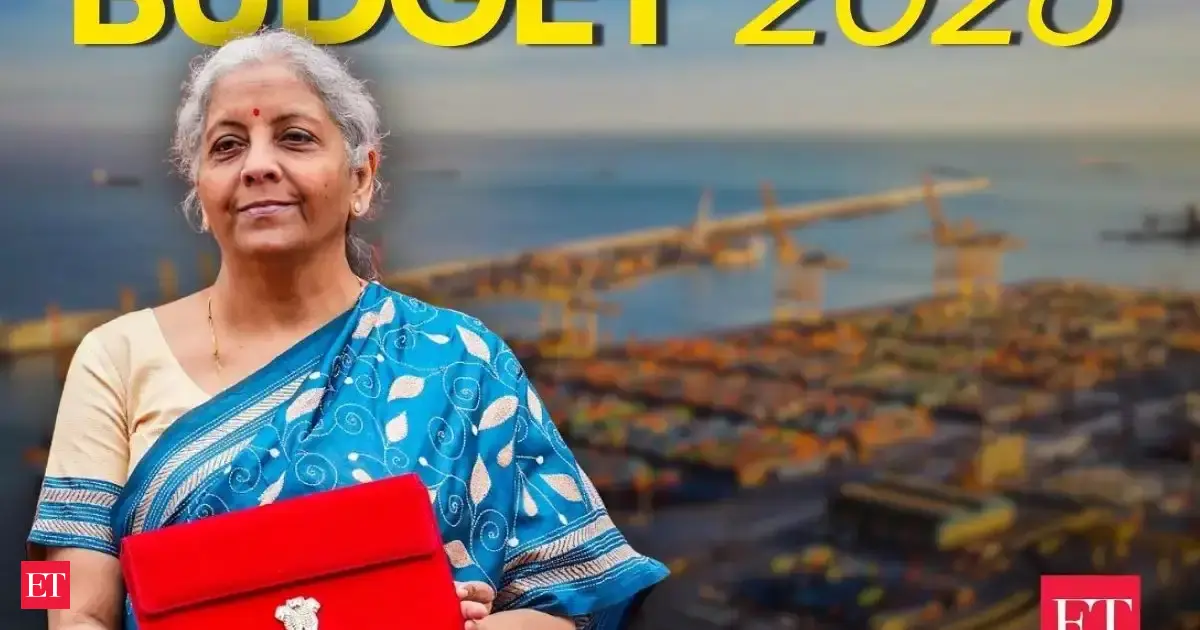
Union Budget 2026-27 was unveiled by Finance Minister Nirmala Sitharaman.
GK and monthly revision
Budget 2026: Govt bets Rs 20,000 crore on carbon capture drive
The Union Budget 2026-27, presented by Finance Minister Nirmala Sitharaman, allocates a significant Rs 20,000 crore towards carbon capture and utilisation, emphasizing India's commitment to green initiatives. The budget also outlines plans for seven high-speed rail corridors, a ship repair ecosystem, and incentives for seaplane manufacturing, alongside banking reforms. These strategic investments aim to boost economic growth, enhance connectivity, and promote environmental sustainability, making them critical for competitive exam preparation.
Revision structure
Monthly events and exam calendar context
Static GK and one-liner notes
Quiz and mock-test revision path
Key points
Exam-ready takeaways
A significant Rs 20,000 crore has been allocated for carbon capture and utilisation.
The budget includes plans for the development of seven new high-speed rail corridors.
Incentives will be provided to boost seaplane manufacturing for tourism and connectivity.
A high-level committee is planned to assess banking reforms for sustained growth.
Detailed analysis
Full exam-oriented breakdown
The Union Budget 2026-27, presented by Finance Minister Nirmala Sitharaman, stands as a strategic blueprint for India's future, meticulously balancing economic growth with environmental sustainability and infrastructural advancement. The allocation of a substantial Rs 20,000 crore for carbon capture and utilisation (CCU) technologies is a testament to India's unwavering commitment to its climate goals, while simultaneous investments in high-speed rail, seaplane manufacturing, and banking reforms underscore a holistic vision for national development. **Background Context: A Green and Growth-Oriented Trajectory** India's journey towards sustainable development has gained significant momentum, especially following its enhanced Nationally Determined Contributions (NDCs) under the Paris Agreement and Prime Minister Narendra Modi's 'Panchamrit' pledges at COP26 in Glasgow in 2021. These commitments include achieving Net Zero emissions by 2070, reducing emissions intensity of GDP by 45% by 2030 (from 2005 levels), and increasing non-fossil fuel energy capacity to 500 GW by 2030. The emphasis on carbon capture is a crucial step towards decarbonizing hard-to-abate sectors like steel, cement, and petrochemicals, which are vital for economic growth but also significant emitters. Historically, India has been proactive in environmental protection, enshrined in Article 48A of the Constitution (Directive Principles of State Policy) which mandates the state to 'endeavour to protect and improve the environment and to safeguard the forests and wildlife of the country', and Article 51A(g) (Fundamental Duties) which calls upon citizens to 'protect and improve the natural environment'. Simultaneously, India's infrastructure push has been a cornerstone of its economic strategy, dating back to early Five-Year Plans. The current government's focus on projects like the National Infrastructure Pipeline and PM Gati Shakti Master Plan aims to enhance multi-modal connectivity, reduce logistics costs, and boost manufacturing. The planned seven high-speed rail corridors and a ship repair ecosystem are extensions of this vision, designed to modernize transport networks and facilitate trade. **What Happened and Key Stakeholders** Finance Minister Nirmala Sitharaman, representing the Ministry of Finance, unveiled the Union Budget 2026-27. The key announcements include: 1. **Rs 20,000 crore for Carbon Capture and Utilisation:** This allocation is a direct investment into research, development, and deployment of CCU technologies. Key stakeholders include the Ministry of Environment, Forest and Climate Change, Ministry of Power, Ministry of Science & Technology, NITI Aayog, public sector enterprises (e.g., NTPC, ONGC), private industrial players in heavy industries, and research institutions. 2. **Seven High-Speed Rail Corridors:** This ambitious project will be spearheaded by the Ministry of Railways, National High-Speed Rail Corporation Limited (NHSRCL), state governments, and private contractors involved in construction and technology supply. 3. **Incentives for Seaplane Manufacturing:** This initiative aims to boost tourism and regional connectivity. The Ministry of Civil Aviation, Ministry of Tourism, private aviation manufacturers, and state tourism departments are key players. 4. **Ship Repair Ecosystem:** The Ministry of Ports, Shipping and Waterways, along with public and private shipyards, will be central to developing this sector, enhancing India's maritime capabilities and 'Make in India' efforts. 5. **High-Level Committee for Banking Reforms:** The Ministry of Finance, Reserve Bank of India (RBI), and public and private sector banks will be the primary stakeholders. The committee's recommendations will be crucial for ensuring sustained growth and stability in the financial sector. **Significance for India and Future Implications** The Budget 2026-27's proposals carry profound significance for India. The Rs 20,000 crore for CCU is a game-changer for India's green transition. By investing in this nascent technology, India can not only meet its climate targets but also emerge as a leader in green technologies, potentially creating a new 'green economy' and skilled jobs. This aligns with the 'National Green Hydrogen Mission', aiming to make India a hub for green hydrogen production and export, further reducing reliance on fossil fuels. The infrastructure push, particularly the high-speed rail corridors, will revolutionize connectivity, reduce travel times, boost economic activity in regions along these corridors, and support 'Make in India' by creating demand for local manufacturing. The seaplane initiative will unlock tourism potential in remote areas and enhance regional air connectivity, a goal aligned with the UDAN scheme. A robust ship repair ecosystem will strengthen India's maritime industry, critical for trade and defence. The banking reforms are vital for maintaining financial stability, ensuring adequate credit flow to productive sectors, and safeguarding economic growth. Past challenges with Non-Performing Assets (NPAs) highlight the need for continuous reforms to build a resilient banking sector capable of supporting India's aspirations of becoming a $5 trillion economy. Looking ahead, the successful implementation of these initiatives will depend on effective policy execution, technological advancements in CCU, seamless coordination between central and state governments for infrastructure projects, and robust regulatory oversight for banking reforms. These investments are projected to drive job creation, attract foreign investment, improve India's global competitiveness, and solidify its position as a responsible global actor committed to both economic prosperity and environmental stewardship. This budget truly reflects a strategic long-term vision for a developed and sustainable India. **Related Constitutional Articles, Acts, or Policies:** * **Article 112:** Pertains to the Annual Financial Statement (Union Budget). * **Article 48A & 51A(g):** Constitutional provisions for environmental protection and improvement. * **Environment (Protection) Act, 1986:** Comprehensive legislation empowering the central government to protect and improve environmental quality. * **Paris Agreement & India's NDCs:** International commitments driving climate action. * **National Green Hydrogen Mission:** Policy framework for India's green energy transition. * **PM Gati Shakti Master Plan:** Integrated infrastructure development. * **Banking Regulation Act, 1949 & RBI Act, 1934:** Govern the functioning of banking and the central bank in India. * **Insolvency and Bankruptcy Code (IBC), 2016:** A key reform for strengthening the banking sector by resolving corporate insolvencies.
How to study
Turn news into exam marks
Revise monthly events by exam family instead of reading random updates.
Pair one-liners with mock tests so mistakes become the next revision list.
Keep state job pages, calendar pages and GK packs connected in one path.