

The U.S. government underwent a shutdown due to a funding lapse.
GK and monthly revision
U.S. government shuts down but quick resolution expected
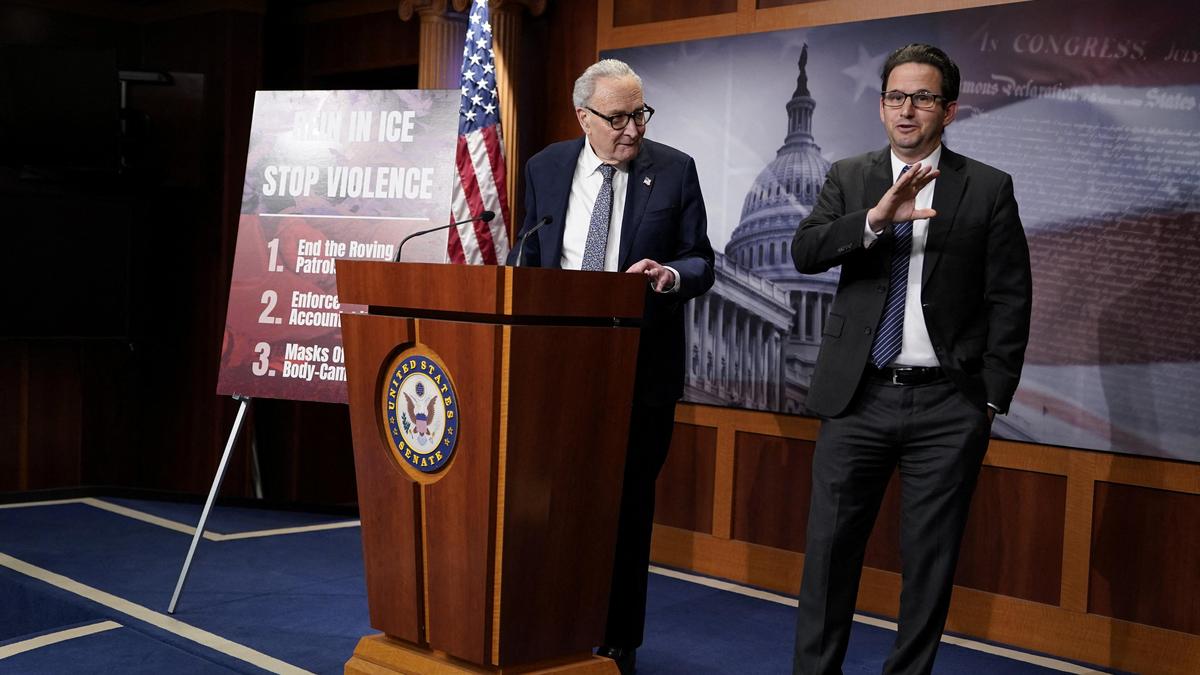
The U.S. government experienced a shutdown due to a funding lapse, a significant event in international politics. This breakdown in negotiations was primarily driven by Democratic anger over the killing of two protesters in Minneapolis by federal immigration agents. While a quick resolution is expected, this incident highlights the complexities of legislative processes and political disagreements in major global powers, making it relevant for understanding international current affairs in competitive exams.
Revision structure
Monthly events and exam calendar context
Static GK and one-liner notes
Quiz and mock-test revision path
Key points
Exam-ready takeaways
The funding lapse followed a breakdown in negotiations.
Negotiation breakdown was driven by Democratic anger.
The anger stemmed from the killing of two protesters.
The incident involving protesters occurred in Minneapolis and involved federal immigration agents.
Detailed analysis
Full exam-oriented breakdown
The recent U.S. government shutdown, though expected to be brief, serves as a potent reminder of the intricate and often fraught nature of legislative processes in major global democracies. For competitive exam aspirants, understanding such events goes beyond mere headlines; it delves into the mechanisms of governance, international relations, and comparative politics. **Background Context: Understanding a U.S. Government Shutdown** In the United States, a government shutdown occurs when Congress fails to pass appropriation bills (funding legislation) for the upcoming fiscal year, or a temporary funding measure (continuing resolution), before the existing funding expires. The U.S. fiscal year begins on October 1st. Without congressional authorization for spending, non-essential government agencies and services cease operations, federal employees are furloughed, and critical functions operate with minimal staff. This mechanism stems from the U.S. Constitution's Article I, Section 9, Clause 7, which states, "No Money shall be drawn from the Treasury, but in Consequence of Appropriations made by Law." This grants Congress the 'power of the purse,' a fundamental check on the Executive branch. **What Happened: The Specific Trigger** This particular funding lapse was not merely a technical disagreement over budget numbers. It was explicitly driven by deep-seated Democratic anger following the killing of two protesters in Minneapolis by federal immigration agents. This incident transformed a routine budget negotiation into a high-stakes political confrontation, where the Democratic party leveraged its legislative power (or lack thereof, depending on the house majority) to express outrage and demand accountability. The breakdown in negotiations suggests that the issue of federal law enforcement conduct, particularly concerning immigration and civil liberties, has become a significant flashpoint in U.S. domestic politics, capable of disrupting even the essential functioning of the government. **Key Stakeholders Involved** 1. **The U.S. Congress (House of Representatives and Senate):** As the body responsible for passing appropriation bills, both chambers, and specifically their party leadership (Democratic and Republican), are central. Their inability to find common ground directly leads to a shutdown. 2. **The U.S. President (Executive Branch):** The President proposes the budget and signs appropriations bills into law. The administration's policies, especially those enforced by federal agencies like immigration, often become targets of legislative scrutiny and bargaining. 3. **Federal Agencies and Employees:** These are the immediate victims, as agencies halt non-essential services and employees face furloughs without pay. 4. **The Democratic Party:** Their anger over the Minneapolis incident was the stated primary driver of the negotiation breakdown, indicating a strategic use of legislative leverage to address specific grievances. 5. **Federal Immigration Agents:** The actions of these agents were the direct cause of the political outrage, placing federal law enforcement under intense scrutiny. 6. **The Public:** Citizens are affected by disruptions to government services, and their perception of government efficiency and accountability is shaped by such events. **Why This Matters for India** While a domestic U.S. issue, a government shutdown in the world's largest economy and a key strategic partner has significant implications for India: 1. **Economic Impact:** The U.S. dollar is a global reserve currency. Prolonged instability can lead to global market volatility, impacting Indian investments, trade, and the rupee's exchange rate. Indian IT companies with significant U.S. exposure could see project delays or payment issues. A stable U.S. economy is crucial for global economic growth, which benefits India's export-oriented sectors. 2. **Geopolitical and Strategic Impact:** India-U.S. relations are a cornerstone of India's foreign policy, particularly in areas like defense, counter-terrorism, and regional security (e.g., QUAD). A U.S. government distracted by internal crises may be less effective or decisive on international issues, potentially affecting cooperation on shared strategic interests. Delays in policy implementation, diplomatic engagements, or defense procurements could occur. 3. **Policy Certainty:** India relies on consistent U.S. foreign policy and economic engagement. Internal U.S. political turmoil can introduce uncertainty, making long-term planning for bilateral projects or international collaborations challenging. **Historical Context and Broader Themes** U.S. government shutdowns are not new. Notable shutdowns occurred in 1995-96 (over Medicare and Medicaid), 2013 (over the Affordable Care Act), and 2018-19 (over border wall funding), the latter being the longest in U.S. history at 35 days. These incidents highlight fundamental tensions in the U.S. system: the separation of powers, the 'power of the purse' wielded by Congress, and the increasing partisan polarization that often turns budget negotiations into battles over broader ideological or policy issues. This current shutdown links to broader themes of governance, fiscal responsibility, civil liberties, and the accountability of law enforcement. **Future Implications** While a quick resolution is expected in this specific instance, the underlying issues remain. The incident underscores the fragility of political consensus in the U.S. and the potential for domestic policy disputes, especially those involving sensitive issues like police conduct and immigration, to paralyze the government. For India, this means continued monitoring of U.S. political stability. If such shutdowns become more frequent or prolonged, it could signal a deeper structural challenge to U.S. governance, potentially impacting its global leadership role and reliability as a strategic partner. **Related Constitutional Articles (U.S. & Comparative Indian Context)** * **U.S. Constitution, Article I, Section 9, Clause 7:** Grants Congress the 'power of the purse,' mandating that no money can be spent without an appropriation law. This is the constitutional basis for the shutdown. * **Indian Constitution, Article 112 (Annual Financial Statement):** Mandates the presentation of the Union Budget (Annual Financial Statement) to Parliament. This is similar to the U.S. President's budget proposal. * **Indian Constitution, Article 114 (Appropriation Bills):** Requires Parliamentary approval (through an Appropriation Bill) for withdrawing money from the Consolidated Fund of India to meet grants voted by the Lok Sabha and expenditure charged on the Consolidated Fund. This parallels the U.S. Congressional appropriation process, emphasizing legislative control over finances. While India has a parliamentary system where the executive (council of ministers) generally commands a majority in the Lok Sabha, making shutdowns less likely, the principle of legislative control over public finance is common to both democracies.
How to study
Turn news into exam marks
Revise monthly events by exam family instead of reading random updates.
Pair one-liners with mock tests so mistakes become the next revision list.
Keep state job pages, calendar pages and GK packs connected in one path.