

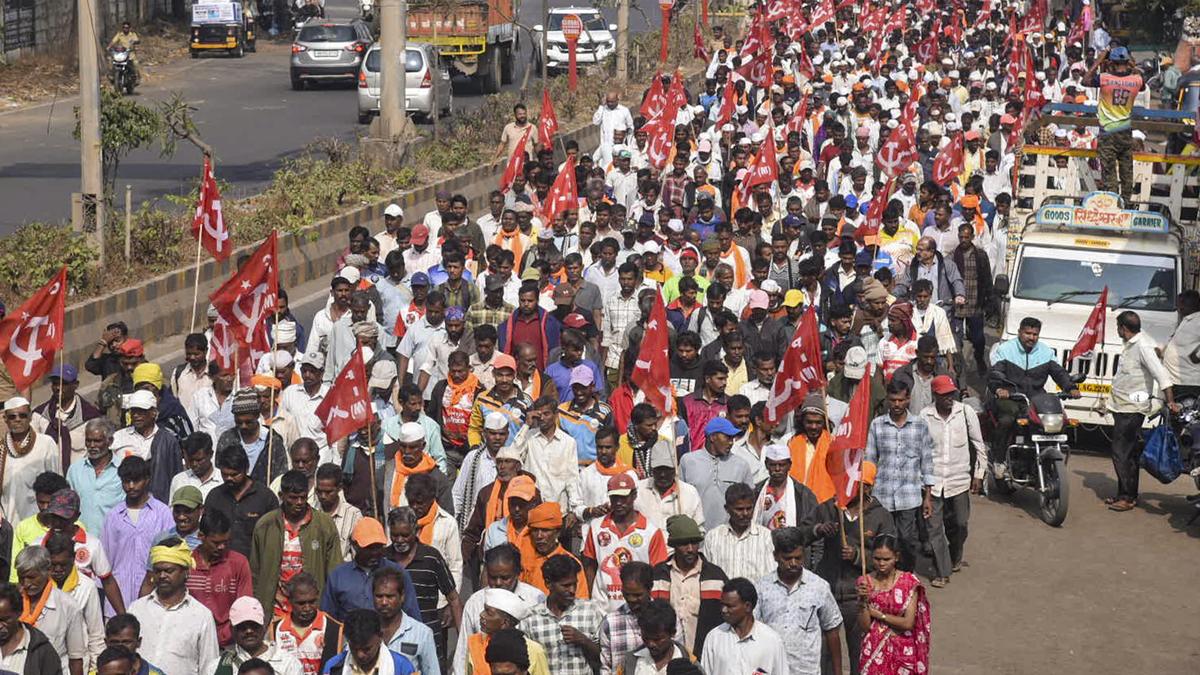
Farmers from Nashik, Maharashtra, undertook a long march to press for their demands.
GK and monthly revision
Nashik farmers conclude long march after Maharashtra government agrees to demands
Farmers from Nashik concluded a significant long march after the Maharashtra government agreed to re-examine forest land claims across the state. This development is crucial for understanding issues related to tribal and forest dwellers' rights, land reforms, and the implementation of the Forest Rights Act (FRA), 2006. It highlights the state's responsiveness to agrarian demands and is relevant for competitive exams focusing on governance, social justice, and state-specific policies.
Revision structure
Monthly events and exam calendar context
Static GK and one-liner notes
Quiz and mock-test revision path
Key points
Exam-ready takeaways
The Maharashtra State Government agreed to re-examine forest land claims for eligible landholders.
The agreement specifically targets forest landholders across the entire state of Maharashtra.
The primary demand met was the re-examination of land claims, crucial for securing land rights.
This issue is directly related to the implementation of the Forest Rights Act (FRA), 2006, concerning forest dwellers' rights.
Detailed analysis
Full exam-oriented breakdown
The recent agreement by the Maharashtra government to re-examine forest land claims, following a significant long march by farmers from Nashik, marks a crucial moment in India's ongoing struggle for social justice, land rights, and effective governance. This development is deeply rooted in the historical injustices faced by forest-dwelling communities and the subsequent legislative efforts to rectify them, primarily through the Forest Rights Act (FRA), 2006. **Background Context and Historical Roots:** For centuries, forest dwellers, predominantly tribal communities, have lived in harmony with forests, depending on them for their livelihood, culture, and survival. However, colonial forest laws, such as the Indian Forest Act of 1865 and later the Indian Forest Act, 1927, systematically dispossessed these communities of their traditional land rights, declaring vast tracts as 'reserved' or 'protected' forests. This created a profound disconnect between the people and their ancestral lands, leading to widespread poverty, displacement, and marginalization. Post-independence, despite progressive rhetoric, the plight of these communities largely continued, often exacerbated by conservation policies that failed to recognize their symbiotic relationship with nature. The demand for recognition of these rights culminated in the enactment of the Scheduled Tribes and Other Traditional Forest Dwellers (Recognition of Forest Rights) Act, 2006, popularly known as the FRA. This landmark legislation aimed to undo historical injustices by recognizing the individual and community forest rights (IFRs and CFRs) of those who have lived in and depended on forests for generations. **What Happened: The Nashik Farmers' Long March:** In recent times, the implementation of the FRA has been fraught with challenges. Many eligible claims for forest land have been rejected, pending, or not properly processed, leaving millions of forest dwellers in a state of insecurity. This bureaucratic inertia and perceived government apathy spurred farmers, particularly adivasi (tribal) communities, from Nashik and other parts of Maharashtra, to undertake a 'long march.' Organized by farmer organizations, notably the Akhil Bharatiya Kisan Sabha (AIKS), these marches, echoing previous successful demonstrations, aimed to pressure the state government into addressing their grievances. Their primary demand centered on the proper and timely re-examination of rejected forest land claims, ensuring that legitimate landholders receive their due titles. The Maharashtra government, faced with the determined protest, ultimately agreed to re-examine these claims across the state, signaling a significant victory for the farmers and a commitment to address the implementation gaps of the FRA. **Key Stakeholders Involved:** * **Farmers and Tribal Communities:** These are the primary stakeholders and beneficiaries, whose lives and livelihoods are directly impacted by land rights. Their organized protests demonstrate their agency and determination to secure justice. * **Maharashtra State Government:** As the executive authority, it is responsible for the implementation of the FRA and other land-related policies. Its responsiveness (or lack thereof) directly affects the lives of millions. * **Forest Department:** Often viewed as a key player, its historical role in forest management has frequently clashed with tribal rights. Its cooperation is crucial for the successful implementation of the FRA. * **Civil Society Organizations/Activist Groups:** Organizations like AIKS play a vital role in mobilizing, organizing, and advocating for the rights of farmers and tribal communities, providing a voice to the marginalized. **Significance for India and Constitutional Relevance:** This development holds immense significance for India. Firstly, it underscores the persistent issue of **agrarian distress** and **land rights** for marginalized communities, which remains a core challenge for social justice. Secondly, it highlights the critical importance of effective **governance** and the implementation of progressive laws like the FRA. The FRA is intrinsically linked to several constitutional provisions: the **Fifth Schedule**, which deals with the administration and control of Scheduled Areas and Scheduled Tribes, empowering Gram Sabhas; **Article 21**, guaranteeing the right to life and livelihood, which is directly impacted by land security; and **Directive Principles of State Policy** like **Article 46**, promoting the educational and economic interests of Scheduled Castes, Scheduled Tribes, and other weaker sections, and **Article 39(b) and (c)**, emphasizing equitable distribution of material resources. The successful re-examination and granting of titles can significantly alleviate poverty, empower tribal communities, and reduce social inequalities, contributing to the broader goal of inclusive development. **Future Implications:** The Maharashtra government's agreement sets a precedent and could inspire similar movements in other states grappling with FRA implementation challenges. While the agreement is a positive step, the real test lies in its actual execution. Challenges include bureaucratic hurdles, potential resistance from sections of the forest department, and ensuring that the re-examination process is fair, transparent, and expedited. The outcome will significantly impact the livelihoods of thousands and could serve as a model for effective resolution of land disputes. Furthermore, it reinforces the power of peaceful protest in a democracy and the necessity for governments to be responsive to the demands of their citizens, particularly the most vulnerable. This move could also lead to a more balanced approach to conservation, integrating the rights and traditional knowledge of forest dwellers into sustainable forest management practices, rather than viewing them as antagonists.
How to study
Turn news into exam marks
Revise monthly events by exam family instead of reading random updates.
Pair one-liners with mock tests so mistakes become the next revision list.
Keep state job pages, calendar pages and GK packs connected in one path.