

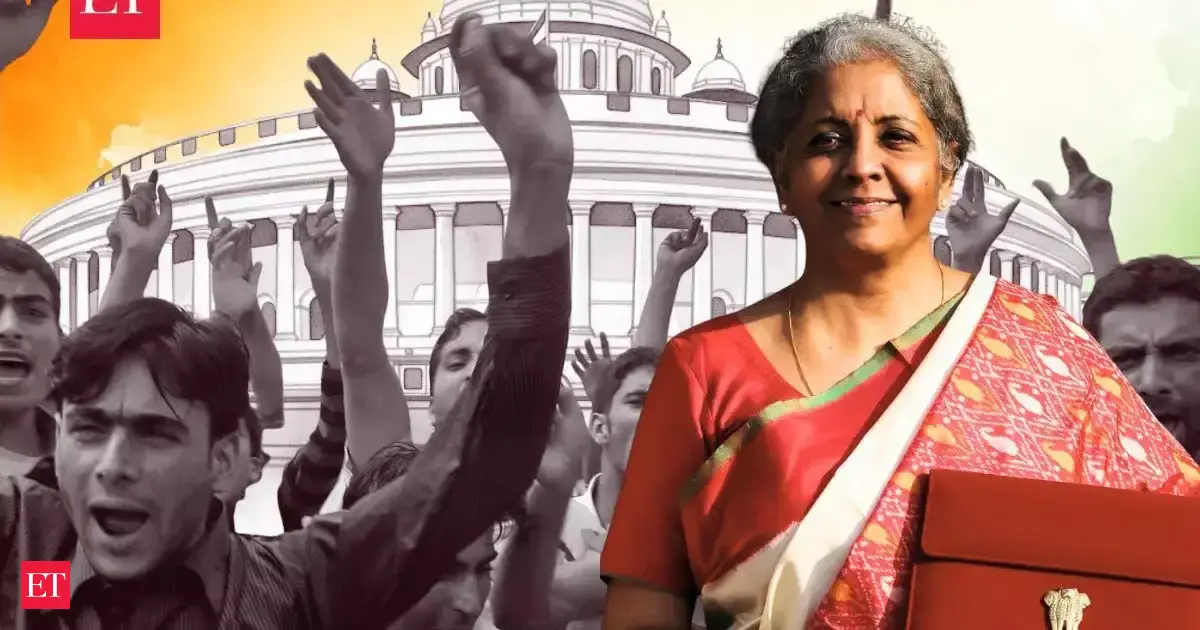
Union Budget 2026 was presented by Finance Minister Nirmala Sitharaman.
GK and monthly revision
Budget 2026: What’s coming, what matters, and how India’s money manual gets a makeover
Finance Minister Nirmala Sitharaman presented the Union Budget 2026, marking her ninth consecutive parliamentary Budget presentation. This Budget is significant for its focus on smoother implementation of existing tax laws and addressing business friction points, rather than introducing major new policy announcements. This approach highlights a shift towards execution and stability in economic governance, crucial for understanding India's fiscal policy direction.
Revision structure
Monthly events and exam calendar context
Static GK and one-liner notes
Quiz and mock-test revision path
Key points
Exam-ready takeaways
This marks Nirmala Sitharaman's ninth consecutive Budget presentation in Parliament.
The Budget's primary focus is on smoother implementation of existing tax laws.
It aims to address and resolve various business friction points.
The Budget is characterized by a lack of major new policy announcements, acting as a 'bridge'.
Detailed analysis
Full exam-oriented breakdown
The Union Budget, an annual financial statement of the estimated receipts and expenditures of the Government of India for a particular fiscal year (April 1 to March 31), is one of the most significant policy documents shaping the nation's economic trajectory. The Union Budget 2026, presented by Finance Minister Nirmala Sitharaman, marks a historic milestone as her ninth consecutive parliamentary Budget presentation. This continuity itself signifies a period of consistent economic stewardship, providing a degree of predictability that is often welcomed by markets and investors. **Background Context and What Happened:** The process of budgeting in India is rooted in constitutional mandate, requiring the government to present an Annual Financial Statement to Parliament as per **Article 112** of the Constitution. Historically, the budget presentation involved significant policy announcements, often introducing new schemes, tax reforms, or sectoral incentives. Over the past decade, especially since 2014, India's economic policy has focused on structural reforms, fiscal consolidation, and improving the ease of doing business. The shift from presenting the budget on the last working day of February to February 1st in 2017, and the merger of the Railway Budget with the General Budget, were also significant procedural reforms aimed at streamlining the process and allowing more time for implementation before the new fiscal year began. Budget 2026, however, stands out for its distinct approach. Instead of a flurry of new schemes or major policy overhauls, it has been characterized as a 'bridge budget' – one primarily focused on the smoother implementation of existing tax laws and addressing various 'business friction points'. This implies a mature phase of economic governance where the emphasis shifts from policy formulation to efficient execution and fine-tuning. This approach is particularly relevant in the context of India's ambition to become a developed nation ('Viksit Bharat' by 2047), where predictable policies and a stable regulatory environment are paramount for attracting sustained investment and fostering domestic growth. **Key Stakeholders Involved:** The primary stakeholder is the **Finance Minister, Nirmala Sitharaman**, who, along with her team in the **Ministry of Finance** (Departments of Economic Affairs, Revenue, and Expenditure), drafts and presents the budget. **Parliament**, particularly the Lok Sabha, plays a crucial role in debating and approving the budget proposals, as all taxation and expenditure must have parliamentary sanction (**Article 265**). The budget is essentially a 'Money Bill' (**Article 110**), giving the Lok Sabha primacy in its passage. **Businesses and industries** are direct beneficiaries or affected parties, as tax laws and regulatory frameworks impact their operations, investment decisions, and profitability. **Citizens** are also stakeholders, as the budget's fiscal policies affect inflation, employment, and public services. Other entities like the **Reserve Bank of India (RBI)** are also crucial, as fiscal policy needs to be synchronized with monetary policy for overall economic stability. **Significance for India:** This budget's emphasis on implementation and addressing friction points holds profound significance for India. Firstly, it signals a commitment to **policy stability and predictability**. Businesses thrive in an environment where tax laws are clear, consistent, and efficiently administered, reducing compliance costs and uncertainties. This can significantly enhance India's 'Ease of Doing Business' ranking and attractiveness for both domestic and foreign direct investment. Secondly, by resolving 'friction points', the government aims to **streamline regulatory processes**, making it easier for businesses to operate, innovate, and expand. This is critical for boosting manufacturing, services, and job creation, aligning with initiatives like 'Make in India' and 'Atmanirbhar Bharat'. Thirdly, this approach contributes to **fiscal prudence and consolidation**. By focusing on optimizing existing revenue streams and expenditure efficiency rather than introducing new, potentially expensive, initiatives, the government can maintain its commitment to reducing the fiscal deficit and managing public debt, which is crucial for long-term economic health. The budget also draws upon the **Consolidated Fund of India (Article 266)** for all major expenditures and receipts, emphasizing transparency and accountability in public finance. **Future Implications:** Looking ahead, this 'bridge budget' approach could set a new precedent for economic governance, prioritizing administrative efficiency and continuity. It suggests a future where economic reforms are more incremental and focused on systemic improvements rather than revolutionary changes. This could lead to a more robust and resilient Indian economy, capable of navigating global economic uncertainties. A stable tax regime and reduced compliance burden are expected to foster greater private sector investment, leading to sustained economic growth and job creation. It also reinforces the idea that India's economic framework is maturing, moving beyond a phase of constant policy experimentation to one of consolidation and optimization, crucial for achieving the 'Viksit Bharat' vision by 2047.
How to study
Turn news into exam marks
Revise monthly events by exam family instead of reading random updates.
Pair one-liners with mock tests so mistakes become the next revision list.
Keep state job pages, calendar pages and GK packs connected in one path.