

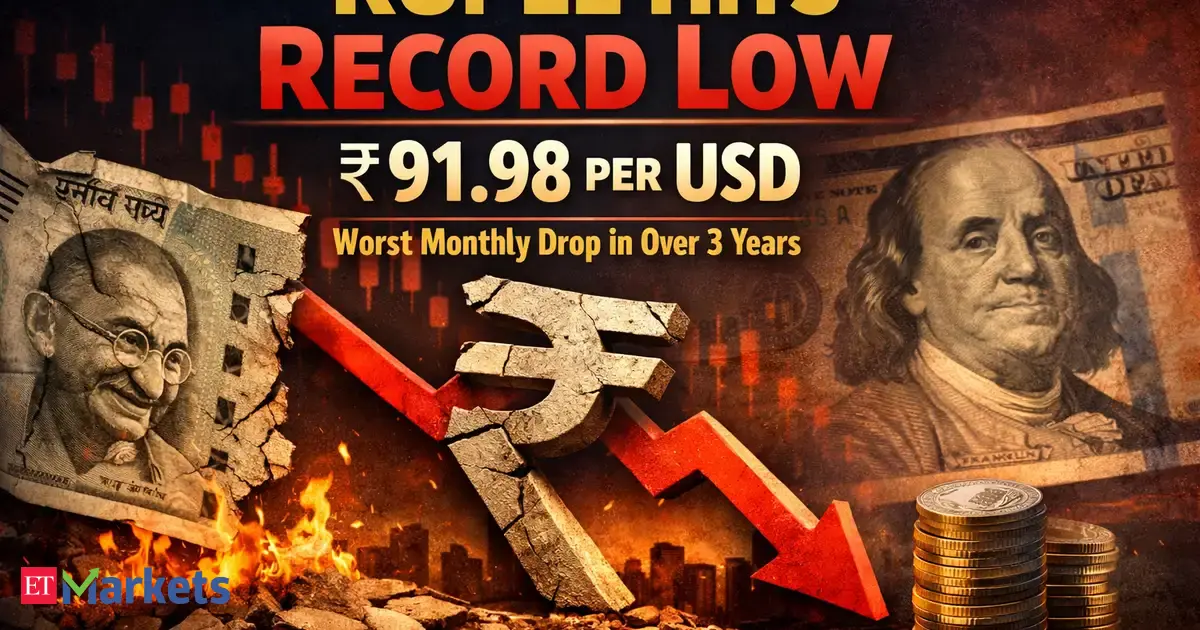
The Indian rupee depreciated to a historic low of 91.98 per US Dollar.
GK and monthly revision
Rupee sinks to record low of 91.98 per USD, logs worst monthly fall in over 3 years
The Indian rupee reached a historic low of 91.98 per US Dollar, experiencing its worst monthly fall since September 2022. This depreciation was primarily driven by persistent foreign investor selling and robust corporate demand for dollars. The Reserve Bank of India (RBI) intervened to stabilize the currency. This event is significant for understanding India's economic stability and monetary policy, with upcoming influences including India's federal budget and US Federal Reserve announcements.
Revision structure
Monthly events and exam calendar context
Static GK and one-liner notes
Quiz and mock-test revision path
Key points
Exam-ready takeaways
The currency registered its worst monthly fall since September 2022.
Key factors contributing to the rupee's fall included persistent foreign investor selling and strong corporate demand for dollars.
The Reserve Bank of India (RBI) intervened in the market to provide support to the rupee.
Future movements of the rupee will be influenced by India's federal budget proposal and the US President's Federal Reserve nominee announcement.
Detailed analysis
Full exam-oriented breakdown
The recent fall of the Indian Rupee to a historic low of 91.98 per US Dollar, marking its worst monthly performance since September 2022, is a critical economic development for competitive exam aspirants to understand deeply. This event reflects the intricate interplay of global and domestic economic forces, monetary policy, and market sentiment. **Background Context: Understanding Currency Depreciation** Currency depreciation refers to a fall in the value of a country's currency relative to other currencies in a floating exchange rate system. This is primarily driven by market forces of demand and supply. A stronger demand for foreign currency (like the USD) or a weaker demand for the domestic currency (INR) leads to depreciation. Factors influencing this include trade deficits (more imports than exports), capital outflows (foreign investors pulling money out), high inflation, interest rate differentials, and geopolitical events. India operates under a 'managed float' exchange rate regime, where the Reserve Bank of India (RBI) intervenes periodically to iron out excessive volatility, rather than targeting a specific exchange rate level. **What Happened and Why?** On a specific Friday, the Indian Rupee depreciated significantly, hitting a record low against the US Dollar. The immediate catalysts identified were persistent foreign investor selling and strong corporate demand for dollars. Foreign Portfolio Investors (FPIs) often withdraw funds from emerging markets like India when global interest rates rise (making developed markets more attractive) or when there's uncertainty. This outflow of capital increases the demand for dollars as FPIs convert their rupee holdings back into dollars. Concurrently, Indian corporates, engaging in international trade or having external debt obligations, require dollars for imports, debt servicing, or overseas investments. High import bills, particularly for crude oil and other essential commodities, further fuel this dollar demand. The RBI's intervention, likely through selling dollars from its foreign exchange reserves, aimed to inject dollar liquidity into the market to temper the depreciation, highlighting its commitment to managing volatility. **Key Stakeholders and Their Roles** 1. **Reserve Bank of India (RBI):** As the central bank, the RBI is the primary custodian of India's monetary policy and exchange rate stability. Under the Reserve Bank of India Act, 1934, and the Monetary Policy Framework Agreement, its mandate includes maintaining price stability (inflation targeting) while also managing the external value of the rupee. It intervenes in the forex market to curb excessive volatility using tools like selling/buying foreign currency, adjusting interest rates, and implementing capital controls if necessary. 2. **Foreign Institutional Investors (FIIs)/Foreign Portfolio Investors (FPIs):** These are crucial players in India's capital markets. Their inflows and outflows significantly impact the demand for and supply of the rupee. Their decisions are influenced by global risk appetite, interest rate differentials between India and developed economies (especially the US), and India's economic growth prospects. 3. **Indian Corporates:** Businesses engaged in international trade (importers, exporters) or those with foreign borrowings (External Commercial Borrowings - ECBs) are significant demanders or suppliers of foreign currency. Strong import demand for raw materials or capital goods, or repayment of foreign debt, increases dollar demand. 4. **Government of India (Ministry of Finance):** The government's fiscal policy (Union Budget, taxation, expenditure) and trade policies (EXIM policy) indirectly influence the rupee. A large fiscal deficit can lead to higher inflation or borrowing, impacting investor confidence. Favourable trade policies can boost exports, increasing dollar supply. 5. **Exporters and Importers:** Exporters benefit from a depreciating rupee as their goods become cheaper for foreign buyers, potentially boosting competitiveness. Importers, conversely, face higher costs for imported goods and raw materials, which can be passed on to consumers, contributing to inflation. **Significance for India and Broader Themes** Rupee depreciation has multi-faceted implications for India. Economically, it can worsen the Current Account Deficit (CAD) if imports remain inelastic (e.g., oil). It fuels imported inflation, as essential commodities like crude oil, edible oils, and electronics become more expensive, impacting household budgets. This puts pressure on the RBI to balance growth with inflation control. A weaker rupee also increases the burden of servicing external debt for the government and corporates. On the positive side, it can make Indian exports more competitive, potentially boosting export-oriented industries and job creation. However, persistent depreciation can deter foreign investment, signalling economic instability. This event links to broader themes of global economic interconnectedness, the challenges of managing capital flows in an open economy, and the delicate balance between monetary and fiscal policies. **Historical Context and Future Implications** India has experienced several periods of rupee depreciation, notably during the 1991 economic crisis, the 2008 global financial crisis, and the 2013 'taper tantrum.' Each instance prompted policy responses, leading to stronger foreign exchange reserves and more robust regulatory frameworks (like the Foreign Exchange Management Act, 1999 - FEMA, which replaced the Foreign Exchange Regulation Act, 1973 - FERA). The current situation is influenced by both domestic factors and global headwinds, particularly the monetary policy stance of the US Federal Reserve. Future implications hinge on several factors: the upcoming Union Budget proposal, which will outline the government's fiscal roadmap and can influence investor sentiment; the US President's Federal Reserve nominee announcement, which could signal future US interest rate trajectories and impact global capital flows; and the RBI's continued vigilance and intervention strategy. A sustained period of rupee weakness could force the RBI to tighten monetary policy more aggressively, potentially impacting economic growth. The focus will be on maintaining macroeconomic stability through prudent fiscal management and effective monetary policy coordination.
How to study
Turn news into exam marks
Revise monthly events by exam family instead of reading random updates.
Pair one-liners with mock tests so mistakes become the next revision list.
Keep state job pages, calendar pages and GK packs connected in one path.