

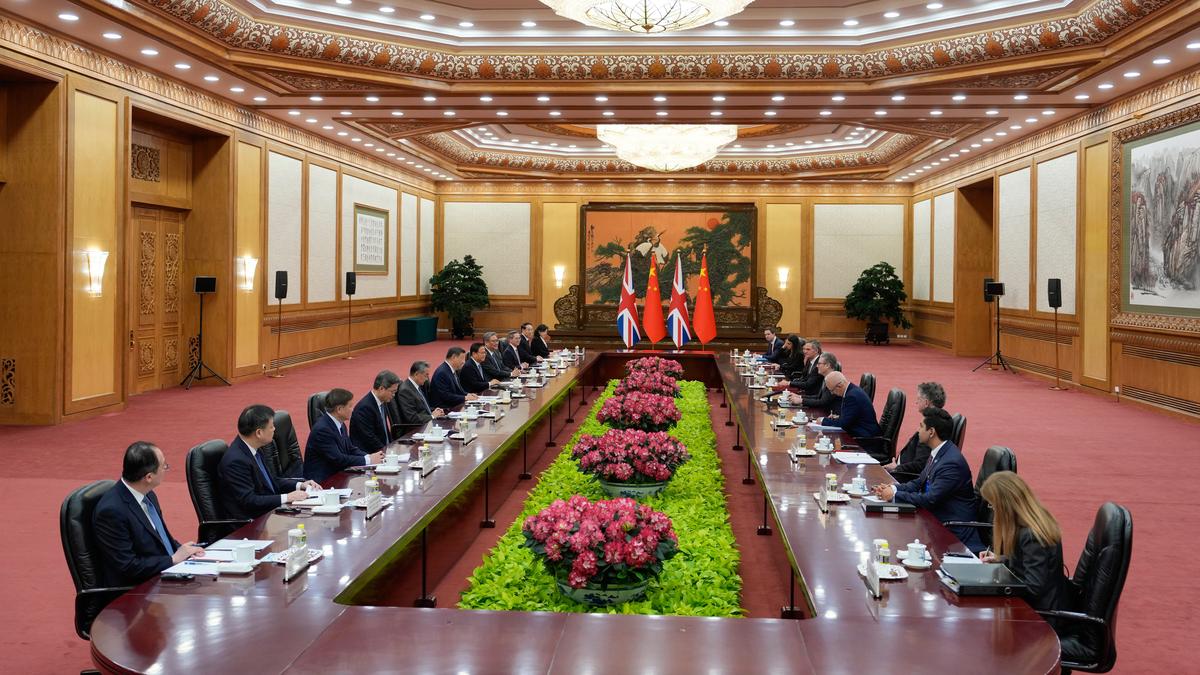
British Prime Minister Keir Starmer met Chinese President Xi Jinping.
GK and monthly revision
Britain’s PM Keir Starmer meets Xi Jinping in bid to reset strained ties
British Prime Minister Keir Starmer met Chinese President Xi Jinping, marking the first visit by a UK PM to China since 2018. This visit aims to reset strained bilateral ties, a significant development in international relations. It also highlights geopolitical shifts, occurring amidst tensions between Britain and its ally the United States over President Donald Trump's remarks. This event is crucial for understanding current global diplomatic dynamics for competitive exams.
Revision structure
Monthly events and exam calendar context
Static GK and one-liner notes
Quiz and mock-test revision path
Key points
Exam-ready takeaways
This marks the first visit by a British Prime Minister to China since 2018.
The primary objective of the visit is to reset strained bilateral ties between Britain and China.
The visit occurs amidst existing tensions between Britain and its longstanding close ally, the United States.
Tensions between Britain and the US are attributed to recent remarks made by President Donald Trump.
Detailed analysis
Full exam-oriented breakdown
The recent meeting between British Prime Minister Keir Starmer and Chinese President Xi Jinping marks a pivotal moment in international diplomacy, signifying the first visit by a UK Prime Minister to China since 2018. This engagement is aimed at 'resetting' strained bilateral ties, a move laden with geopolitical implications, especially against the backdrop of growing tensions between Britain and its traditional ally, the United States, exacerbated by President Donald Trump's recent remarks. **Background Context and Strained Ties:** For several years, relations between the UK and China have been under significant strain. This deterioration can be traced back to several key issues. Post-Brexit, the UK embarked on a 'Global Britain' strategy, seeking new alliances and trade opportunities, but this has often clashed with China's assertiveness. A major point of contention has been China's imposition of the National Security Law in Hong Kong in 2020, which the UK, as a signatory to the 1984 Sino-British Joint Declaration, viewed as a breach of autonomy and human rights. In response, the UK offered a special visa route for Hong Kong British National (Overseas) passport holders. Furthermore, the UK reversed its decision to allow Huawei a role in its 5G infrastructure in 2020, citing national security concerns and pressure from the US. Human rights abuses in Xinjiang against the Uyghur Muslim minority and China's stance on the South China Sea have also fueled Western criticism, including from the UK. Economically, concerns over intellectual property theft and unfair trade practices have added to the friction. The formation of the AUKUS security pact involving the US, UK, and Australia in 2021, seen by many as a counter-China initiative in the Indo-Pacific, further solidified China's perception of Western containment efforts. **The Meeting and Key Stakeholders:** Keir Starmer's visit represents a pragmatic shift for the Labour government, which, while maintaining a firm stance on human rights and national security, also recognizes the economic imperative of engaging with China, the world's second-largest economy. The primary objective is to 'reset' ties, which likely involves exploring avenues for cooperation on global challenges like climate change, trade, and regional stability, while managing areas of disagreement. Key stakeholders include the **United Kingdom**, under the Labour government, seeking to balance economic interests with democratic values and security concerns in a post-Brexit world. **China**, led by President Xi Jinping, aims to project its global influence, counter Western pressure, and ensure continued economic growth. The **United States** is another critical stakeholder; the reported tensions between the UK and US over Donald Trump's remarks highlight the complexities of transatlantic relations and the challenges the UK faces in navigating its alliances while pursuing its independent foreign policy agenda. **Significance for India:** This development holds significant implications for India. Geopolitically, India operates on a principle of strategic autonomy, engaging with multiple global powers without exclusive alignment. A potential 'reset' in UK-China relations could influence the broader geopolitical landscape, particularly in the Indo-Pacific. India, a member of QUAD (along with the US, Japan, and Australia), is keen on maintaining a free and open Indo-Pacific, which often puts it at odds with China's expansive claims. Shifts in UK foreign policy towards China could impact the cohesion of Western-led initiatives and multilateral forums where India is a participant. Economically, both the UK and China are major trading partners for India. Any changes in their economic relationship, such as trade agreements or investment flows, could indirectly affect India's economic interests, supply chains, and market access. For instance, increased UK-China trade could divert investment or attention from India, or conversely, create new opportunities. India's own complex relationship with China, marked by border disputes (like those along the Line of Actual Control) and a significant trade deficit, means it closely observes how other major powers manage their engagement with Beijing. India's foreign policy, guided by principles like Panchsheel and the promotion of international peace and security (enshrined in **Article 51** of the Indian Constitution), dictates a careful approach to such evolving global dynamics. **Future Implications:** The visit could signal a more nuanced approach by Western nations towards China, moving away from pure confrontation towards 'managed competition' or 'de-risking' rather than 'decoupling.' This could have implications for global governance, climate change efforts, and the stability of the international order. For the UK, it represents an attempt to carve out an independent foreign policy path post-Brexit, balancing its traditional alliance with the US with the economic realities of engaging with China. It also challenges the perception of a unified Western front against China, potentially leading to a more multipolar global order. For India, it underscores the need to continuously adapt its foreign policy, strengthening its strategic partnerships while safeguarding its national interests amidst an increasingly complex and interconnected world. The future will reveal whether this 'reset' is merely a diplomatic overture or a fundamental shift in UK-China dynamics, with ripple effects across the globe.
How to study
Turn news into exam marks
Revise monthly events by exam family instead of reading random updates.
Pair one-liners with mock tests so mistakes become the next revision list.
Keep state job pages, calendar pages and GK packs connected in one path.