

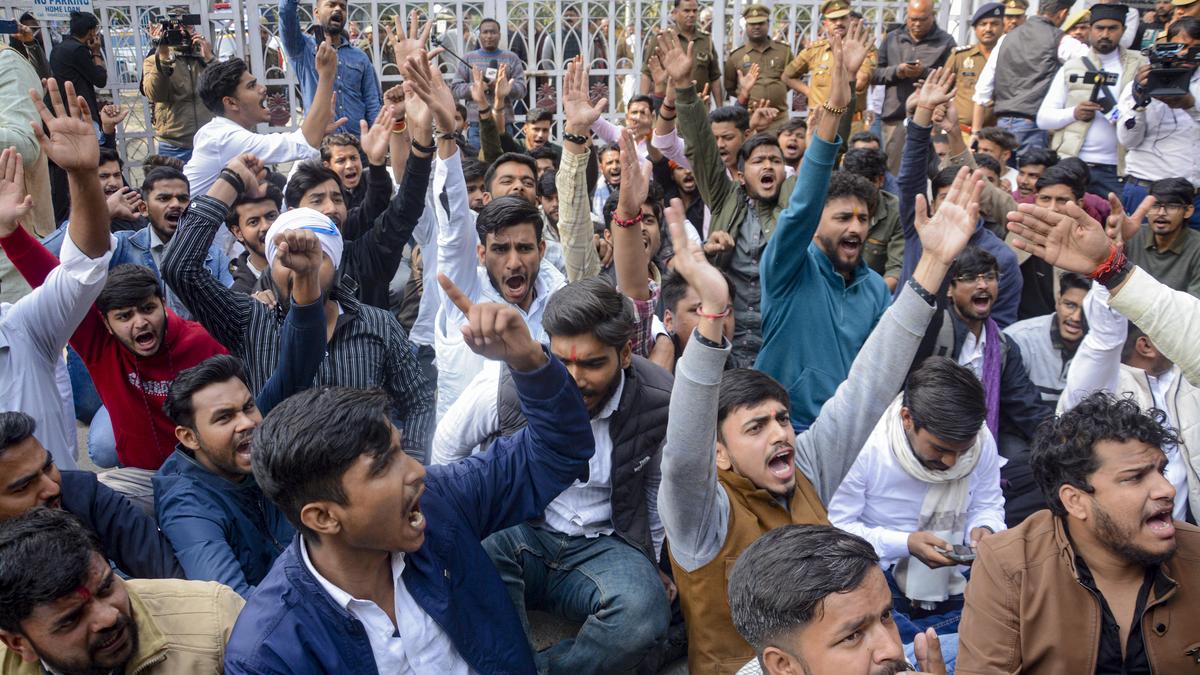
Students demonstrated against the University Grants Commission (UGC) (Promotion of Equity in Higher Education Institutions) Regulations, 2026.
GK and monthly revision
New UGC equity regulations spark student protests, political fallout in U.P.
Students at Lucknow University are protesting against the University Grants Commission (UGC) (Promotion of Equity in Higher Education Institutions) Regulations, 2026. They allege that these new regulations could lead to increased caste conflict and disrupt social harmony on higher education campuses in Uttar Pradesh. This development is significant for competitive exams as it pertains to education policy, social justice issues, and the role of regulatory bodies like UGC.
Revision structure
Monthly events and exam calendar context
Static GK and one-liner notes
Quiz and mock-test revision path
Key points
Exam-ready takeaways
The protests specifically occurred at Lucknow University, located in Uttar Pradesh (U.P.).
Protesters claimed the new regulations could potentially lead to caste conflict on university campuses.
Concerns were raised that the regulations might disrupt social harmony within higher education institutions.
The University Grants Commission (UGC) is the central statutory body responsible for these regulations.
Detailed analysis
Full exam-oriented breakdown
The recent student protests at Lucknow University against the University Grants Commission (UGC) (Promotion of Equity in Higher Education Institutions) Regulations, 2026, illuminate a persistent and often contentious debate in India: the balance between equity, affirmative action, and social harmony in higher education. These regulations, still in their nascent stage, have already sparked significant concern, particularly regarding their potential impact on caste dynamics on campuses. Understanding this issue requires delving into its historical, constitutional, and socio-political dimensions. The **background context** for these regulations lies in India's long-standing commitment to social justice and the upliftment of historically disadvantaged communities. Since independence, the Indian state has implemented various forms of affirmative action, most notably reservations in education and public employment, to address historical injustices and ensure equitable representation. The University Grants Commission (UGC), established in 1956 under the UGC Act, is the primary statutory body responsible for the coordination, determination, and maintenance of standards in university education. Its role often involves framing policies and regulations to guide higher education institutions across the country, including those related to admission, faculty recruitment, and campus environment. The stated objective of the 2026 regulations is 'Promotion of Equity,' which typically implies measures to ensure fair and just treatment for all, often through targeted interventions for marginalized groups. **What happened** specifically was that a section of students at Lucknow University demonstrated against these new UGC regulations. Their core contention is that the regulations, far from promoting harmony, could inadvertently lead to increased caste conflict and disrupt the delicate social fabric within higher education institutions. While the precise provisions of the 2026 regulations that triggered these specific concerns are not explicitly detailed in the prompt, the general apprehension suggests that students perceive them as potentially altering existing reservation frameworks or introducing new criteria that could be divisive. **Key stakeholders** involved in this unfolding situation are numerous. Firstly, the **University Grants Commission (UGC)** is the central regulatory body that formulated these regulations. Its mandate is to ensure quality and equity in higher education. Secondly, the **students and student organizations** at Lucknow University are the primary protesters, representing a segment of the campus community directly affected by and concerned about the regulations' implications. Their voices are crucial in democratic policy-making. Thirdly, **higher education institutions** themselves, like Lucknow University, are critical stakeholders as they are responsible for implementing these regulations and managing campus environments. The **state government of Uttar Pradesh** and the broader **political establishment** also become stakeholders due to the potential for political fallout, law and order implications, and the general impact on public sentiment and electoral calculations, especially given the sensitive nature of caste-related issues in Indian politics. Finally, the **Central Government** is an overarching stakeholder, as the UGC functions under the Ministry of Education, and its policies reflect broader national educational and social justice agendas. **Why this matters for India** is multi-faceted. Socially, it reignites the complex debate around affirmative action, caste, and merit. India's social landscape is profoundly shaped by caste, and policies aimed at equity often face scrutiny regarding their implementation and unintended consequences. Economically, a harmonious and productive higher education sector is vital for human capital development, innovation, and economic growth. Any disruption on campuses can impede academic progress and research. Politically, caste remains a significant determinant in electoral politics, particularly in states like Uttar Pradesh. Student protests can quickly escalate into broader political movements, forcing political parties to take stances and potentially influencing policy direction. The issue also touches upon the **constitutional morality** of the nation, as enshrined in the Preamble's ideals of justice, liberty, equality, and fraternity, and the specific provisions for social justice. The **historical context** of affirmative action in India is deep-rooted. The Constitution itself, adopted in 1950, included provisions for special measures for Scheduled Castes (SCs) and Scheduled Tribes (STs). The **Mandal Commission Report** (1980) led to the implementation of reservations for Other Backward Classes (OBCs) in central government services and educational institutions in the early 1990s, a policy that sparked widespread protests but was ultimately upheld by the Supreme Court in the landmark **Indra Sawhney case (1992)**, albeit with the 'creamy layer' exclusion. More recently, the **103rd Constitutional Amendment Act, 2019**, introduced a 10% reservation for Economically Weaker Sections (EWS) in educational institutions and government jobs, further expanding the scope of affirmative action. These historical precedents demonstrate the continuous evolution and contestation surrounding reservation policies, which are often seen as necessary for social mobility but also criticized for potential divisiveness or impact on merit. **Related constitutional articles** are central to this discussion. **Article 15(4)** and **15(5)** empower the state to make special provisions for the advancement of any socially and educationally backward classes of citizens or for the Scheduled Castes and the Scheduled Tribes, including in educational institutions. **Article 16(4)** allows for reservation in appointments for backward classes not adequately represented in services. **Article 46**, a Directive Principle of State Policy, mandates the state to promote with special care the educational and economic interests of the weaker sections of the people, especially the Scheduled Castes and the Scheduled Tribes, and to protect them from social injustice and all forms of exploitation. The **UGC Act, 1956**, itself provides the statutory framework for the Commission's functions. The **future implications** of these protests and the regulations are significant. Firstly, they could lead to wider protests across other universities if student concerns are not adequately addressed or if the regulations are perceived as detrimental. Secondly, there could be legal challenges to the regulations, potentially involving the Supreme Court, which has historically played a crucial role in interpreting and shaping reservation policies. Thirdly, the government might be compelled to clarify, amend, or even reconsider certain aspects of the regulations to mitigate public and political backlash. The incident underscores the ongoing challenge of designing and implementing policies that genuinely promote equity without exacerbating social divisions, and highlights the need for inclusive dialogue and thorough impact assessments before major policy shifts in sensitive areas like affirmative action in education.
How to study
Turn news into exam marks
Revise monthly events by exam family instead of reading random updates.
Pair one-liners with mock tests so mistakes become the next revision list.
Keep state job pages, calendar pages and GK packs connected in one path.