

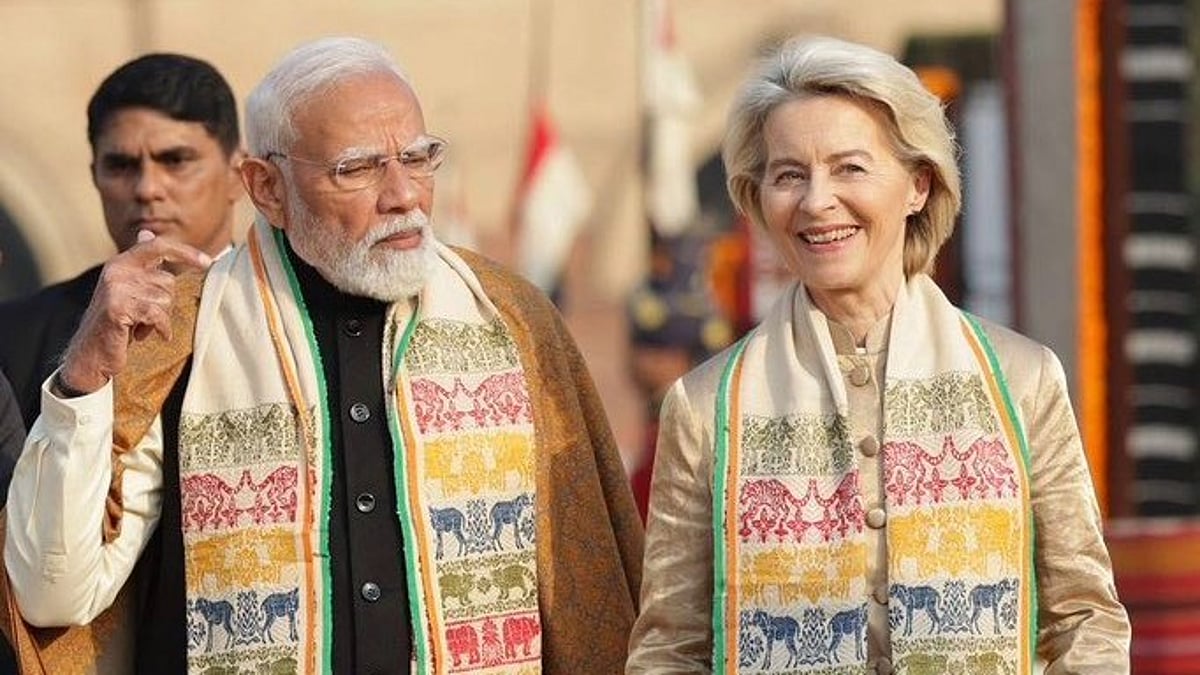
The ongoing negotiations are for the India-EU Free Trade Agreement (FTA).
GK and monthly revision
“Mother of all deals” India-EU Free Trade Agreement locks in market access, but climate compliance looms large
India and the European Union are negotiating a Free Trade Agreement (FTA), dubbed the "Mother of all deals," aiming for extensive tariff reductions to enhance market access for Indian exporters. This agreement is crucial for India's economic growth and integration into global trade. However, the EU's Carbon Border Adjustment Mechanism (CBAM) poses a significant challenge for Indian industries regarding climate compliance and potential additional taxes, making it a key area for exam focus on international trade and environmental policy.
Revision structure
Monthly events and exam calendar context
Static GK and one-liner notes
Quiz and mock-test revision path
Key points
Exam-ready takeaways
The proposed FTA is being referred to as the "Mother of all deals" due to its potential scope and impact.
A primary objective of the India-EU FTA is to achieve wide-ranging tariff reductions.
A significant challenge for Indian exporters under the FTA is the EU’s Carbon Border Adjustment Mechanism (CBAM).
The FTA aims to secure enhanced market access for Indian products in the European Union.
Detailed analysis
Full exam-oriented breakdown
The ongoing negotiations for the India-European Union Free Trade Agreement (FTA), ambitiously dubbed the “Mother of all deals,” represent a pivotal moment in India's economic diplomacy and its quest for deeper integration into the global economy. This comprehensive agreement aims to unlock significant market access for Indian goods and services in the EU, India's second-largest trading partner, while navigating complex challenges like the EU’s Carbon Border Adjustment Mechanism (CBAM). **Background Context and Historical Perspective:** India and the EU share a long-standing relationship, evolving from colonial trade ties to a strategic partnership. The idea of a comprehensive trade agreement isn't new; negotiations for a Broad-based Trade and Investment Agreement (BTIA) commenced in 2007 but were suspended in 2013 due to persistent differences over issues such as market access for automobiles, wines, and spirits, as well as intellectual property rights and data security. After a hiatus, both sides, recognizing the immense potential and the changing geopolitical landscape, decided to resume negotiations in June 2022, signaling a renewed commitment to strengthening economic ties. This revival is also driven by global supply chain disruptions and the need for diversification, especially in the wake of events like the COVID-19 pandemic and geopolitical tensions. **What Happened and Key Objectives:** The current negotiations are far-reaching, covering not just trade in goods but also services, investment, intellectual property rights, geographical indications, and sustainable development. The primary objective is to achieve wide-ranging tariff reductions, ideally bringing them down to zero across a significant number of product lines. For India, this means enhanced access to the EU's massive market of 27 nations and over 450 million consumers, which is the world's third-largest economy. This market access is crucial for sectors like textiles, pharmaceuticals, automotive components, and IT services, which stand to benefit immensely from reduced trade barriers. The deal is expected to boost India's exports, attract foreign direct investment, and create employment opportunities. **Key Stakeholders Involved:** On the Indian side, the Ministry of Commerce and Industry is the lead negotiator, working in consultation with various other ministries, industry associations (like FICCI, CII, ASSOCHAM), and export promotion councils. Indian exporters, particularly those in MSMEs, are key beneficiaries. The EU's negotiating arm is the European Commission, which represents the collective economic interests of its 27 member states. Each member state, with its diverse economic profile and domestic political considerations, plays a role in shaping the EU's mandate. European businesses, particularly those looking for new markets and diversified supply chains, are also significant stakeholders. **Why This Matters for India:** The India-EU FTA holds immense significance for India's economic trajectory. Economically, it promises to significantly boost India's export potential, diversify its trade basket, and potentially increase its GDP. The 'Make in India' and 'Atmanirbhar Bharat' initiatives could receive a fillip by gaining access to advanced technology and investment from Europe, while also providing a larger market for domestically manufactured goods. Politically, a successful FTA would elevate India's standing as a reliable and significant global economic partner, strengthening its strategic autonomy. Socially, increased trade and investment are expected to lead to job creation and improved living standards. However, a significant challenge looms large: the EU’s Carbon Border Adjustment Mechanism (CBAM). Effective from October 1, 2023, with financial implications from January 1, 2026, CBAM will impose a carbon tariff on imports of certain carbon-intensive goods (initially iron and steel, cement, fertilizers, aluminum, hydrogen, and electricity) into the EU. This mechanism aims to prevent 'carbon leakage' – where EU companies might move production to countries with less stringent climate policies. For India, a major exporter of steel, aluminum, and cement, CBAM poses a substantial threat. Indian industries, often reliant on carbon-intensive production methods, face the prospect of additional taxes, which could erode their price competitiveness and market share in the EU. This necessitates a rapid transition towards greener manufacturing processes and significant investment in decarbonization technologies. **Constitutional and Policy References:** While the Indian Constitution does not explicitly detail the process for Free Trade Agreements, the power to enter into international treaties and agreements primarily rests with the Union Executive. Article 73 outlines the extent of the executive power of the Union. Furthermore, Article 253 grants Parliament the power to make any law for implementing any treaty, agreement, or convention with any other country or any decision made at any international conference, association, or other body. This provides the legislative backing for any domestic law changes required by the FTA. The Directive Principles of State Policy, particularly Article 51, which mandates the state to endeavor to promote international peace and security and foster respect for international law and treaty obligations, provides a guiding principle for India’s engagement in international agreements. The Foreign Trade (Development and Regulation) Act, 1992, and the periodically updated Foreign Trade Policy (FTP) are the primary legislative and policy frameworks governing India's international trade. **Future Implications:** The successful conclusion of the India-EU FTA, despite the CBAM hurdle, could be a game-changer. It would signify a major step towards India's target of achieving $1 trillion in merchandise exports and $1 trillion in services exports by 2030. It would also push Indian industries to adopt more sustainable and environmentally friendly practices to comply with EU standards, potentially leading to a greener economy domestically. Conversely, if the CBAM issue is not adequately addressed, it could significantly undermine the benefits of the FTA and strain trade relations. The outcome of these negotiations will also set a precedent for India's future trade agreements with other developed economies, influencing its approach to environmental and labor standards in international trade. It underscores the evolving landscape of global trade, where environmental compliance is becoming as critical as tariff reductions.
How to study
Turn news into exam marks
Revise monthly events by exam family instead of reading random updates.
Pair one-liners with mock tests so mistakes become the next revision list.
Keep state job pages, calendar pages and GK packs connected in one path.