

India and the European Union (EU) have signed a major Free Trade Agreement (FTA).
GK and monthly revision
India-EU trade pact the biggest in history, Modi says, as tariffs head to zero
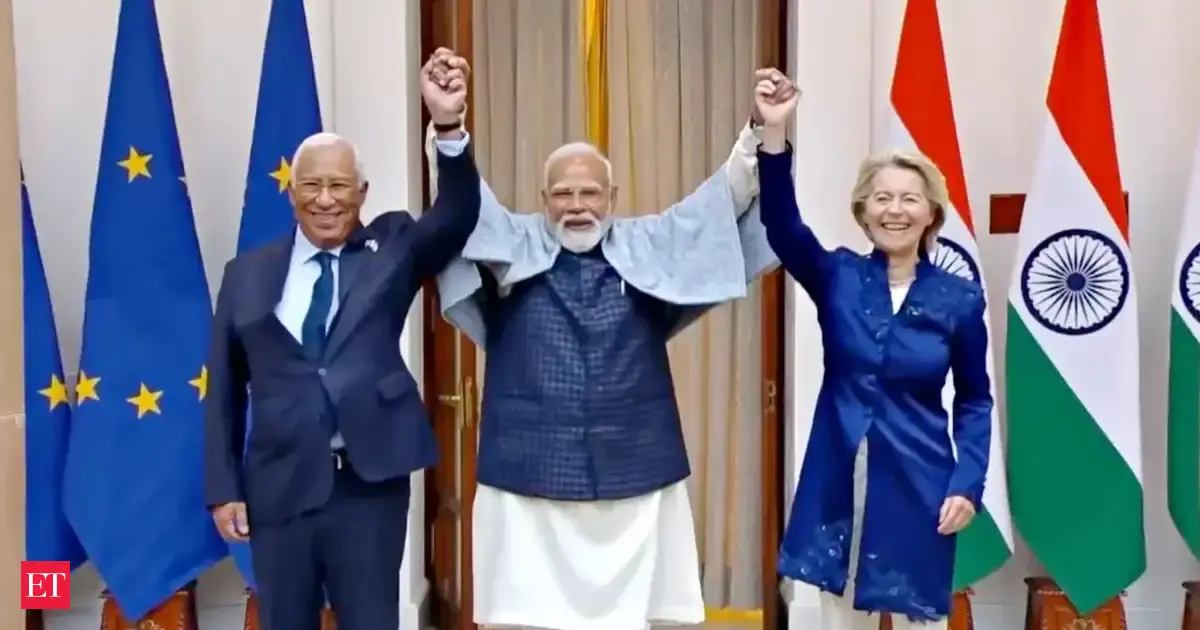
India and the European Union have signed a historic Free Trade Agreement (FTA), which Prime Minister Modi termed the "biggest in history". This landmark deal aims to significantly boost bilateral trade by reducing tariffs on most goods over several years, eventually leading to zero tariffs. The agreement also seeks to foster cooperation in manufacturing and technology, strengthening India-EU relations and economic ties, making it crucial for competitive exam preparation.
Revision structure
Monthly events and exam calendar context
Static GK and one-liner notes
Quiz and mock-test revision path
Key points
Exam-ready takeaways
Prime Minister Modi characterized this trade pact as the "biggest in history".
The agreement's primary objective is to significantly boost trade between India and the EU.
A key provision of the deal is the reduction of tariffs on most goods, aiming for tariffs to head to zero over several years.
The pact also seeks to foster cooperation in manufacturing and technology between the two democratic powers.
Detailed analysis
Full exam-oriented breakdown
The recent breakthrough in the India-European Union (EU) Free Trade Agreement (FTA) negotiations, hailed by Prime Minister Modi as potentially the "biggest in history," marks a pivotal moment in India's economic diplomacy and international relations. This comprehensive pact aims to significantly boost bilateral trade by phasing out tariffs on most goods, fostering cooperation in critical sectors like manufacturing and technology, and solidifying the strategic partnership between two of the world's largest democratic powers. **Background Context and Historical Journey:** India and the EU have a long-standing relationship, evolving from a purely economic one to a strategic partnership. The EU is India's third-largest trading partner, and India is the EU's tenth-largest. Efforts to forge a comprehensive trade agreement, initially termed the Broad-based Trade and Investment Agreement (BTIA), began way back in 2007. These negotiations, however, stalled in 2013 due primarily to significant differences over issues such as market access for goods and services, intellectual property rights, investor protection, and non-tariff barriers. After an eight-year hiatus, both sides decided to re-engage in May 2021 at the India-EU Leaders' Meeting in Porto, Portugal, signaling a renewed political will to overcome past hurdles and forge a 'balanced, ambitious, comprehensive, and mutually beneficial' agreement. The subsequent launch of formal negotiations in June 2022, alongside an Investment Protection Agreement (IPA) and an Agreement on Geographical Indications (GIs), set the stage for the current momentum. **What the Agreement Entails:** While specific details of the final text are still emerging and subject to ratification, the core objective of this FTA is the substantial reduction and eventual elimination of tariffs on a vast array of goods. This phased approach, spanning several years, is designed to provide industries on both sides with time to adapt. Beyond tariffs, the agreement is expected to cover a wide range of areas, including trade in services, investment facilitation, dispute settlement mechanisms, technical barriers to trade, sanitary and phytosanitary measures, intellectual property rights, and potentially provisions on sustainable development, labor, and environmental standards. The emphasis on cooperation in manufacturing and technology is particularly crucial, indicating a move beyond mere commodity trade to deeper industrial integration and knowledge transfer. **Key Stakeholders Involved:** On the Indian side, the primary stakeholders include the **Government of India**, particularly the Ministry of Commerce and Industry, which leads the negotiations, and the Prime Minister's Office, which provides strategic direction. Indian businesses, especially those in export-oriented sectors like textiles, leather, pharmaceuticals, IT services, and engineering goods, stand to gain significant market access. Consumers in India could benefit from a wider array of imported goods and potentially lower prices. On the EU side, the **European Commission** acts as the chief negotiator on behalf of its 27 member states. EU industries, particularly in sectors like machinery, chemicals, automobiles, and advanced technology, are key beneficiaries, as are European consumers. The **World Trade Organization (WTO)** framework forms the overarching legal context, ensuring the agreement adheres to multilateral trade rules. **Significance for India:** This FTA holds immense significance for India across economic, strategic, and political dimensions. Economically, gaining enhanced access to the EU's large and affluent market (over 450 million consumers) will provide a substantial boost to India's exports, helping to diversify its trade basket and reduce reliance on specific markets. It is expected to create new job opportunities, foster domestic manufacturing through increased investment and technology transfer, and contribute significantly to India's ambition of becoming a $5 trillion economy. The agreement aligns with the 'Make in India' initiative by attracting European investments and technologies, enhancing India's manufacturing capabilities, and integrating Indian companies further into global supply chains. Strategically, strengthening ties with the EU, a bloc of advanced economies and a major global normative power, enhances India's geopolitical standing. It offers a crucial partnership in a multipolar world, promoting shared democratic values and multilateralism. **Constitutional and Policy Framework:** The implementation of such a significant international agreement in India involves specific constitutional provisions. **Article 253** of the Indian Constitution grants Parliament the power to legislate for implementing any international treaty, agreement, or convention. This means that once the FTA is signed, domestic legislation may be required to bring India's laws and regulations into conformity with the agreement's provisions. Furthermore, **Article 51** emphasizes the State's directive to endeavor to promote international peace and security, maintain just and honorable relations between nations, foster respect for international law and treaty obligations, and encourage settlement of international disputes by arbitration. This article provides the broader constitutional mandate for India's engagement in international agreements. The **Foreign Trade (Development and Regulation) Act, 1992**, and subsequent amendments, along with India's various Foreign Trade Policies (FTPs), provide the statutory framework for governing India's international trade, under which this FTA will operate. **Future Implications:** Looking ahead, the successful implementation of the India-EU FTA will not be without challenges. Phased tariff reductions will require domestic industries to enhance competitiveness. Non-tariff barriers, such as regulatory alignment, product standards, and certification processes, will need careful navigation. However, the potential benefits far outweigh these challenges. The agreement could serve as a template for India's future trade negotiations with other significant blocs. It will also deepen cooperation in emerging areas like digital trade, green technologies, and resilient supply chains, positioning India as a key player in the global economic architecture. The FTA is expected to be a cornerstone of India's economic growth strategy and a testament to its commitment to open and rules-based international trade.
How to study
Turn news into exam marks
Revise monthly events by exam family instead of reading random updates.
Pair one-liners with mock tests so mistakes become the next revision list.
Keep state job pages, calendar pages and GK packs connected in one path.