

India has signed a landmark Free Trade Agreement (FTA) with the European Union (EU).
GK and monthly revision
India-EU ‘mother of all deals’ explained for stock market investors: The good, the bad and the ugly
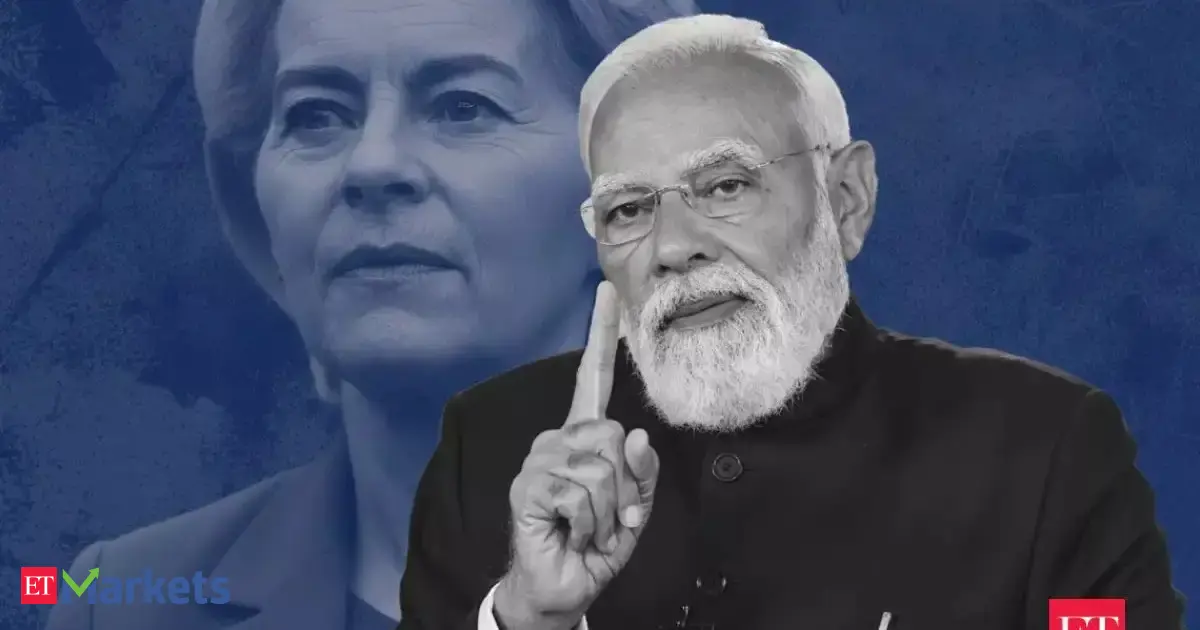
India has signed a landmark Free Trade Agreement (FTA) with the European Union, which Prime Minister Narendra Modi termed the "mother of all deals." This significant economic pact is set to boost bilateral trade, impacting various sectors differently. For competitive exams, understanding the parties involved, the nature of the agreement, and its broad economic implications for key sectors like textiles and automobiles is crucial.
Revision structure
Monthly events and exam calendar context
Static GK and one-liner notes
Quiz and mock-test revision path
Key points
Exam-ready takeaways
Prime Minister Narendra Modi referred to this India-EU FTA as the "mother of all deals."
The agreement aims to significantly boost trade and economic cooperation between India and the EU.
Following the announcement, textile stocks in India jumped by up to 12% on export optimism.
Indian automakers' stocks fell by over 4% due to concerns about stiffer competition from EU imports.
Detailed analysis
Full exam-oriented breakdown
The recent Free Trade Agreement (FTA) between India and the European Union, hailed by Prime Minister Narendra Modi as the "mother of all deals," marks a pivotal moment in India's foreign economic policy. This agreement is not just a commercial pact; it is a strategic move that reflects India's growing global economic ambitions and its evolving geopolitical calculus. **Background Context and Historical Trajectory:** India and the European Union, two of the world's largest economies and democracies, share a long-standing relationship. The EU is India's third-largest trading partner, and India is the EU's tenth-largest. Efforts to forge a comprehensive trade agreement date back to 2007, when negotiations for a Broad-based Trade and Investment Agreement (BTIA) were launched. However, these talks stalled in 2013 over significant differences on issues such as tariffs on automobiles, market access for services, intellectual property rights, and data security. The resumption of negotiations in 2021-2022, following the India-EU Leaders' Meeting in Porto in 2021, signaled a renewed commitment from both sides. This revival was driven by a combination of factors: the need for diversified supply chains post-pandemic, geopolitical realignments (including the Ukraine conflict and a desire to reduce reliance on China), and India's 'Atmanirbhar Bharat' (self-reliant India) vision, which paradoxically also emphasizes global integration. **What Happened:** The article highlights that India has signed this landmark FTA with the European Union. While the full specifics are often complex and phased, such an agreement typically involves significant tariff reductions or eliminations on a wide range of goods, greater market access for services, provisions for investment protection, intellectual property rights, and cooperation on sustainable development. The immediate market reaction underscores the mixed implications: textile stocks surged on the promise of enhanced export opportunities to the vast European market, while automakers faced a downturn due to fears of increased competition from European imports. This dichotomy perfectly illustrates the double-edged sword of trade liberalization – opening new avenues for competitive sectors while challenging less competitive ones. **Key Stakeholders Involved:** On the Indian side, the primary stakeholders include the **Government of India**, particularly the Ministry of Commerce and Industry, which spearheads the negotiations. **Indian businesses**, spanning various sectors like textiles, pharmaceuticals, IT services, agriculture, and automobiles, are directly impacted. Textile exporters stand to gain significantly from reduced tariffs, boosting their competitiveness. Conversely, domestic auto manufacturers, who have historically benefited from protective tariffs, face the prospect of tougher competition from high-quality European vehicles. **Indian consumers** could benefit from a wider array of goods at potentially lower prices. For the EU, the **European Commission** acts as the negotiating body on behalf of its 27 member states. **European businesses**, especially those in luxury goods, machinery, automotive, and high-tech sectors, anticipate greater market access in India. The **World Trade Organization (WTO)** provides the overarching multilateral framework within which such bilateral FTAs are negotiated and implemented. **Significance for India:** This FTA holds immense significance for India. Economically, it provides preferential access to the world's largest single market (EU's GDP is over $17 trillion), potentially boosting India's exports and contributing to its goal of becoming a $5 trillion economy. It can attract substantial Foreign Direct Investment (FDI) from EU countries, fostering technology transfer and job creation under the 'Make in India' initiative. Strategically, strengthening ties with the EU diversifies India's trade relationships, reducing over-reliance on any single region and enhancing its strategic autonomy in a multipolar world. It also aligns with India's 'Act East' and broader foreign policy objectives of forging closer ties with major global powers. However, it also presents challenges, such as the need for Indian industries to upgrade quality and standards to meet stringent EU regulations, and the potential for certain domestic sectors to face intense competition. **Constitutional and Policy Framework:** From a constitutional perspective, international agreements like FTAs fall under the purview of the Union Government. **Article 253** of the Indian Constitution empowers Parliament to make any law for implementing any treaty, agreement, or convention with any other country or any decision made at any international conference, association, or other body. This article is crucial as it provides the legal basis for domestic legislation required to implement international trade commitments. The **Foreign Trade (Development and Regulation) Act, 1992**, further governs India's foreign trade, and the country's **Foreign Trade Policy** outlines the government's strategic approach to exports and imports, often revised to align with new trade agreements. **Future Implications:** The successful implementation of the India-EU FTA could serve as a template for India's other ongoing FTA negotiations, such as those with the UK and Canada. It is expected to deepen economic integration, potentially leading to increased bilateral trade and investment flows. Over the long term, it could drive innovation and efficiency in Indian industries, pushing them to become more globally competitive. The agreement also solidifies India's role as a reliable and attractive destination for trade and investment, reinforcing its position in global supply chains. However, careful monitoring and adaptation will be necessary to mitigate adverse impacts on vulnerable domestic sectors and ensure that the benefits are equitably distributed across the Indian economy.
How to study
Turn news into exam marks
Revise monthly events by exam family instead of reading random updates.
Pair one-liners with mock tests so mistakes become the next revision list.
Keep state job pages, calendar pages and GK packs connected in one path.