

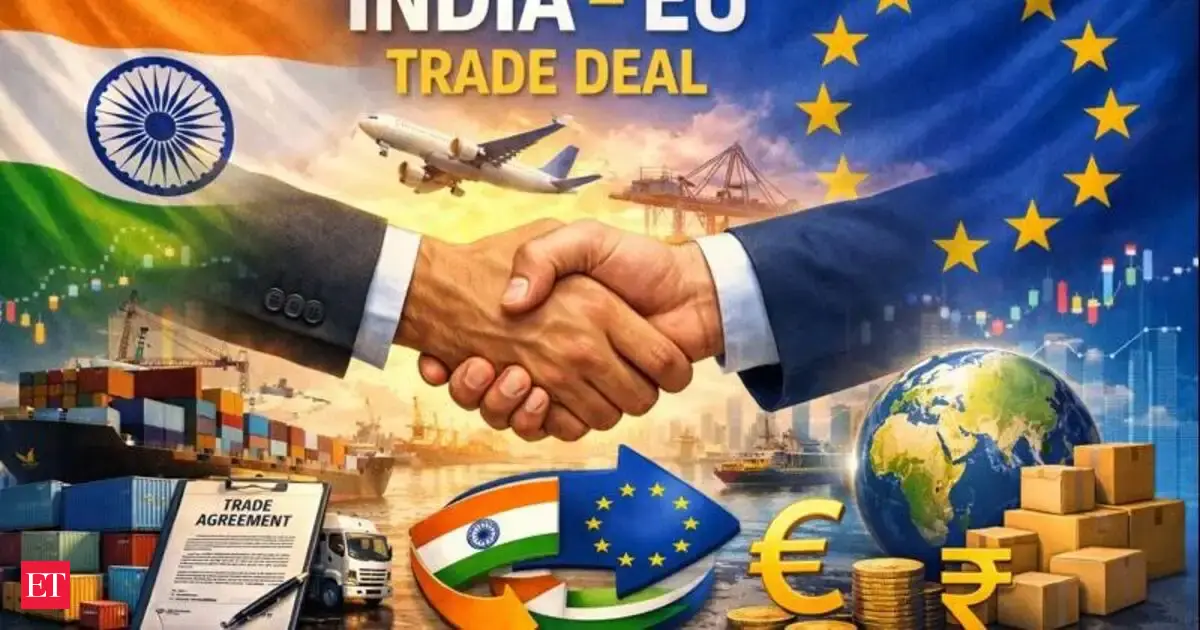
India and the European Union (EU) have successfully concluded a Free Trade Agreement (FTA).
GK and monthly revision
India-EU FTA will drive India's integration with global auto value chains: Siam, ACMA
India and the European Union have finalized a Free Trade Agreement, a significant move to deepen economic ties. This pact is expected to bolster India's integration into global automotive supply chains and enhance consumer choices in both regions. It aims to boost exports, attract investments, and foster overall economic growth, making it crucial for understanding international trade policies in competitive exams.
Revision structure
Monthly events and exam calendar context
Static GK and one-liner notes
Quiz and mock-test revision path
Key points
Exam-ready takeaways
The FTA is projected to significantly integrate India into global automotive value chains.
The agreement aims to enhance consumer choices in both the Indian and European markets.
Industry associations such as Siam and ACMA have expressed support for the India-EU FTA.
Key anticipated outcomes include boosted exports, increased investment, and broad-based economic growth.
Detailed analysis
Full exam-oriented breakdown
The finalization of a Free Trade Agreement (FTA) between India and the European Union (EU) marks a pivotal moment in their long-standing economic relationship. This agreement, officially known as the India-EU Trade and Investment Agreement (TIA), is far more than just a reduction in tariffs; it is a comprehensive pact designed to deepen economic integration, enhance market access, and align regulatory frameworks across a vast geographical and economic expanse. The journey towards this agreement has been protracted, with negotiations initially launched in 2007 but stalling in 2013 due to significant differences on issues such as market access for automobiles, wines and spirits, and data security. The renewed impetus for talks began in 2021, driven by a shared strategic vision, the need for supply chain diversification post-pandemic, and geopolitical realignments. At its core, an FTA is a treaty between two or more countries to reduce or eliminate certain barriers to trade and investment. In this context, the India-EU FTA aims to remove tariffs on a significant portion of goods, ease non-tariff barriers, and facilitate trade in services. The European Union is India's second-largest trading partner, after the US, and a major source of foreign direct investment. Conversely, India is a significant and growing market for EU goods and services. The renewed negotiations reflect a mutual desire to unlock the full potential of this economic partnership, especially in light of global economic uncertainties and the imperative to build resilient supply chains. Key stakeholders in this monumental agreement include the governments of India and the EU member states, represented by the Ministry of Commerce and Industry on the Indian side and the European Commission for the EU. Industry associations, such as the Society of Indian Automobile Manufacturers (SIAM) and the Automotive Component Manufacturers Association of India (ACMA), are crucial voices, representing sectors poised for significant impact. Their support, as highlighted in the article, underscores the anticipated positive outcomes for the automotive sector. Beyond these, various other manufacturing and service industries, agricultural producers, and critically, consumers in both regions, are significant stakeholders, as the agreement promises enhanced choices and potentially lower prices. The significance of this FTA for India is multi-faceted. Economically, it is projected to provide a substantial boost to India's exports, particularly in sectors like textiles, pharmaceuticals, chemicals, and most notably, the automotive industry. By reducing tariffs, Indian manufacturers will gain more competitive access to the vast EU market, fostering export-led growth and creating new employment opportunities. The agreement is also expected to attract greater foreign direct investment (FDI) from European companies, drawn by improved market access and a more predictable regulatory environment. This influx of capital can lead to technology transfer, skill development, and the modernization of Indian industries, aligning with the 'Make in India' and 'Atmanirbhar Bharat' initiatives by integrating India deeper into global value chains, not just as a consumer but as a significant producer and exporter. From a political and strategic perspective, the FTA strengthens India's relationship with a crucial global bloc, diversifying its trade partnerships and reducing over-reliance on any single region. This aligns with India's broader foreign policy objectives of strategic autonomy and multi-alignment. Historically, India has been cautious about FTAs, but a recent shift in policy, evidenced by agreements with the UAE, Australia, and EFTA, signals a proactive approach to global economic engagement. For the EU, the agreement offers access to one of the world's fastest-growing major economies, providing new avenues for European businesses and strengthening its geopolitical presence in the Indo-Pacific region. Regarding constitutional provisions, the power to enter into and implement international treaties and agreements primarily rests with the Union Government. **Article 253** of the Indian Constitution empowers Parliament to make any law for implementing any treaty, agreement, or convention with any other country or any decision made at any international conference, association, or other body. This provides the constitutional backing for the legislative actions required to operationalize the FTA. Furthermore, Entry 14 of the Union List under the **Seventh Schedule** deals with 'entering into treaties and agreements with foreign countries and implementing treaties, agreements and conventions with foreign countries', clearly placing international trade and treaty-making within the purview of the central government. The future implications are profound. While the FTA offers immense opportunities, it also presents challenges. Increased competition from European goods might necessitate greater efficiency and quality improvements from domestic industries. India will need to ensure its regulatory environment remains conducive to business, and that its domestic industries are adequately supported to leverage the opportunities. The agreement could also serve as a template for future FTAs with other significant economic blocs, further cementing India's role in global trade governance. The successful implementation of this FTA will be crucial for India's ambition to become a major global economic power and a reliable partner in resilient global supply chains.
How to study
Turn news into exam marks
Revise monthly events by exam family instead of reading random updates.
Pair one-liners with mock tests so mistakes become the next revision list.
Keep state job pages, calendar pages and GK packs connected in one path.