

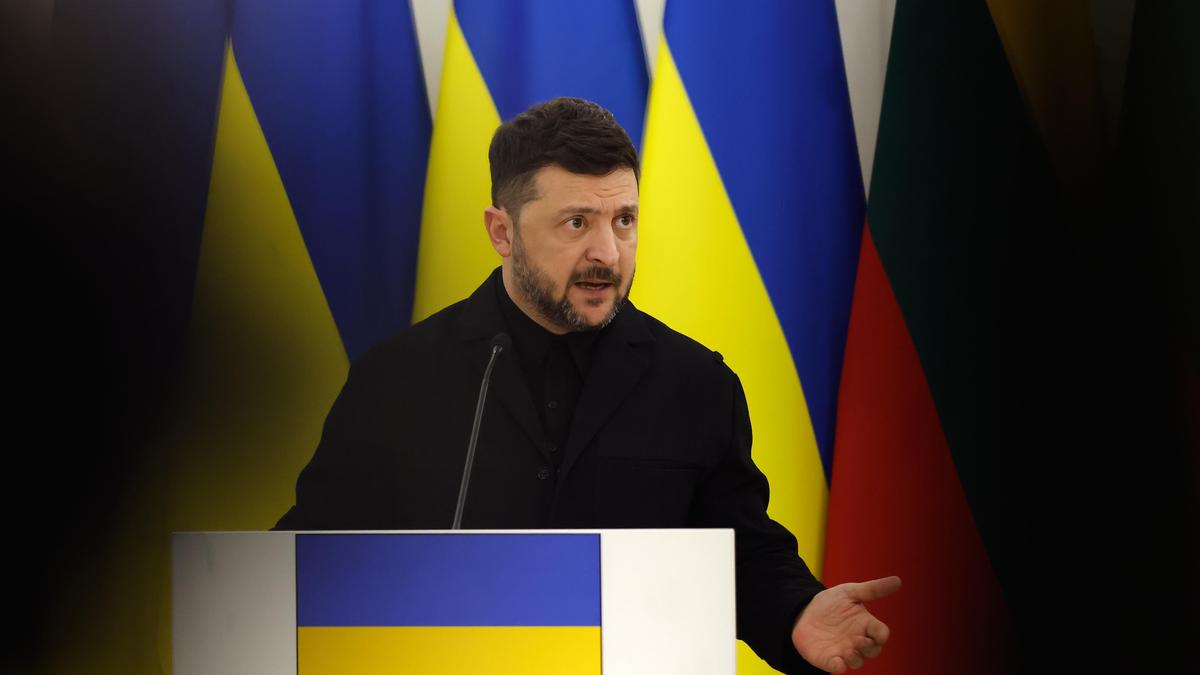
Ukrainian President Volodymyr Zelenskyy stated that a U.S. security agreement for Ukraine is "100% ready" to be signed.
GK and monthly revision
U.S. security agreement for Ukraine is '100% ready' to be signed, Zelenskyy says
Ukrainian President Volodymyr Zelenskyy announced that a security agreement with the U.S. is "100% ready" for signing, signaling strengthened bilateral defense ties. Concurrently, Ukraine is intensely pursuing European Union membership by 2027, viewing it as a crucial "economic security guarantee." These developments are vital for understanding Ukraine's geopolitical strategy and its integration into Western alliances, a key topic for international relations in competitive exams.
Revision structure
Monthly events and exam calendar context
Static GK and one-liner notes
Quiz and mock-test revision path
Key points
Exam-ready takeaways
Zelenskyy emphasized Ukraine's ongoing push for full European Union (EU) membership.
Ukraine's specific target year for achieving European Union membership is 2027.
President Zelenskyy described EU membership as an “economic security guarantee” for Ukraine.
The statements highlight Ukraine's dual strategy for stability through bilateral defense pacts and integration into European economic blocs.
Detailed analysis
Full exam-oriented breakdown
The announcement by Ukrainian President Volodymyr Zelenskyy that a U.S. security agreement is "100% ready" for signing, coupled with Ukraine's ambitious push for European Union (EU) membership by 2027 as an "economic security guarantee," marks a pivotal moment in the ongoing geopolitical realignments triggered by the conflict with Russia. These developments underscore Ukraine's resolute commitment to integrating with Western political, economic, and security structures, fundamentally reshaping the future of Eastern Europe and global international relations. **Background Context and Historical Trajectory:** Ukraine's journey towards closer ties with the West is rooted in its post-Soviet independence in 1991. Historically intertwined with Russia, Ukraine has grappled with its identity and geopolitical orientation. The early 2000s saw a growing divide, epitomized by the 2004 Orange Revolution, which challenged pro-Russian electoral fraud and signaled a desire for democratic reform and European integration. The pivotal moment arrived with the 2013-2014 Maidan Revolution (Revolution of Dignity), sparked by President Viktor Yanukovych's decision to reject an association agreement with the EU in favor of closer ties with Russia. This led to Yanukovych's ouster, followed swiftly by Russia's annexation of Crimea in March 2014 and the instigation of a separatist conflict in the Donbas region. These events dramatically escalated tensions, culminating in Russia's full-scale invasion of Ukraine in February 2022, a brutal act that galvanized Western support for Ukraine and accelerated its aspirations for EU and NATO membership. **The Dual Strategy: Security Pact and EU Membership:** President Zelenskyy's statement on the U.S. security agreement highlights Ukraine's immediate need for robust, long-term defense guarantees. These bilateral security pacts, initiated following the G7 Vilnius Declaration in July 2023, aim to provide Ukraine with sustained military aid, intelligence sharing, training, and defense industrial cooperation, ensuring its capacity to defend against future aggression. These agreements are crucial stop-gaps while Ukraine awaits potential NATO membership, a process complicated by the ongoing war. Simultaneously, Ukraine's intensified push for EU membership by 2027 is a strategic move to secure its long-term economic stability and democratic future. Zelenskyy's description of EU membership as an "economic security guarantee" is apt; it promises access to the EU's vast single market, structural funds, and the rule of law framework, which are vital for post-war reconstruction and sustainable development. While the EU granted Ukraine candidate status in June 2022, the path to full membership is arduous, requiring extensive reforms in governance, judiciary, economy, and anti-corruption measures to align with the stringent *acquis communautaire*. **Key Stakeholders and Their Motivations:** 1. **Ukraine:** Seeks to preserve its sovereignty, territorial integrity, and democratic values, ensuring its security and economic prosperity through integration with Western institutions. 2. **United States:** Aims to uphold the international rules-based order, deter Russian expansionism, strengthen transatlantic alliances, and reinforce its global leadership role by supporting Ukraine's defense and reconstruction. 3. **European Union:** Driven by a desire to expand its zone of peace, stability, and democratic values, secure its eastern flank, and demonstrate its commitment to European solidarity. However, the process also presents challenges related to absorption capacity, institutional reforms, and financial burdens. 4. **Russia:** Views Ukraine's westward integration, especially potential NATO membership, as an existential security threat, aiming to prevent it from escaping its sphere of influence and challenge the existing post-Cold War security architecture. **Significance for India:** For India, these developments carry profound implications across strategic, economic, and diplomatic fronts. India has maintained a nuanced stance on the Russia-Ukraine conflict, advocating for peaceful resolution, respect for international law, and sovereignty, while refraining from directly condemning Russia. This reflects India's foreign policy of **strategic autonomy**, balancing its historical defense and energy ties with Russia with its growing strategic partnership with the U.S. and other Western powers. Economically, the conflict has exacerbated global inflation, particularly in energy and food prices, impacting India's import bill and food security. India's reliance on Russian military hardware necessitates careful navigation of Western sanctions, prompting a push for defense indigenization and diversification of imports. Diplomatically, India has leveraged its position to engage with both sides, as seen in Prime Minister Modi's calls for dialogue. The reshaping of the global order, with a more assertive Russia and a strengthened Western bloc, necessitates India to adapt its foreign policy to protect its interests and enhance its influence in a multipolar world. **Related Constitutional Articles and Policies (India):** While direct Indian constitutional articles on Ukraine's foreign policy are not applicable, India's approach is guided by its **Directive Principles of State Policy**, specifically **Article 51**, which mandates the State to: (a) promote international peace and security; (b) maintain just and honourable relations between nations; (c) foster respect for international law and treaty obligations; and (d) encourage settlement of international disputes by arbitration. This article forms the bedrock of India's commitment to a rules-based international order and its advocacy for peaceful resolution. India's evolving policy of 'multi-alignment' or 'issue-based alignment' allows it to engage with various blocs based on its national interests, rather than ideological commitments, which is evident in its handling of the Ukraine crisis. **Future Implications:** The signing of the U.S. security pact will solidify Ukraine's defense capabilities and deepen its alignment with the West, potentially leading to a more prolonged and entrenched conflict with Russia. Ukraine's EU membership by 2027, if achieved, would represent a significant expansion of the EU's geopolitical footprint and a historic shift in the European security landscape. It would also necessitate considerable internal reforms within the EU to accommodate a large, war-torn nation. For global geopolitics, these moves signify a hardening of the divide between Russia and the West, potentially leading to new security architectures and alliances. India will need to continue its pragmatic foreign policy, balancing its relationships to secure its economic growth and strategic interests amidst this evolving global order. The long-term implications include a re-evaluation of international security norms, the role of international organizations, and the prospects for global peace and stability.
How to study
Turn news into exam marks
Revise monthly events by exam family instead of reading random updates.
Pair one-liners with mock tests so mistakes become the next revision list.
Keep state job pages, calendar pages and GK packs connected in one path.