

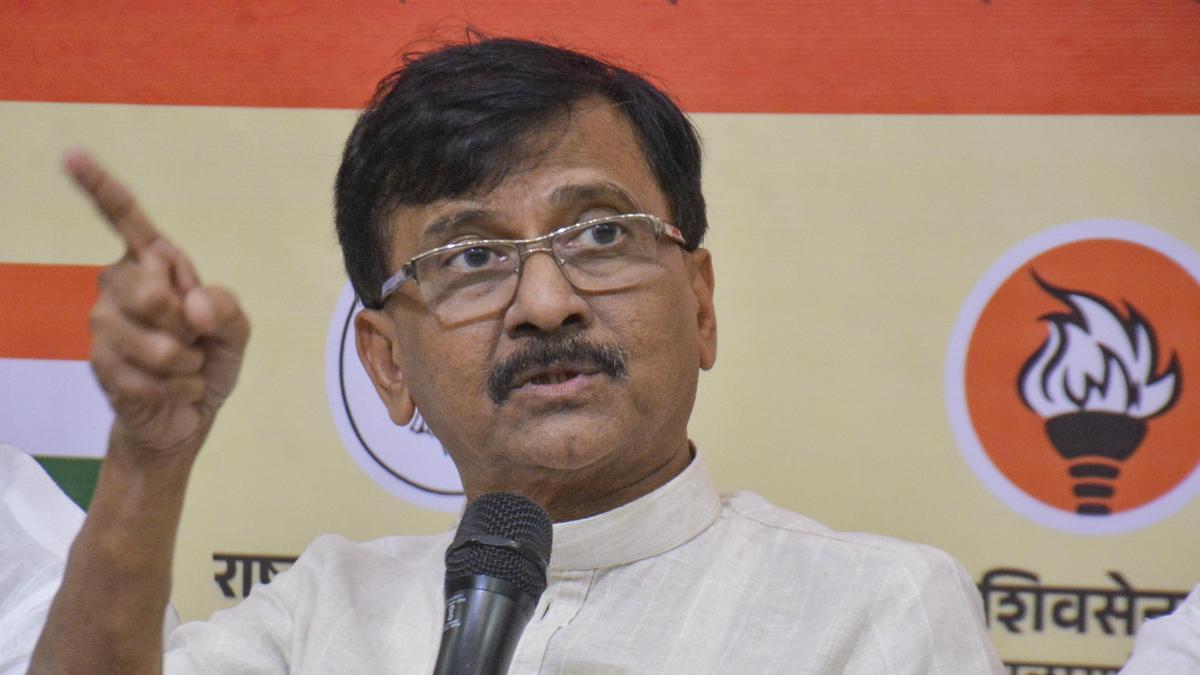
Rajya Sabha MP Sanjay Raut criticized the conferment of the Padma Bhushan award upon former Maharashtra Governor Bhagat Singh Koshyari.
GK and monthly revision
Raut slams Padma Bhushan honour for Koshyari, accuses him of toppling Uddhav govt.
Rajya Sabha MP Sanjay Raut criticized the Padma Bhushan honour for former Maharashtra Governor Bhagat Singh Koshyari. Raut accused Koshyari of illegally toppling the Uddhav Thackeray government, citing a Supreme Court observation regarding Koshyari's actions during his tenure. This event is significant for competitive exams as it highlights the constitutional role and discretionary powers of the Governor, a frequently tested topic in Indian Polity and current affairs.
Revision structure
Monthly events and exam calendar context
Static GK and one-liner notes
Quiz and mock-test revision path
Key points
Exam-ready takeaways
Raut accused Bhagat Singh Koshyari of illegally toppling the Uddhav Thackeray-led government in Maharashtra.
The Padma Bhushan is India's third-highest civilian award, conferred by the President of India.
Sanjay Raut referenced a Supreme Court observation that stated Koshyari acted illegally during his tenure as Governor.
The controversy underscores the constitutional role and discretionary powers of the Governor, a key topic for Indian Polity.
Detailed analysis
Full exam-oriented breakdown
The recent controversy surrounding the Padma Bhushan award to former Maharashtra Governor Bhagat Singh Koshyari, criticized by Rajya Sabha MP Sanjay Raut, brings into sharp focus the contentious role of the Governor in India's federal structure. This incident is not merely about a civilian award; it delves deep into the constitutional powers, political ethics, and the delicate balance of power between the Centre and states, making it a crucial topic for competitive exam aspirants. **Background Context: The Maharashtra Political Crisis of 2022** To understand the gravity of Raut's accusation, one must recall the tumultuous political events in Maharashtra in June 2022. The state was governed by the Maha Vikas Aghadi (MVA) coalition, comprising the Shiv Sena (Uddhav Thackeray faction), Nationalist Congress Party (NCP), and Indian National Congress. This coalition had formed the government in November 2019 after the original Shiv Sena-BJP alliance fractured post-assembly elections. In June 2022, a rebellion led by Shiv Sena leader Eknath Shinde, supported by a significant number of Shiv Sena MLAs, destabilized the MVA government. The rebel MLAs moved to Surat and then Guwahati, effectively reducing the MVA's legislative strength. **What Happened: Governor's Actions and the Supreme Court's View** Amidst the political turmoil, Governor Bhagat Singh Koshyari played a pivotal role. He asked then-Chief Minister Uddhav Thackeray to prove his majority on the floor of the Assembly, setting a deadline for a trust vote. This move was seen by many as politically motivated, designed to favor the rebel faction and the opposition BJP. Uddhav Thackeray, facing an imminent loss of majority and feeling the Governor's actions were unconstitutional, resigned as Chief Minister on June 29, 2022, before the scheduled floor test. Subsequently, Eknath Shinde, with the support of the BJP, formed the new government, becoming the Chief Minister. The matter eventually reached the Supreme Court. In its May 2023 judgment, while it could not restore the Uddhav Thackeray government due to his resignation, the Court made strong observations regarding Governor Koshyari's actions. The Supreme Court stated that the Governor was not justified in calling for a floor test based on the request of the Eknath Shinde faction, as there was no objective material to doubt the confidence of the then-incumbent government. The Court noted that the Governor's decision to call for a floor test was based on the premise that a faction of the Shiv Sena had withdrawn support, which was not the case under the Tenth Schedule (Anti-defection Law). The Court also highlighted that the Speaker (and implicitly the Governor) should not enter the political arena. **Key Stakeholders Involved:** 1. **Bhagat Singh Koshyari:** Former Governor of Maharashtra, whose actions during the political crisis are under scrutiny. His conferment of the Padma Bhushan, India's third-highest civilian award (established in 1954), sparked the controversy. 2. **Sanjay Raut:** Rajya Sabha MP from the Shiv Sena (Uddhav Balasaheb Thackeray) faction, a vocal critic of Koshyari's role and the recipient of the award. 3. **Uddhav Thackeray:** Former Chief Minister of Maharashtra, whose government was toppled. 4. **Eknath Shinde:** Leader of the rebel Shiv Sena faction and current Chief Minister of Maharashtra. 5. **Supreme Court of India:** The apex judicial body whose observations form the basis of Raut's criticism, underscoring its role as the guardian of the Constitution. **Why This Matters for India: Significance and Constitutional Connections** This episode is profoundly significant for Indian polity. It underscores the perennial debate over the **role and discretionary powers of the Governor** (Articles 153, 154, 163, 164). The Governor, appointed by the President (Article 155), acts as a vital link between the Union and State governments but is often accused of acting as an agent of the Centre, especially when different political parties govern at the Centre and in the State. The Supreme Court's observations reiterate the need for the Governor to act impartially and within constitutional bounds, rather than as a political player. This incident also highlights challenges to **federalism** and **Centre-state relations**. Allegations of Governors facilitating the downfall of state governments erode trust and can destabilize democratically elected state administrations. It also touches upon the **anti-defection law (Tenth Schedule)**, as the defection of MLAs was central to the crisis, and the Speaker's role in adjudicating such matters. The controversy around the Padma Bhushan brings into question the criteria for such high civilian honors, especially when the recipient's actions have faced judicial censure. **Historical Context and Future Implications** The office of Governor has a long history of controversies. Landmark judgments like the **S.R. Bommai v. Union of India (1994)** case significantly curtailed the arbitrary use of Article 356 (President's Rule) and emphasized that the majority of a government must be tested on the floor of the House. Commissions like the **Sarkaria Commission (1983)** and the **Punchhi Commission (2007)** have also made extensive recommendations to streamline the Governor's powers and ensure impartiality. Despite these recommendations and judicial pronouncements, the issue resurfaces, indicating a persistent institutional challenge. In the future, such incidents might lead to renewed calls for constitutional amendments or clearer guidelines regarding the Governor's discretionary powers, particularly concerning floor tests and government formation. It also sets a precedent for how civilian awards are perceived in the public eye, especially when the recipients have been involved in politically charged controversies. For aspirants, understanding this complex interplay of constitutional provisions, judicial pronouncements, and political realities is paramount for a holistic grasp of Indian governance.
How to study
Turn news into exam marks
Revise monthly events by exam family instead of reading random updates.
Pair one-liners with mock tests so mistakes become the next revision list.
Keep state job pages, calendar pages and GK packs connected in one path.