

The pro-military party that declared victory in Myanmar's junta-run polls is the Union Solidarity and Development Party (USDP).
GK and monthly revision
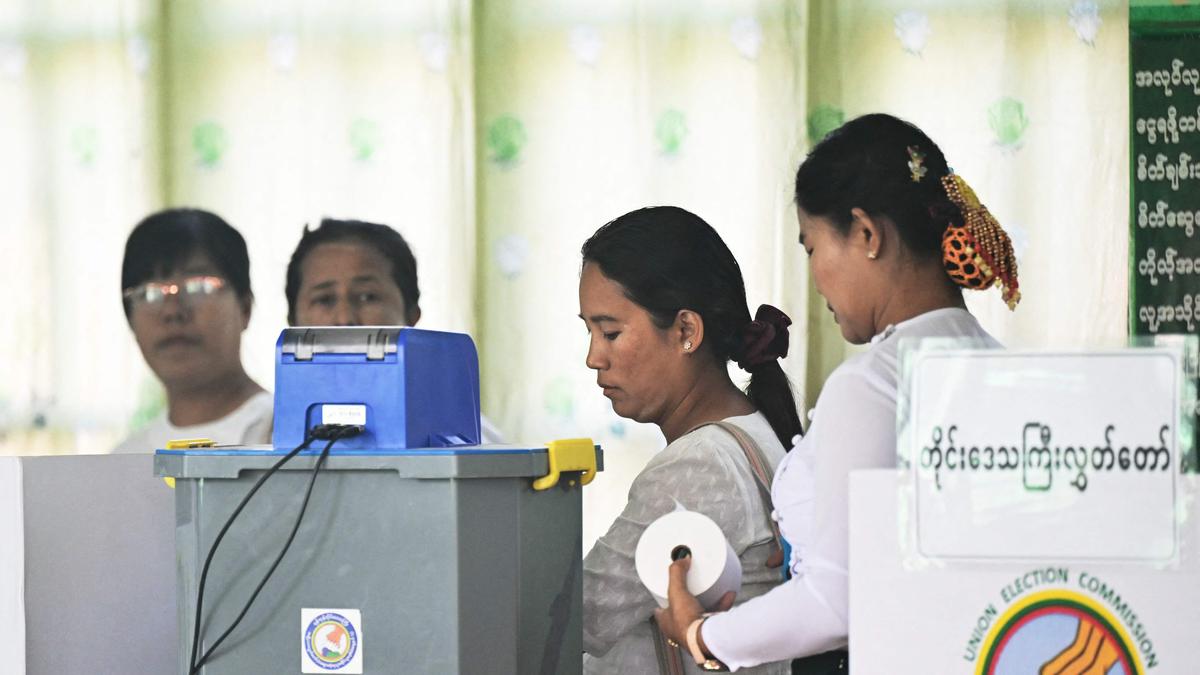
Myanmar pro-military party declares victory in junta-run polls
Myanmar's pro-military Union Solidarity and Development Party (USDP) declared victory in recently held junta-run polls. This move is largely viewed as an attempt by the military, which seized power in a February 2021 coup, to legitimize its control and formalize its rule. This development is significant for understanding the geopolitical dynamics in Southeast Asia and its potential implications for regional stability and India's foreign policy, making it relevant for competitive exam preparation.
Revision structure
Monthly events and exam calendar context
Static GK and one-liner notes
Quiz and mock-test revision path
Key points
Exam-ready takeaways
The Union Solidarity and Development Party (USDP) is widely considered a civilian proxy of the Myanmar military.
The military seized power in Myanmar through a coup d'état in February 2021.
The recent polls were conducted under the administration of the military junta in Myanmar.
This victory aims to formalize and legitimize the military's control over the government following the 2021 coup.
Detailed analysis
Full exam-oriented breakdown
The recent declaration of victory by the pro-military Union Solidarity and Development Party (USDP) in Myanmar's junta-run polls marks a critical juncture in the country's tumultuous political landscape. This development is not merely an internal affair but holds profound implications for regional stability and India's strategic interests, making it a crucial topic for competitive exam aspirants. **The Backdrop: Myanmar's Fragile Democratic Experiment** To understand the current situation, one must look at Myanmar's history of military rule. For nearly five decades, from 1962 to 2011, Myanmar (formerly Burma) was governed by successive military juntas. A roadmap to 'disciplined democracy' began with the adoption of a military-drafted constitution in 2008, which reserved 25% of parliamentary seats for unelected military personnel and gave the Tatmadaw (Myanmar Armed Forces) significant veto power. The 2010 elections, widely boycotted and deemed unfair, brought the USDP – essentially a military proxy – to power. However, a significant shift occurred in 2015 when the National League for Democracy (NLD), led by Nobel laureate Aung San Suu Kyi, swept the elections, signaling a strong public desire for democracy. The NLD's landslide victory in 2020 further solidified its mandate, winning 82% of the vote. **The 2021 Coup and its Aftermath** This democratic momentum was brutally interrupted on February 1, 2021, when the Tatmadaw, under Commander-in-Chief Min Aung Hlaing, staged a coup d'état. The military cited unsubstantiated claims of widespread voter fraud in the 2020 elections as its justification, despite independent observers finding no significant irregularities. Aung San Suu Kyi and other NLD leaders were arrested, and a state of emergency was declared. The coup triggered widespread peaceful protests across the country, which were met with brutal force by the military, leading to thousands of deaths, arrests, and a severe humanitarian crisis. This crackdown also fueled the emergence of armed resistance groups, including the People's Defence Force (PDF), aligned with the National Unity Government (NUG), formed by deposed NLD lawmakers and ethnic minority representatives. **The Junta-run Polls and USDP's 'Victory'** Against this backdrop of widespread civil disobedience and armed conflict, the military junta proceeded with its plan to hold fresh elections. The recent polls, conducted under the military's administration, are widely seen as a cynical attempt to legitimize its control and formalize its rule, which was seized unconstitutionally. The USDP's declaration of victory in these polls is hardly surprising, given the severe restrictions on opposition parties, the suppression of dissent, and the lack of independent oversight. Most international bodies and democratic nations are unlikely to recognize the legitimacy of these elections, viewing them as a sham designed to entrench military power and sideline the democratically elected NLD. **Key Stakeholders and Their Motives** * **Tatmadaw (Myanmar Military):** Driven by a deep-seated belief in its right to rule, a desire to maintain its substantial economic interests, and a fear of losing its constitutionally guaranteed powers. The military views itself as the sole guardian of national unity and stability. * **Union Solidarity and Development Party (USDP):** Functions as the political arm of the military, designed to provide a civilian façade for military governance. Its primary objective is to facilitate and legitimize military control. * **National League for Democracy (NLD) & Aung San Suu Kyi:** Represent the democratic aspirations of the Myanmar people. Their electoral victories demonstrate popular support for civilian rule, but they are currently suppressed and their leaders imprisoned. * **Civilian Population & Opposition (NUG, PDF):** A significant portion of the population actively resists military rule through peaceful protests and, increasingly, armed resistance. They seek the restoration of democracy and federalism. * **ASEAN:** The regional bloc has struggled to formulate a coherent and effective response, adhering to its principle of non-interference while facing pressure to address the crisis. Its 'Five-Point Consensus' has largely failed to achieve its objectives. * **China:** Myanmar's largest neighbor and key economic partner, China maintains a pragmatic approach, engaging with the junta while also having ties with ethnic armed groups. Its primary interest is stability along its border and safeguarding its investments. * **India:** Shares a long land and maritime border with Myanmar and has significant strategic and security interests. **Significance for India** Myanmar's instability directly impacts India's **"Act East Policy"**, which aims to enhance economic and strategic ties with Southeast Asian nations. The Kaladan Multi-Modal Transit Transport Project, a key connectivity initiative, runs through Myanmar and is crucial for linking India's landlocked Northeast with the Bay of Bengal. Instability in Myanmar threatens the project's progress and viability. From a **security perspective**, the porous border with Myanmar is a major concern. It is a known route for insurgency groups operating in India's Northeast, drug trafficking (Golden Triangle), and arms smuggling. A chaotic Myanmar could exacerbate these cross-border challenges, leading to increased radicalization and security threats. The refugee crisis is another pressing issue; India has already witnessed an influx of Chin refugees fleeing persecution, adding pressure on border states like Mizoram. **Diplomatically**, India faces a delicate balancing act. While a proponent of democracy globally, India also prioritizes its strategic interests, including counter-balancing China's influence and ensuring border security. India has historically maintained engagement with both democratic and military regimes in Myanmar. This approach is guided by pragmatic considerations, but also draws criticism for potentially undermining democratic values. There are no direct Indian constitutional articles related to a foreign country's internal politics, but India's foreign policy is guided by principles enshrined in the Preamble (justice, liberty, equality, fraternity) and Directive Principles of State Policy (Article 51: promotion of international peace and security, maintenance of just and honorable relations between nations, respect for international law). **Future Implications** The 'victory' of the USDP is unlikely to bring stability. Instead, it is expected to further entrench military rule, deepen the conflict, and prolong the humanitarian crisis. The international community, particularly Western nations, will likely increase sanctions and diplomatic pressure. ASEAN's credibility as a regional body will continue to be tested. For India, the challenge will be to navigate this complex scenario, balancing its strategic imperative for a stable, cooperative neighbor with its commitment to democratic principles. The ongoing civil war could escalate, leading to greater displacement and regional instability, forcing India to re-evaluate its engagement strategies and potentially increasing its security burden.
How to study
Turn news into exam marks
Revise monthly events by exam family instead of reading random updates.
Pair one-liners with mock tests so mistakes become the next revision list.
Keep state job pages, calendar pages and GK packs connected in one path.