

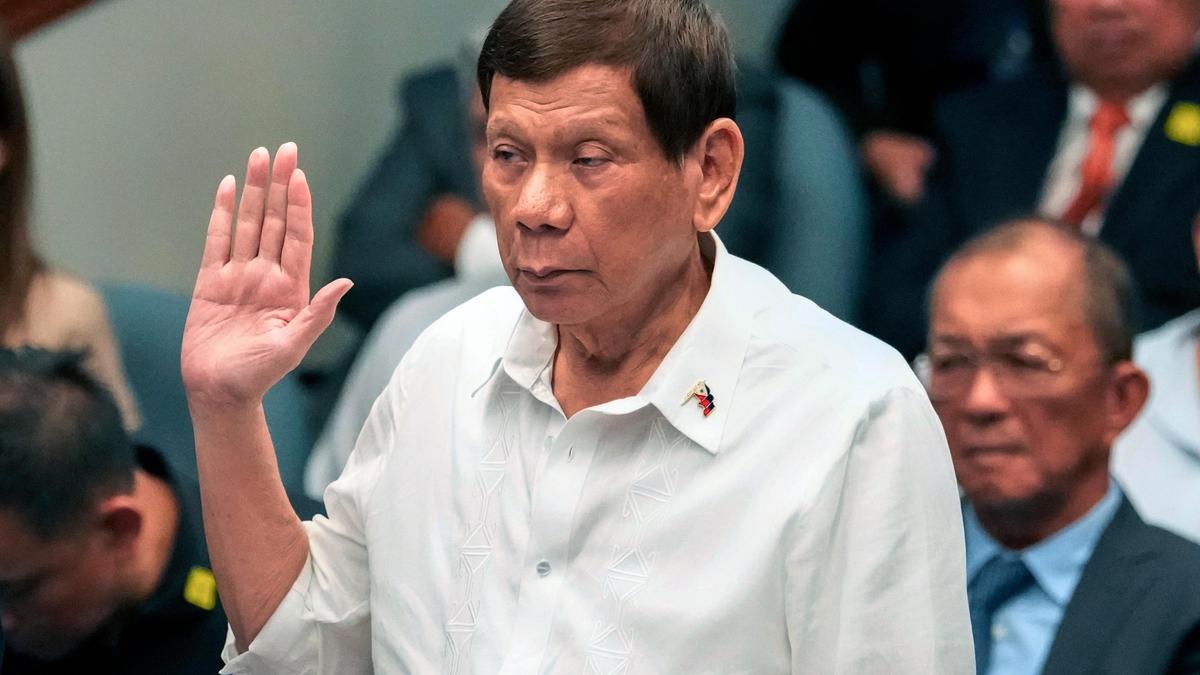
Former Philippines President Rodrigo Duterte was declared fit for legal proceedings.
GK and monthly revision
Former Philippines President Duterte fit for pre-trial hearings, ICC judges rule
Former Philippines President Rodrigo Duterte has been declared fit by International Criminal Court (ICC) judges to participate in pre-trial hearings. This ruling, based on independent medical expert reports, is significant as it allows the legal proceedings against a former head of state to move forward. For competitive exams, this highlights the role of international judicial bodies like the ICC and the principle of accountability for leaders in international law.
Revision structure
Monthly events and exam calendar context
Static GK and one-liner notes
Quiz and mock-test revision path
Key points
Exam-ready takeaways
The ruling was made by judges of the International Criminal Court (ICC).
Duterte was deemed fit to participate in pre-trial hearings.
The decision was based on a report submitted by independent medical experts.
This allows him to understand and participate in his case before the ICC.
Detailed analysis
Full exam-oriented breakdown
The ruling by International Criminal Court (ICC) judges declaring former Philippines President Rodrigo Duterte fit for pre-trial hearings marks a pivotal moment in the pursuit of international justice and accountability for alleged human rights abuses. This development, based on a report by independent medical experts, signals the ICC's determination to proceed with its investigation into the 'war on drugs' campaign under Duterte's presidency. **Background Context and What Happened:** Rodrigo Duterte served as President of the Philippines from June 30, 2016, to June 30, 2022. During his tenure, he launched a brutal campaign against illegal drugs, which became notoriously known as the 'war on drugs.' This campaign led to thousands of deaths, many of which were attributed to extrajudicial killings by police and vigilante groups. Human rights organizations and international bodies raised serious concerns, alleging widespread abuses and crimes against humanity. In February 2018, the ICC's then-Prosecutor, Fatou Bensouda, initiated a preliminary examination into the situation in the Philippines. This escalated to a formal investigation in September 2021, focusing on alleged crimes against humanity committed between July 1, 2016, and March 16, 2019, the date the Philippines’ withdrawal from the Rome Statute became effective. Despite the withdrawal, the ICC retains jurisdiction over crimes committed while the Philippines was a State Party to the Rome Statute. The latest development, announced recently, confirms that independent medical experts have assessed Duterte and found him capable of understanding and participating in his case, clearing a crucial procedural hurdle for the pre-trial hearings to advance. **Key Stakeholders Involved:** 1. **Rodrigo Duterte:** The central figure, accused of orchestrating or being responsible for alleged crimes against humanity during his presidency. His fitness to participate is crucial for the fairness of any proceedings. 2. **International Criminal Court (ICC):** Established by the Rome Statute in 1998 (entered into force in 2002), the ICC is an independent international judicial body with jurisdiction to prosecute individuals for the most serious international crimes: genocide, war crimes, crimes against humanity, and the crime of aggression. The ICC's Prosecutor initiates investigations, and the Pre-Trial Chamber oversees the initial stages of a case. 3. **Victims and their Families:** Thousands of individuals and families in the Philippines who suffered losses during the 'war on drugs' are key stakeholders. They seek justice and accountability for the alleged atrocities committed. 4. **The Government of the Philippines:** While the Duterte administration withdrew from the ICC, the current Marcos Jr. administration has also indicated it will not cooperate with the ICC's investigation, citing sovereignty concerns. This non-cooperation poses a significant challenge to the ICC's ability to conduct its work on the ground and secure potential arrests. 5. **Independent Medical Experts:** Their impartial assessment of Duterte's mental and physical fitness is fundamental to ensuring due process and the legitimacy of the legal proceedings. **Why This Matters for India & Historical Context:** For India, this case, while geographically distant, holds significant implications in understanding the broader landscape of international law and accountability. India is not a signatory to the Rome Statute and therefore not a member of the ICC. This stance is rooted in several factors, including concerns over national sovereignty, potential for politically motivated prosecutions, and issues with the definition of certain crimes within the Statute. India's foreign policy often emphasizes non-interference in the internal affairs of sovereign states, while also advocating for human rights and the rule of law globally. This case highlights the tension between these principles: the pursuit of international justice versus the assertion of national sovereignty. From a constitutional perspective, India's approach to international law is guided by **Article 51** of the Directive Principles of State Policy, which mandates the State to 'foster respect for international law and treaty obligations in the dealings of organised peoples with one another.' While not directly binding India to the ICC, it underscores India's general commitment to the international legal order. Historically, the concept of international criminal justice evolved significantly after World War II with the Nuremberg and Tokyo Trials, leading to the establishment of ad-hoc tribunals (like for Yugoslavia and Rwanda) and eventually the permanent ICC. The challenge of prosecuting former heads of state, often shielded by sovereign immunity, is a recurring theme, which the ICC aims to overcome for the most egregious crimes. **Future Implications:** The ruling allows the ICC's Pre-Trial Chamber to continue its work, which could eventually lead to an indictment and a full trial. However, significant hurdles remain. The primary challenge will be securing Duterte's cooperation or his physical transfer to The Hague, given the Philippines' non-cooperation stance. This situation tests the limits of the ICC's enforcement mechanisms, which rely heavily on state cooperation. The outcome of this case could set a crucial precedent for how international bodies hold powerful leaders accountable, especially those from non-member states where crimes were committed while they were signatories. It will also influence the ICC's legitimacy and effectiveness on the global stage, particularly in its ongoing efforts to address impunity for mass atrocities. Success in this case could strengthen the international legal framework for human rights, while failure to secure accountability might embolden other leaders to disregard international norms.
How to study
Turn news into exam marks
Revise monthly events by exam family instead of reading random updates.
Pair one-liners with mock tests so mistakes become the next revision list.
Keep state job pages, calendar pages and GK packs connected in one path.