

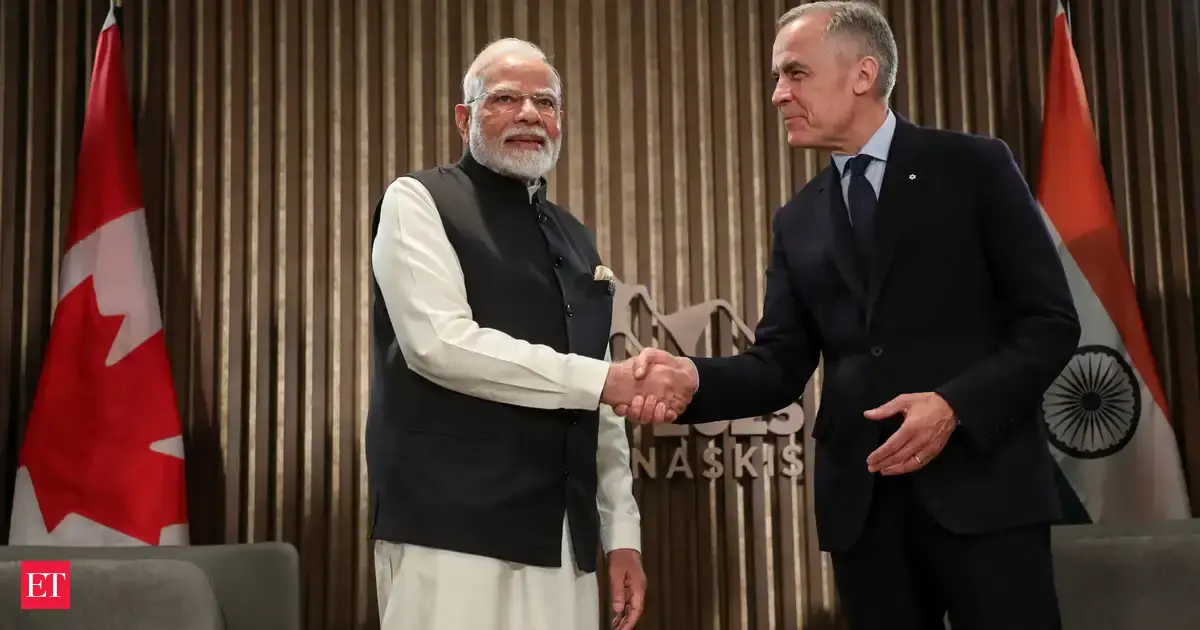
Canada's Prime Minister Mark Carney is likely to visit India in the first week of March.
GK and monthly revision
Canada's PM Carney likely to visit India in early March; C$2.8 bn uranium supply deal on cards
Canada's Prime Minister Mark Carney is expected to visit India in the first week of March to sign multiple agreements. A key focus will be a C$2.8 billion uranium supply deal, alongside cooperation in energy, critical minerals, artificial intelligence, and quantum computing. This visit aims to bolster strategic bilateral ties and economic collaboration, crucial for India's energy security and technological advancement.
Revision structure
Monthly events and exam calendar context
Static GK and one-liner notes
Quiz and mock-test revision path
Key points
Exam-ready takeaways
The visit is expected to finalize a C$2.8 billion uranium supply deal between Canada and India.
Multiple agreements covering energy, critical minerals, artificial intelligence, and quantum computing are on cards.
The information was provided by India’s High Commissioner to Canada, Dinesh Patnaik.
The visit signifies strengthening bilateral cooperation in strategic sectors like nuclear energy and advanced technology.
Detailed analysis
Full exam-oriented breakdown
The impending visit of Canadian Prime Minister Mark Carney to India in early March, with a significant C$2.8 billion uranium supply deal on the agenda, marks a crucial juncture in India-Canada bilateral relations. This visit, as highlighted by India’s High Commissioner to Canada, Dinesh Patnaik, signifies a deepening of strategic cooperation beyond traditional economic ties, encompassing critical areas like energy, critical minerals, artificial intelligence (AI), and quantum computing. **Background Context and Historical Threads:** India and Canada share a complex yet evolving relationship, particularly in the nuclear domain. Canada was a key partner in India's nascent nuclear program in the 1950s and 60s, supplying the CIRUS research reactor, which played a role in India's first peaceful nuclear explosion (PNE), 'Smiling Buddha,' in 1974. This event led to a significant rupture in nuclear cooperation, with Canada imposing sanctions and suspending all nuclear assistance, citing concerns over the dual-use nature of technology. For decades, this cast a shadow over their relationship. However, the landscape began to shift after the 2008 India-US Civil Nuclear Agreement, which effectively brought India into the global nuclear fold despite not being a signatory to the Nuclear Non-Proliferation Treaty (NPT). This agreement, combined with an Additional Protocol with the International Atomic Energy Agency (IAEA), allowed India to resume civil nuclear cooperation with several countries, including Canada. A landmark C$350 million uranium supply deal was signed between India and Canada's Cameco Corporation in 2015, marking a full circle in their nuclear relationship and paving the way for the current proposed agreement. **What's Happening Now and Key Stakeholders:** Prime Minister Carney's visit is poised to solidify these renewed ties. The proposed C$2.8 billion uranium supply deal is central, demonstrating Canada's commitment to being a reliable energy partner for India. Beyond nuclear fuel, the agenda includes agreements on energy diversification, securing critical minerals—essential for high-tech industries and green technologies—and collaboration in cutting-edge fields like AI and quantum computing. Key stakeholders include the **Government of India** (Ministry of External Affairs, Department of Atomic Energy, Ministry of Commerce & Industry) and the **Government of Canada** (Prime Minister's Office, Global Affairs Canada). For the uranium deal, India's **Nuclear Power Corporation of India Limited (NPCIL)** will be the primary beneficiary, while Canada's **Cameco Corporation** is a likely supplier. India's High Commissioner Dinesh Patnaik plays a vital role in facilitating these diplomatic and economic engagements. **Significance for India:** This multi-faceted cooperation holds immense significance for India. The uranium supply deal directly addresses India's burgeoning **energy security** needs. With ambitious targets to expand its nuclear power capacity as part of its clean energy transition and commitment to achieve Net Zero emissions by 2070, a consistent and diversified supply of uranium is paramount. Nuclear energy is a stable, baseload power source crucial for reducing reliance on fossil fuels. Furthermore, cooperation on **critical minerals** is vital for India's strategic autonomy and economic growth. These minerals (e.g., lithium, cobalt, rare earths) are indispensable for manufacturing electric vehicles, solar panels, semiconductors, and defence equipment. Securing a stable supply chain from a trusted partner like Canada reduces geopolitical risks. Collaboration in **AI and quantum computing** positions India at the forefront of technological innovation, fostering research, development, and talent exchange, which are critical for India's digital economy and national security. Politically, strengthening ties with a G7 nation like Canada enhances India's global standing and diplomatic influence. **Constitutional and Policy Relevance:** India's **Atomic Energy Act, 1962**, provides the legal framework for the development, control, and use of atomic energy for peaceful purposes, making such international deals legally permissible. India's broader **foreign policy** objectives, centered on strategic autonomy and multi-alignment, are reflected in its outreach to diverse partners for energy and technology needs. The emphasis on clean energy aligns with India's **Nationally Determined Contributions (NDCs)** under the Paris Agreement, where nuclear power is a key component of decarbonization strategies. The push for critical minerals aligns with India's evolving **Critical Minerals Policy**, aimed at building robust domestic supply chains and international partnerships to secure these vital resources. **Future Implications:** The visit is expected to pave the way for a more robust and diversified strategic partnership. It will likely lead to increased bilateral trade and investment, particularly in clean energy, mining, and high-tech sectors. For India, it signifies a step towards greater energy independence and technological leadership. The agreements could establish precedents for future collaborations with other developed nations in sensitive technological domains. This enduring partnership with Canada underscores India's proactive approach to diversifying its strategic dependencies and strengthening its position as a responsible global power, committed to sustainable development and technological advancement.
How to study
Turn news into exam marks
Revise monthly events by exam family instead of reading random updates.
Pair one-liners with mock tests so mistakes become the next revision list.
Keep state job pages, calendar pages and GK packs connected in one path.