

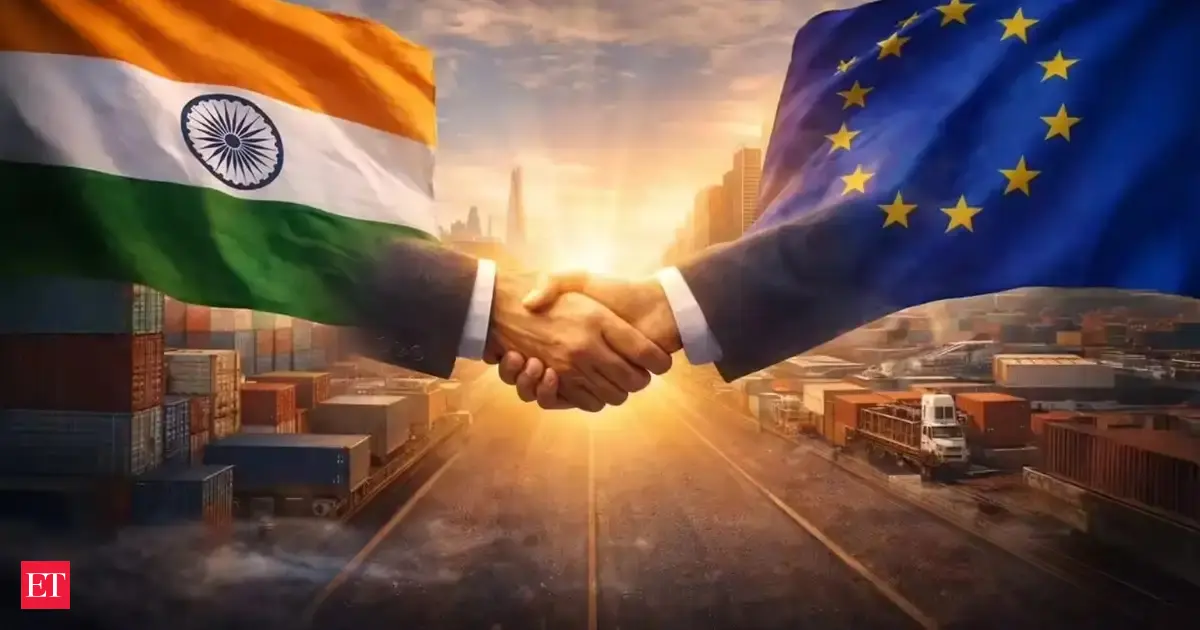
India and the European Union (EU) are set to finalize a major Free Trade Agreement (FTA).
GK and monthly revision
All roads lead to a deal as India and EU gear up for FTA finale
India and the European Union are poised to finalize a significant Free Trade Agreement (FTA), alongside a strategic defence pact and a mobility framework. This summit, hosted by Prime Minister Narendra Modi, aims to forge a market of two billion people, deepening bilateral ties across economic and strategic sectors. This development is crucial for understanding India's foreign policy, trade relations, and economic integration for competitive exams.
Revision structure
Monthly events and exam calendar context
Static GK and one-liner notes
Quiz and mock-test revision path
Key points
Exam-ready takeaways
Key outcomes expected from the summit also include a strategic defence pact and a mobility framework.
Prime Minister Narendra Modi will host European leaders for the finalisation of these agreements.
The agreement is projected to create a combined market of two billion people.
The primary objective is to deepen bilateral ties between India and the EU across various sectors.
Detailed analysis
Full exam-oriented breakdown
The impending finalization of the Free Trade Agreement (FTA) between India and the European Union (EU), alongside a strategic defence pact and a mobility framework, marks a pivotal moment in India's foreign policy and economic trajectory. This development, poised to create a formidable market of two billion people, signifies a deepening of bilateral ties and holds profound implications for India's economic growth, geopolitical standing, and strategic autonomy. **Background Context and Historical Trajectory:** India and the EU, representing two of the world's largest economies and democracies, have historically shared a robust, albeit complex, relationship. The idea of a comprehensive trade agreement, initially dubbed the Broad-based Trade and Investment Agreement (BTIA), dates back to 2007. Negotiations for the BTIA commenced with great optimism, aiming to liberalize trade in goods, services, and investment. However, these talks stalled in 2013 due to significant differences on key issues. The EU pressed for deeper tariff cuts, greater market access in sectors like automobiles and wines, and stringent intellectual property rights enforcement, while India sought concessions on services mobility, data security status, and resolution of non-tariff barriers affecting its agricultural and pharmaceutical exports. The inability to bridge these gaps led to a decade-long hiatus. The resumption of negotiations in June 2022, after a gap of nine years, was spurred by a confluence of geopolitical and economic factors. The COVID-19 pandemic exposed vulnerabilities in global supply chains, prompting nations to diversify trade partners. Russia's invasion of Ukraine further accelerated the need for strategic realignment and energy security, pushing the EU to look beyond traditional partners. For India, the desire to boost manufacturing through its 'Make in India' initiative and Production Linked Incentive (PLI) schemes, coupled with a strategic imperative to expand its economic footprint and reduce over-reliance on certain markets, made the EU a crucial partner. Both sides recognized the immense untapped potential in their economic relationship; the EU is India's third-largest trading partner (after the US and China) and a significant source of Foreign Direct Investment (FDI). **What's Happening and Key Stakeholders:** The current summit, hosted by Prime Minister Narendra Modi, is expected to finalize not just the Comprehensive FTA, but also a strategic defence pact and a mobility framework. The FTA aims to reduce tariffs, eliminate non-tariff barriers, and promote trade in goods, services, and investment. The defence pact could involve cooperation in defence technology, co-production, and joint exercises, enhancing India's defence manufacturing capabilities and strategic independence. The mobility framework is crucial for facilitating the movement of skilled professionals, students, and workers between India and EU member states, addressing a long-standing Indian demand for easier visa norms and mutual recognition of qualifications. Key stakeholders include the Government of India (Ministry of Commerce and Industry, Ministry of External Affairs), Indian businesses (especially in textiles, pharmaceuticals, IT services, and agriculture), Indian consumers, and the European Commission (the EU's executive arm) representing its 27 member states, European businesses, and consumers. **Significance for India:** This multi-faceted agreement holds immense significance for India. Economically, the FTA will provide Indian goods and services with greater access to a vast, high-income market, potentially boosting exports in sectors like textiles, leather, gems and jewellery, pharmaceuticals, and IT services. This aligns perfectly with India's ambition to become a global manufacturing hub and a $5 trillion economy. Increased FDI from the EU will bring capital, technology, and best practices, fostering innovation and job creation. While opening up the Indian market to EU products will increase competition for domestic industries, it is expected to drive efficiency and quality improvements, ultimately benefiting Indian consumers through wider choices and potentially lower prices. Strategically, the defence pact diversifies India's defence procurement base, reducing its historical dependence on a few countries and facilitating technology transfer. This bolsters India's 'Atmanirbhar Bharat' (self-reliant India) vision in defence. Politically, closer ties with the EU, a bloc committed to rules-based international order, strengthens India's strategic autonomy and its position in a multipolar world. It offers a counter-balance to growing Chinese influence and enhances cooperation on critical global issues such as climate change, digital governance, and multilateral reforms. The mobility framework will address the needs of India's young and skilled workforce, facilitating brain circulation and strengthening people-to-people ties. **Constitutional Provisions and Broader Themes:** India's engagement in international agreements like the FTA is rooted in its constitutional framework. **Article 253** of the Indian Constitution grants Parliament the power to make any law for implementing any treaty, agreement, or convention with any other country or any decision made at any international conference, association, or other body. This empowers the Indian government to enact necessary domestic legislation to give effect to the provisions of the FTA. Furthermore, **Article 246** read with the Seventh Schedule places 'foreign affairs' (Entry 10), 'entering into treaties and agreements' (Entry 14), and 'trade and commerce with foreign countries, import and export across customs frontiers' (Entry 41) under the Union List, underscoring the central government's exclusive authority in these matters. The agreement reflects India's broader foreign policy of 'strategic autonomy' and 'economic diplomacy', where economic engagement is leveraged to achieve strategic objectives and enhance national interest. **Future Implications:** The successful finalization and implementation of these agreements will solidify India's position as a reliable and attractive global partner. It could set a precedent for accelerating other ongoing FTA negotiations, such as those with the UK and Canada. However, challenges remain, including ensuring equitable distribution of benefits, addressing concerns of potentially vulnerable domestic sectors, and navigating regulatory harmonization. The long-term implications include enhanced economic resilience for India, greater integration into global value chains, and a strengthened voice in global governance, contributing to a more balanced and diversified international economic and political order.
How to study
Turn news into exam marks
Revise monthly events by exam family instead of reading random updates.
Pair one-liners with mock tests so mistakes become the next revision list.
Keep state job pages, calendar pages and GK packs connected in one path.