

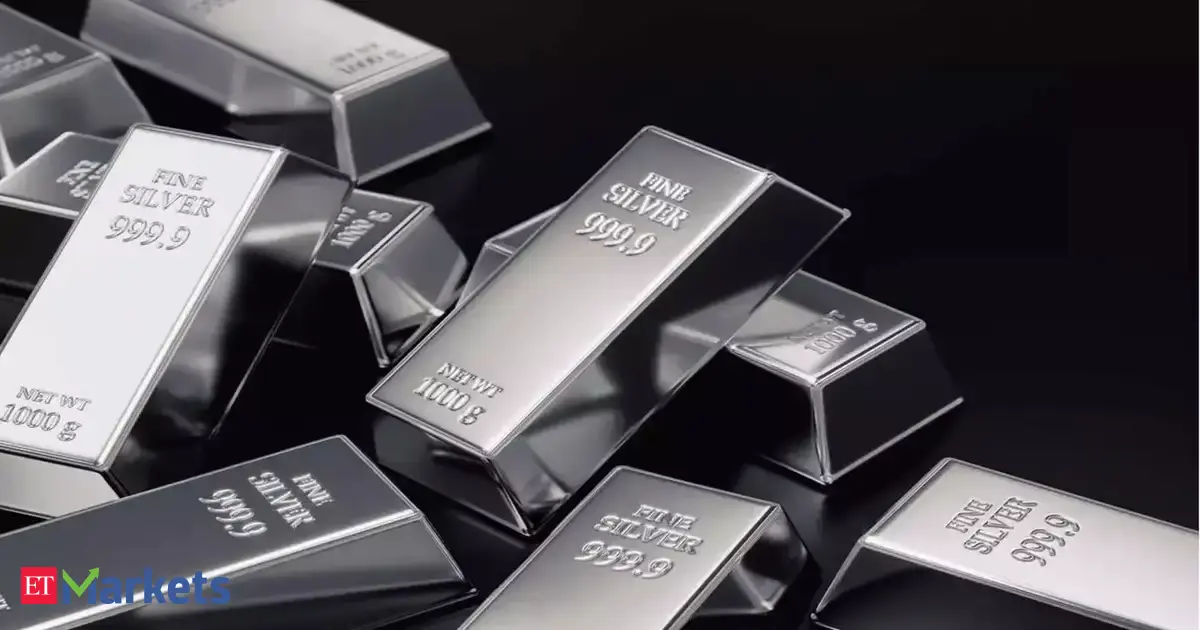
Silver price has surpassed $100 per ounce for the first time in history.
GK and monthly revision
Silver breaches $100/oz: Is the white metal’s best yet to come?
Silver prices have surged past $100 per ounce for the first time, propelled by a weakening dollar, robust industrial demand from green technologies, and existing supply constraints. This milestone signifies silver's evolving role from a traditional safe haven to a critical industrial mineral. Understanding such commodity market dynamics and their underlying economic factors is vital for competitive exam preparation.
Revision structure
Monthly events and exam calendar context
Static GK and one-liner notes
Quiz and mock-test revision path
Key points
Exam-ready takeaways
A key driver for the silver price surge is a weakening US dollar.
Robust industrial demand, particularly for green technologies, is a significant contributing factor.
Supply constraints in the market are also playing a crucial role in the price increase.
Silver's role is evolving from a traditional safe haven asset to a critical industrial mineral.
Detailed analysis
Full exam-oriented breakdown
The recent surge of silver prices past the unprecedented $100 per ounce mark signifies a pivotal moment in global commodity markets, reflecting profound shifts in economic, industrial, and geopolitical landscapes. For competitive exam aspirants, understanding this phenomenon goes beyond mere price points; it involves grasping the intricate web of factors driving it and its far-reaching implications, particularly for India. Historically, silver has worn many hats: a form of currency, a prized ornamental metal, and a traditional 'safe haven' asset, much like gold, during times of economic uncertainty or inflation. Its value was often seen as a hedge against currency depreciation. However, the current surge, culminating in its crossing the $100 threshold, suggests a significant evolution in its role. This isn't just about investors seeking refuge; it's fundamentally about industrial demand. The background to this surge is multifaceted. Firstly, the global economic environment, characterized by post-pandemic recovery efforts, has seen periods of high inflation and varying monetary policy responses from central banks. A weakening US dollar, a common phenomenon during periods of high inflation or dovish monetary policy, makes dollar-denominated commodities like silver cheaper for holders of other currencies, thus boosting demand. Secondly, and perhaps more critically, robust industrial demand, particularly from the burgeoning 'green technologies' sector, has emerged as a dominant driver. Silver is an indispensable component in solar photovoltaic cells, electric vehicle batteries, and numerous electronic devices. As nations worldwide commit to renewable energy targets and sustainable development goals, the demand for these technologies, and consequently for silver, has skyrocketed. India, with its ambitious National Solar Mission and push for electric mobility under schemes like FAME India, is a significant contributor to this global demand. Thirdly, existing supply constraints, often stemming from underinvestment in mining, geopolitical disruptions in key producing regions, and the fact that silver is often a byproduct of other metal mining (like copper or zinc), have exacerbated the demand-supply imbalance. Key stakeholders in this scenario include mining companies, who stand to benefit from higher prices, though the lead time for increasing production is often long. Industrial consumers, ranging from solar panel manufacturers to electronics giants, face increased input costs, potentially affecting their profitability or leading to higher consumer prices. Investors, both institutional and retail, view silver as an attractive asset for capital appreciation and as an inflation hedge. For governments, particularly those of net importing nations like India, the surge presents a complex challenge. Consumers, especially in India where silver jewellery and silverware hold cultural significance, might face higher prices. For India, the implications are substantial. India is one of the world's largest importers of silver, primarily for its jewellery sector and increasingly for industrial applications. A sustained rise in silver prices directly impacts India's import bill, potentially widening its Current Account Deficit (CAD) and putting pressure on its foreign exchange reserves. This also contributes to 'imported inflation,' as the higher cost of imported silver trickles down to various sectors. The 'Make in India' initiative and the push for 'Atmanirbhar Bharat' (self-reliant India) in electronics and solar manufacturing could face challenges due to higher raw material costs, impacting the competitiveness of domestic products. However, it also underscores the strategic importance of critical minerals and the need for robust policies to secure their supply, potentially through international agreements or domestic exploration efforts. The government's focus on policies promoting renewable energy, while crucial for climate goals, implicitly drives demand for such minerals, necessitating a balanced approach. While direct constitutional articles might not explicitly address commodity prices, the economic implications touch upon various policy domains. The Union Budget, framed annually, accounts for import bills and trade balances. The Foreign Trade Policy, formulated under the Foreign Trade (Development and Regulation) Act, 1992, governs imports and exports, including those of precious metals. The Reserve Bank of India's (RBI) monetary policy, guided by the Monetary Policy Committee, constantly monitors inflation, a factor heavily influenced by global commodity prices. Furthermore, policies related to critical minerals and strategic resources, though nascent, are gaining traction, reflecting the government's understanding of resource security for national development. The broader themes highlighted by silver's surge include the increasing interconnectedness of global commodity markets, the profound economic impact of the global energy transition, and the growing importance of resource security for national economies. Nations are increasingly realizing that access to key raw materials is as vital as energy security. Looking ahead, the future implications suggest continued volatility in silver prices, driven by the ongoing green energy revolution, potential geopolitical shifts, and the ebb and flow of global economic health. For India, this means a continued imperative to diversify its import sources, explore domestic reserves, promote recycling technologies, and integrate commodity price volatility into its long-term economic planning and industrial policy. The white metal's best might indeed be yet to come, but its journey will be fraught with both opportunities and challenges.
How to study
Turn news into exam marks
Revise monthly events by exam family instead of reading random updates.
Pair one-liners with mock tests so mistakes become the next revision list.
Keep state job pages, calendar pages and GK packs connected in one path.