

The Ministry of Home Affairs will present a tableau at the Republic Day parade.
GK and monthly revision
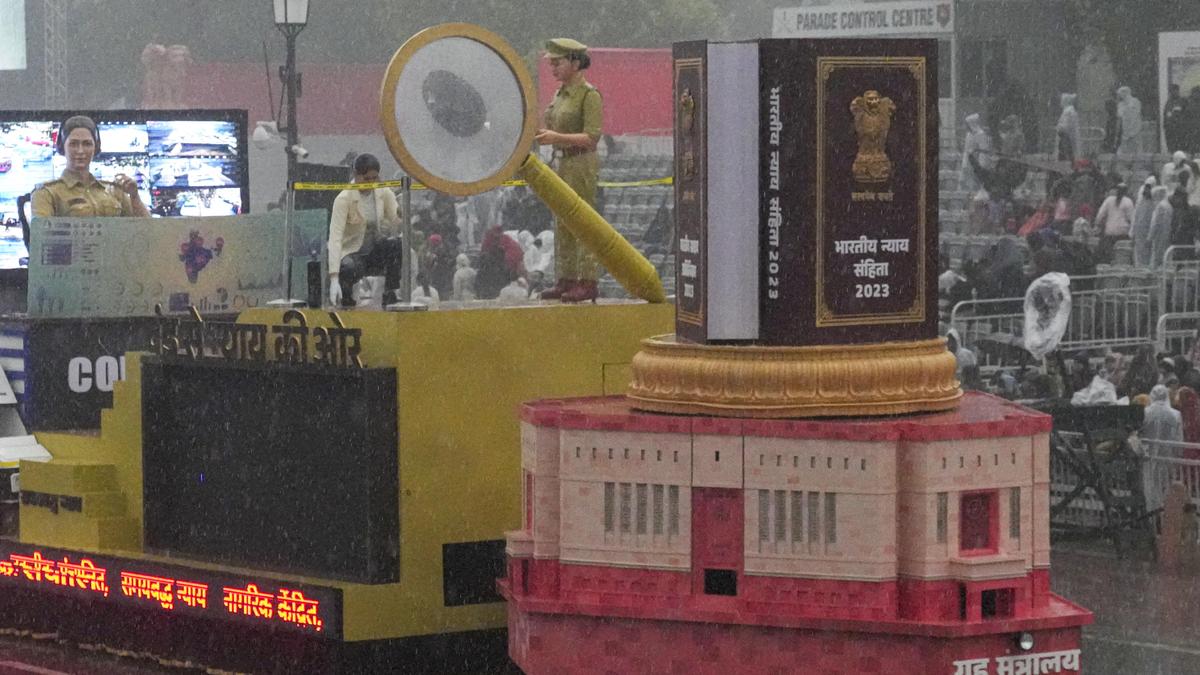
Home Ministry to display tableau on three new criminal laws at Republic Day parade
The Home Ministry will feature a tableau at the upcoming Republic Day parade, highlighting India's three new criminal laws. This initiative aims to showcase the nation's transition towards a modern, technology-driven, time-bound, and citizen-centric justice system. For competitive exams, understanding these new laws and their implications for the Indian legal framework is crucial, as is knowledge about national events like the Republic Day parade.
Revision structure
Monthly events and exam calendar context
Static GK and one-liner notes
Quiz and mock-test revision path
Key points
Exam-ready takeaways
The tableau's theme will be India's three new criminal laws.
It aims to demonstrate India's shift to a modern, technology-driven, time-bound, and citizen-centric justice system.
The display will occur during the annual Republic Day parade, a significant national event.
The three new criminal laws are the Bharatiya Nyaya Sanhita, Bharatiya Nagarik Suraksha Sanhita, and Bharatiya Sakshya Adhiniyam.
Detailed analysis
Full exam-oriented breakdown
The decision by the Ministry of Home Affairs to feature a tableau on India's three new criminal laws at the Republic Day parade is not merely a ceremonial display but a powerful statement about the nation's commitment to modernizing its justice system. This initiative aims to highlight India's transition towards a more contemporary, technology-driven, time-bound, and citizen-centric legal framework. **Background Context and Historical Shift:** For over a century and a half, India's criminal justice system was largely governed by laws enacted during the British colonial era. These included the Indian Penal Code (IPC) of 1860, the Code of Criminal Procedure (CrPC) of 1973 (which replaced the CrPC of 1898), and the Indian Evidence Act of 1872. While these laws provided a structured legal framework, they were often criticized for being colonial in origin, complex, outdated, and contributing to significant delays in justice delivery. The inherent procedural complexities, limited integration of technology, and a focus that sometimes leaned towards state control rather than citizen welfare, necessitated a comprehensive overhaul. Decades of calls for reform, from various Law Commissions and expert committees, culminated in the introduction of these new laws. **What Happened: The New Legal Framework:** The Indian Parliament, in its Winter Session of 2023, passed three landmark bills that received Presidential assent in December 2023. These are: 1. **Bharatiya Nyaya Sanhita (BNS) 2023:** This new law replaces the Indian Penal Code (IPC) of 1860. It aims to consolidate and amend the provisions relating to offences and for matters connected therewith or incidental thereto. Key changes include community service as a punishment for petty offences, specific provisions for organized crime and terrorism, and the removal of sedition (though a new provision addresses acts endangering the sovereignty, unity, and integrity of India). 2. **Bharatiya Nagarik Suraksha Sanhita (BNSS) 2023:** This law replaces the Code of Criminal Procedure (CrPC) of 1973. It introduces significant procedural changes, emphasizing technology. Provisions for e-FIRs, mandatory videography of search and seizure operations, forensic investigation for offences punishable with seven years or more imprisonment, and time limits for various stages of investigation and trial are central to its design. 3. **Bharatiya Sakshya Adhiniyam (BSA) 2023:** This replaces the Indian Evidence Act of 1872. It modernizes the law of evidence, explicitly recognizing electronic and digital records as primary evidence, thereby streamlining the admissibility of contemporary forms of evidence in court. **Key Stakeholders Involved:** * **Ministry of Home Affairs (MHA):** Spearheaded the drafting and introduction of these bills, and is now responsible for showcasing and overseeing their implementation. * **Parliament (Lok Sabha and Rajya Sabha):** Debated and passed these crucial pieces of legislation, reflecting the will of the people. * **The President of India:** Gave assent to the bills, making them laws. * **The Judiciary:** Judges and magistrates will be responsible for interpreting and applying these new laws, requiring extensive training and adaptation. * **Law Enforcement Agencies (Police):** Will be at the forefront of implementing the new procedural codes, from registering e-FIRs to conducting technology-driven investigations. This will necessitate significant capacity building and infrastructure upgrades. * **Legal Fraternity (Lawyers and Prosecutors):** Must familiarize themselves with the new provisions and procedures to effectively represent clients and conduct prosecutions. * **Citizens:** As the ultimate beneficiaries, citizens stand to gain from a more efficient, transparent, and accessible justice system, but also need to be aware of their rights and responsibilities under the new laws. **Significance for India and Broader Themes:** The introduction of these laws marks a paradigm shift in India's governance. Firstly, it addresses the long-standing issue of pendency of cases by introducing time limits for investigations, trials, and pronouncement of judgments. This aligns with the principle of 'justice delayed is justice denied'. Secondly, the emphasis on technology – e-FIRs, digital evidence, videography – aims to enhance transparency, reduce corruption, and improve the efficiency of investigations and trials. This is crucial for a modern, digitally-empowered India. Thirdly, by replacing colonial-era laws with 'Bharatiya' nomenclature and a citizen-centric approach, there is an attempt to decolonize the legal system, making it more reflective of Indian societal values and aspirations. This move is expected to have significant social and political implications, potentially improving public trust in the justice system and impacting crime rates. Economically, a more efficient justice system can attract foreign investment by assuring a robust legal framework for dispute resolution. **Constitutional Provisions and Future Implications:** The legislative power to enact these laws stems from the **Seventh Schedule** of the Indian Constitution, where 'Criminal Law' and 'Criminal Procedure' are listed under the **Concurrent List (List III)**, allowing both the Union and State governments to legislate. The new laws are expected to uphold fundamental rights, particularly **Article 21 (Right to Life and Personal Liberty)**, by ensuring fair and speedy trials. Provisions like free legal aid (**Article 39A**) will remain crucial in the new framework. The successful implementation of these laws hinges on massive infrastructure upgrades, training of police and judicial officers, and public awareness campaigns. Challenges like digital divide, resistance to change, and ensuring adequate resources for forensic facilities and technology will need to be overcome. In the long term, these reforms could significantly enhance India's standing in terms of rule of law and human rights, leading to a more accountable and responsive justice delivery system. **Future Implications:** The journey ahead involves significant challenges. The successful transition will require extensive training for police personnel, judicial officers, and public prosecutors across the country. Infrastructure for digital evidence collection, storage, and forensic analysis needs to be scaled up rapidly. There will also be a period of adaptation for the legal fraternity and citizens to understand and navigate the new procedures and provisions. The ultimate goal is to reduce crime, increase conviction rates, and ensure swift justice, thereby strengthening the rule of law and fostering a safer, more just society. The impact on human rights, particularly regarding new provisions on detention and investigation, will be closely watched by civil society and international bodies.
How to study
Turn news into exam marks
Revise monthly events by exam family instead of reading random updates.
Pair one-liners with mock tests so mistakes become the next revision list.
Keep state job pages, calendar pages and GK packs connected in one path.