
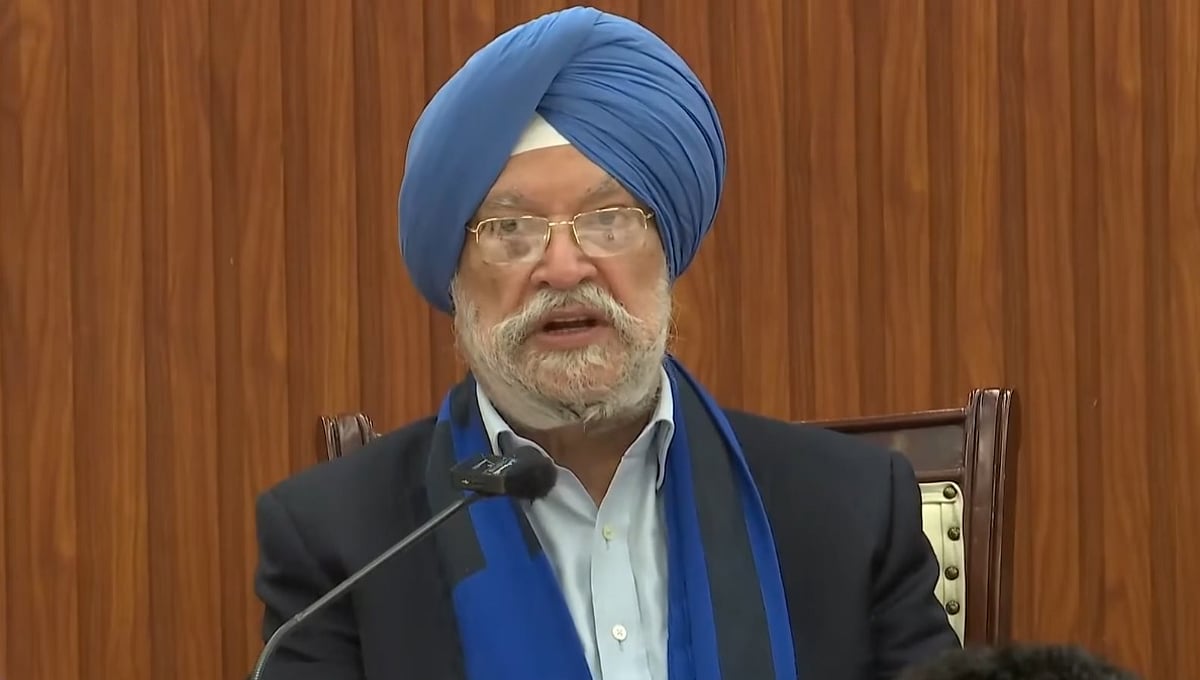
Union Minister Hardeep Puri stated that oil geopolitics is no longer episodic but characterized by permanent volatility.
GK and monthly revision
Oil geopolitics no longer episodic, India must plan for permanent volatility: Hardeep Puri
Union Minister Hardeep Puri highlighted that global oil geopolitics is now marked by permanent volatility, urging India to strategize accordingly. This underscores India's dual challenge: navigating immediate crude oil import dependence while simultaneously investing in long-term energy autonomy. This perspective is crucial for understanding India's energy security policies, its drive for self-reliance, and adaptation to the evolving global energy landscape for competitive exams.
Revision structure
Monthly events and exam calendar context
Static GK and one-liner notes
Quiz and mock-test revision path
Key points
Exam-ready takeaways
India's immediate challenge is to navigate its significant crude oil import dependence.
The minister emphasized the need for India to invest in long-term energy autonomy.
Energy autonomy efforts should include strategies for resources both 'above and below the sea'.
This strategic outlook is vital for India's energy security and economic planning amidst global uncertainties.
Detailed analysis
Full exam-oriented breakdown
India's energy landscape is perpetually at the crossroads of global geopolitics and domestic aspirations. Union Minister Hardeep Puri's assertion that oil geopolitics is no longer an episodic phenomenon but one characterized by 'permanent volatility' serves as a crucial strategic pivot for India. This statement underscores a paradigm shift from reacting to occasional oil shocks to integrating sustained uncertainty into long-term energy planning. For a nation like India, which is the world's third-largest energy consumer and heavily reliant on crude oil imports, this perspective is not merely academic but a fundamental driver of its economic stability, national security, and foreign policy. The background to this 'permanent volatility' is multi-faceted. Historically, global oil markets have seen periods of sharp price fluctuations, often triggered by geopolitical events such as the 1973 Arab oil embargo, the Iran-Iraq war in the 1980s, or the Gulf Wars. However, the current era presents a confluence of factors: the evolving dynamics of OPEC+ production cuts, the Russia-Ukraine conflict disrupting supply chains and reshaping energy alliances, increasing climate change imperatives pushing for energy transition, and the strategic competition among major powers. India's import dependence, currently over 85% for crude oil and about 50% for natural gas, makes it particularly vulnerable to these global tremors. This reliance translates directly into significant current account deficits, inflationary pressures, and fiscal strains due to the massive import bill, which impacts the common citizen through higher fuel prices and cascading effects on goods and services. Key stakeholders in this complex scenario include the Indian government (Ministry of Petroleum and Natural Gas, Ministry of Finance, NITI Aayog), which formulates policies and negotiates supply contracts. Public Sector Undertakings (PSUs) like ONGC, Oil India, IOC, BPCL, and HPCL are critical for domestic exploration, refining, and distribution. Internationally, OPEC+ countries (led by Saudi Arabia and Russia) exert immense influence over global supply and prices. Major oil producers like the United States, and international bodies such as the International Energy Agency (IEA), also play significant roles in shaping the energy market and discourse. Consumers, both industrial and individual, are ultimate stakeholders, bearing the direct impact of price fluctuations. The significance for India is profound. Economically, unpredictable oil prices can derail growth projections, inflate the import bill, weaken the rupee, and exacerbate inflation, directly affecting the Reserve Bank of India's monetary policy decisions. Geopolitically, it necessitates a delicate balance in foreign policy, requiring diversification of import sources, strengthening energy diplomacy with West Asian and other producing nations, and exploring new partnerships. From a national security standpoint, securing a stable and affordable energy supply is paramount for sustaining economic growth, powering defense establishments, and maintaining social stability. The minister's call for investing in long-term energy autonomy, both 'above and below the sea,' points to a dual strategy: enhancing renewable energy capacity (above the sea) and augmenting domestic hydrocarbon exploration and production, including deep-sea and unconventional resources (below the sea). Historically, India has been a net importer of energy since independence, though efforts were made to boost domestic production, notably through ONGC's early discoveries. The journey has been one of increasing dependence, making the current call for autonomy a critical policy shift. Constitutional provisions relevant to this include Entry 53 of List I (Union List) in the Seventh Schedule, which grants the Union government exclusive power over 'Oilfields and mineral oil resources; petroleum and petroleum products; other liquids and substances declared by Parliament by law to be dangerously inflammable.' This empowers the central government to formulate comprehensive energy policies, including exploration and production. While no direct article addresses 'oil geopolitics,' the economic repercussions directly relate to the Union's fiscal responsibilities under Articles like 292 (borrowing by Government of India) and the overall economic planning enshrined in the Directive Principles of State Policy, aiming for economic welfare. Looking ahead, the future implications are clear: India will intensify its push for a multi-pronged energy strategy. This includes aggressive targets for renewable energy deployment (e.g., 500 GW non-fossil fuel capacity by 2030), a focus on green hydrogen production through the National Green Hydrogen Mission, and expansion of nuclear energy. Simultaneously, it will involve maximizing domestic oil and gas production through policies like the Open Acreage Licensing Policy (OALP) and enhanced recovery techniques. The expansion of India's Strategic Petroleum Reserves (SPR) will also be crucial for buffering against short-term supply disruptions. Furthermore, India's energy diplomacy will become more proactive, forging strategic alliances and exploring new avenues for energy trade. The shift from 'episodic' to 'permanent volatility' means India's energy security strategy must be agile, resilient, and forward-looking, balancing immediate needs with long-term sustainability and self-reliance.
How to study
Turn news into exam marks
Revise monthly events by exam family instead of reading random updates.
Pair one-liners with mock tests so mistakes become the next revision list.
Keep state job pages, calendar pages and GK packs connected in one path.