

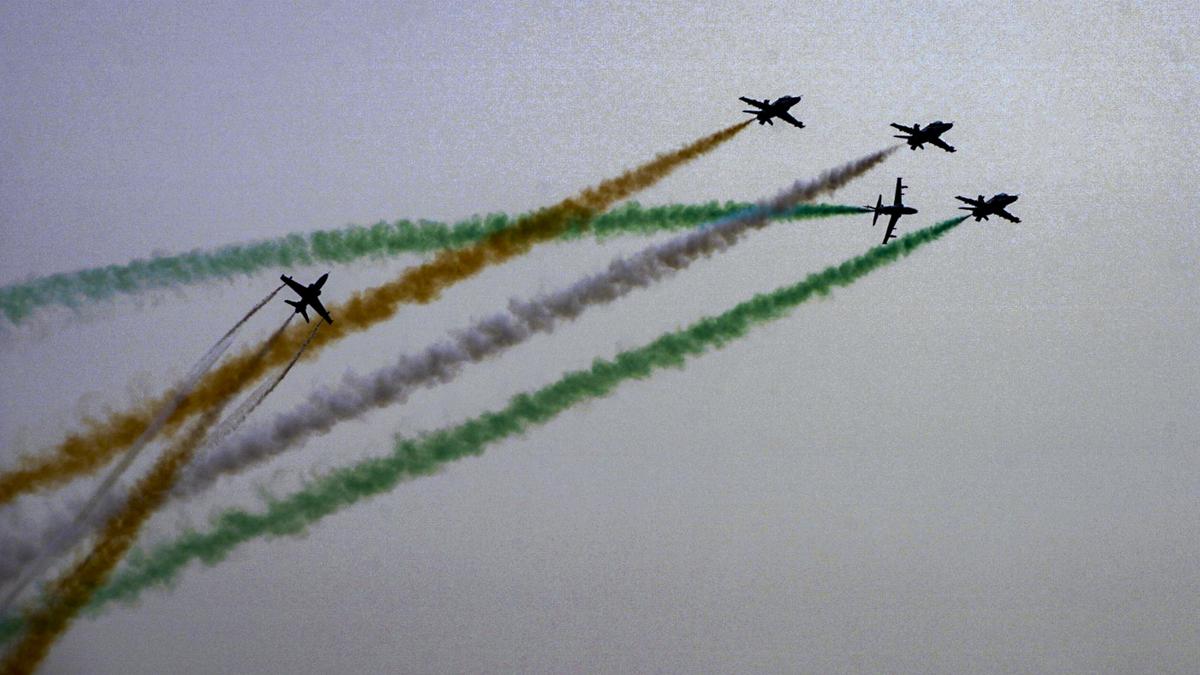
The Indian Air Force (IAF) 'Sindoor' formation will lead the Republic Day flypast.
GK and monthly revision
IAF’s ‘Sindoor’ formation to lead Republic Day flypast
The Indian Air Force's 'Sindoor' formation is set to lead the upcoming Republic Day flypast, a significant event commemorating 'Operation Sindoor'. This operation marks India's decisive military response conducted from May 7 to May 10, following the Pahalgam terror attack. This commemoration is crucial for competitive exams, highlighting national security, military history, and important dates for general awareness questions.
Revision structure
Monthly events and exam calendar context
Static GK and one-liner notes
Quiz and mock-test revision path
Key points
Exam-ready takeaways
The flypast will specifically commemorate 'Operation Sindoor'.
'Operation Sindoor' refers to India's decisive military response.
This military operation was conducted from May 7 to May 10.
The operation was initiated following the Pahalgam terror attack.
Detailed analysis
Full exam-oriented breakdown
The upcoming Republic Day flypast featuring the Indian Air Force's (IAF) 'Sindoor' formation is set to be a poignant reminder of India's unwavering commitment to national security and its decisive military prowess. This commemoration of 'Operation Sindoor', a military response conducted from May 7 to May 10 following the Pahalgam terror attack, underscores the nation's resolve to counter terrorism effectively and swiftly. **Background Context: The Shadow of Terrorism** India has long grappled with the menace of terrorism, particularly in the strategically vital region of Jammu & Kashmir (J&K). The Pahalgam terror attack, like many others, represented a direct challenge to India's sovereignty and the safety of its citizens. While specific details of the 'Pahalgam terror attack' and 'Operation Sindoor' itself may be less publicized compared to other major operations, the very act of commemorating it signifies its importance in India's military history. Such attacks often aim to destabilize the region, sow discord, and undermine governmental authority, necessitating a strong and unequivocal response from the state. **Operation Sindoor: A Decisive Military Response** 'Operation Sindoor' refers to a targeted and decisive military response undertaken by India's armed forces, specifically involving the IAF, between May 7 and May 10. The term 'decisive' implies a swift, effective, and goal-oriented action aimed at neutralizing the threat posed by the terrorists responsible for the Pahalgam attack. While the exact operational details remain largely classified, such operations typically involve intelligence gathering, coordinated ground and air maneuvers, and targeted strikes to eliminate terrorist infrastructure or operatives. The IAF's involvement, through its 'Sindoor' formation leading the Republic Day flypast, highlights the crucial role of air power in modern counter-terrorism operations, providing reconnaissance, rapid deployment, and precision strike capabilities. **Key Stakeholders Involved** Multiple stakeholders are intrinsically linked to 'Operation Sindoor' and its commemoration. The primary stakeholders are the **Indian Air Force (IAF)** and the **Indian Army**, who planned and executed the military response. Their coordination and bravery were paramount to the operation's success. The **Ministry of Defence** and the **Government of India** provided the necessary political and strategic directives, demonstrating the state's resolve. **Intelligence agencies** played a critical role in gathering actionable intelligence. Finally, the **citizens of India**, particularly those in J&K, are indirect stakeholders, as such operations directly impact their security and sense of safety, reinforcing faith in the nation's defense capabilities. **Why This Matters for India** Commemorating 'Operation Sindoor' is profoundly significant for India. Firstly, it reinforces the nation's **national security doctrine**, which prioritizes the protection of its territorial integrity and citizens from all forms of aggression, including terrorism. Secondly, it serves as a powerful **deterrent** to hostile elements, sending an unequivocal message that India will not tolerate acts of terror and will respond with overwhelming force. Thirdly, such acknowledgments boost the **morale** of the armed forces, recognizing their sacrifices and valor. Fourthly, it educates the public about the continuous efforts and challenges faced by the security forces. On a broader scale, it showcases India's **military preparedness** and its capacity to conduct complex, time-bound operations, contributing to regional stability by projecting strength. **Historical Context of Counter-Terrorism in India** India's fight against terrorism dates back decades, with J&K often being a focal point due to cross-border infiltration and state-sponsored terrorism. Operations like 'Operation Sindoor' are part of a larger historical continuum of India's counter-insurgency and counter-terrorism efforts, which include major operations like Operation Vijay (Kargil War, 1999), surgical strikes (2016), and Balakot airstrike (2019). These operations reflect an evolving strategy that combines robust defensive measures with proactive offensive capabilities, moving from a reactive stance to a more assertive one in dealing with threats. **Constitutional and Policy References** India's military actions are rooted in its constitutional framework. **Article 53(2)** of the Constitution vests the supreme command of the Defence Forces of the Union in the President, while the executive power is exercised by the government. **Article 355** places a duty on the Union to protect every State against external aggression and internal disturbance, providing the constitutional basis for deploying armed forces in situations like terror attacks. The **Armed Forces (Special Powers) Act (AFSPA)**, though controversial, has historically been applied in disturbed areas like J&K to enable security forces to operate effectively. India's broader **National Security Policy** and **Counter-Terrorism Policy** guide such operations, emphasizing a multi-pronged approach involving intelligence, law enforcement, and military action, underpinned by international cooperation. **Future Implications** The commemoration of 'Operation Sindoor' carries significant future implications. It signals India's continued commitment to modernizing its armed forces, enhancing intelligence capabilities, and refining its counter-terrorism strategies. As geopolitical landscapes evolve and new forms of threats emerge, India is likely to maintain a proactive stance, leveraging advanced technology and strategic partnerships. Such public commemorations also serve to instill national pride and vigilance among citizens, fostering a collective resolve against internal and external security challenges. It reinforces the message that while India seeks peace, it is always prepared to defend its interests and citizens with decisive action.
How to study
Turn news into exam marks
Revise monthly events by exam family instead of reading random updates.
Pair one-liners with mock tests so mistakes become the next revision list.
Keep state job pages, calendar pages and GK packs connected in one path.