

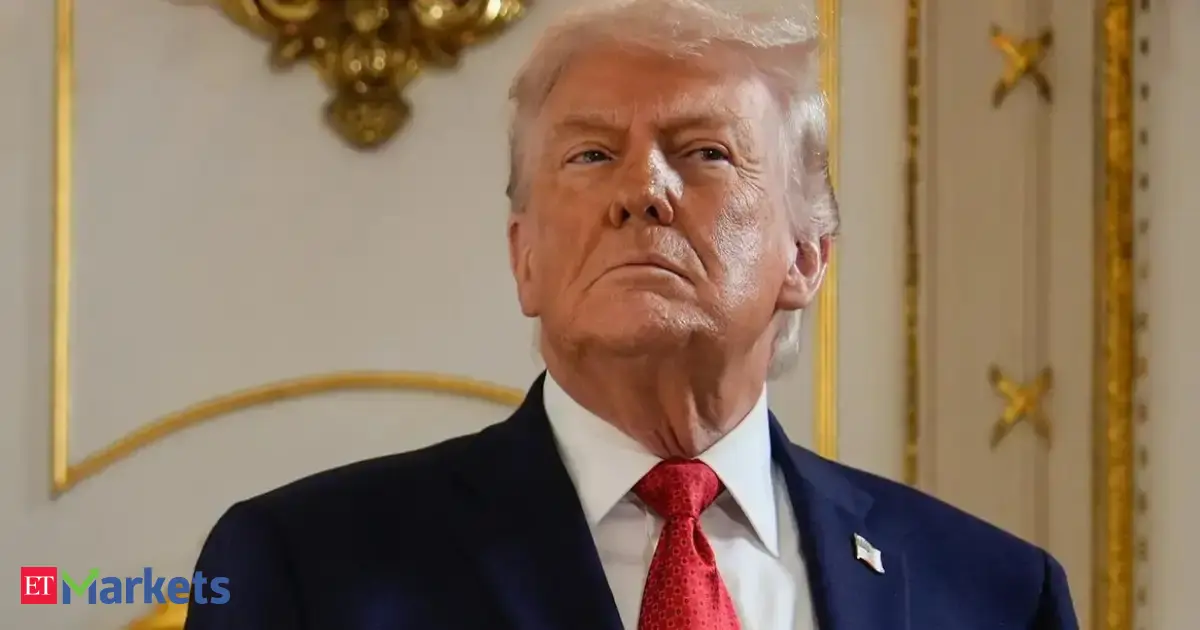
US President Trump threatened new tariffs on eight European countries.
GK and monthly revision
Dow futures sink over 600 points; Trump’s Greenland move drags Europe, Asian markets
President Trump's threat of new tariffs on eight European countries caused global markets to tumble on Tuesday, with Dow futures sinking over 600 points and Asian/European shares declining. This event highlights the significant impact of international trade policies and geopolitical tensions on global economic stability, crucial for understanding contemporary economic affairs and international relations for competitive exams.
Revision structure
Monthly events and exam calendar context
Static GK and one-liner notes
Quiz and mock-test revision path
Key points
Exam-ready takeaways
This announcement led to Dow futures sinking over 600 points.
Asian markets were significantly affected, with Tokyo's Nikkei down 1.1%.
European markets also opened lower, reflecting concerns over trade tensions.
The global market tumble occurred on Tuesday following the tariff threat.
Detailed analysis
Full exam-oriented breakdown
The news of Dow futures sinking over 600 points, coupled with declines across European and Asian markets following former US President Trump's threat of new tariffs on eight European countries, serves as a stark reminder of the interconnectedness of the global economy and the profound impact of protectionist trade policies. This event is not an isolated incident but a continuation of a broader trend of trade tensions that characterized much of the late 2010s. **Background Context: The Rise of Protectionism** To truly understand this market reaction, we must first grasp the concept of 'trade wars' and the underlying philosophy of 'America First' that guided the Trump administration. Beginning in 2018, the US initiated a series of tariff impositions, primarily targeting China, citing unfair trade practices, intellectual property theft, and large trade deficits. This marked a significant departure from the post-World War II global economic order, which largely promoted free trade and multilateralism through institutions like the General Agreement on Tariffs and Trade (GATT) and its successor, the World Trade Organization (WTO). The US argued that existing trade agreements were detrimental to American industries and workers, leading to job losses and a hollowing out of its manufacturing base. This sentiment extended to Europe, with the US frequently criticizing the European Union's trade surpluses and specific policies, particularly regarding agricultural subsidies and automotive tariffs. **What Happened: A Ripple Effect Across Continents** On the specific Tuesday mentioned, President Trump's threat of new tariffs against eight European countries immediately sent shockwaves through global financial markets. Tariffs are essentially taxes on imported goods, making them more expensive and less competitive. Such threats inject immense uncertainty into the global economy. Investors, fearing reduced corporate profits, disrupted supply chains, and a potential slowdown in global economic growth, reacted by selling off equities. This led to Dow futures, a key indicator for the US stock market, plummeting over 600 points. The contagion quickly spread: Tokyo's Nikkei index fell by 1.1%, and European markets opened significantly lower. This immediate, negative reaction underscores how sensitive markets are to geopolitical risks and trade policy shifts. The 'Greenland move' referenced in the article title, though not detailed in the summary, likely refers to a separate geopolitical event that added to the overall market jitters, demonstrating how multiple factors can converge to impact sentiment. **Key Stakeholders and Their Motivations** At the forefront of this episode were the **United States Government**, particularly the President and the Office of the US Trade Representative (USTR), whose primary motivation was to protect domestic industries, reduce trade deficits, and potentially gain leverage in broader economic negotiations. The **European Union (EU)**, represented by the European Commission, stood as the primary target. The EU's interest lay in upholding international trade rules, protecting its member states' industries, and potentially retaliating with its own tariffs to maintain a balance of power. **Global financial markets**, comprising investors, corporations, and traders, are crucial stakeholders as they are the immediate responders, reflecting collective sentiment and economic expectations. Their actions, driven by fear or confidence, dictate the short-term trajectory of asset prices. Finally, specific **industries** (e.g., automotive, agriculture, technology) within both the US and Europe are directly impacted, facing higher costs, reduced sales, and uncertainty about future investments. **Significance for India: Navigating the Global Crosscurrents** For India, a rapidly growing economy deeply integrated into global trade, such events have significant ramifications. Firstly, **economic impact**: Global trade wars can lead to a slowdown in global demand, affecting India's exports. Increased uncertainty can lead to capital flight as foreign institutional investors (FIIs) pull money from emerging markets like India, potentially depreciating the Rupee and increasing the current account deficit. It can also disrupt global supply chains, impacting Indian manufacturers reliant on imported components or global markets for their finished products. Secondly, **policy implications**: India must carefully calibrate its own foreign trade policy (governed by the Foreign Trade (Development and Regulation) Act, 1992) to diversify its export markets, reduce dependence on specific regions, and strengthen domestic manufacturing through initiatives like 'Make in India' and 'Atmanirbhar Bharat'. Thirdly, **geopolitical positioning**: As major global powers engage in trade disputes, India finds itself in a delicate position, needing to maintain good relations with all while safeguarding its own economic interests. This often involves advocating for a rules-based multilateral trading system at forums like the WTO and G20, echoing the spirit of Article 51 of the Indian Constitution, which promotes international peace and security and respect for international law. **Historical Context and Future Implications** Historically, trade disputes are not new, but the scale and frequency of unilateral tariff threats under the Trump administration challenged the very foundations of the WTO's dispute settlement mechanism. The future implications are profound. Continued trade tensions could lead to a fragmentation of global supply chains, a rise in regional trade blocs, and a weakening of multilateral institutions. For India, this necessitates greater resilience, strategic partnerships (e.g., through Free Trade Agreements), and a focus on domestic demand to cushion against external shocks. Constitutional provisions like Article 253, which empowers Parliament to make laws for implementing international agreements, become crucial in navigating these complex global trade dynamics, ensuring India's commitments and interests are aligned in a volatile world order. In essence, the market tumble was more than just numbers; it was a global alarm bell signaling the fragility of economic stability in an era where protectionism and geopolitical tensions increasingly overshadow the principles of free trade and international cooperation.
How to study
Turn news into exam marks
Revise monthly events by exam family instead of reading random updates.
Pair one-liners with mock tests so mistakes become the next revision list.
Keep state job pages, calendar pages and GK packs connected in one path.