

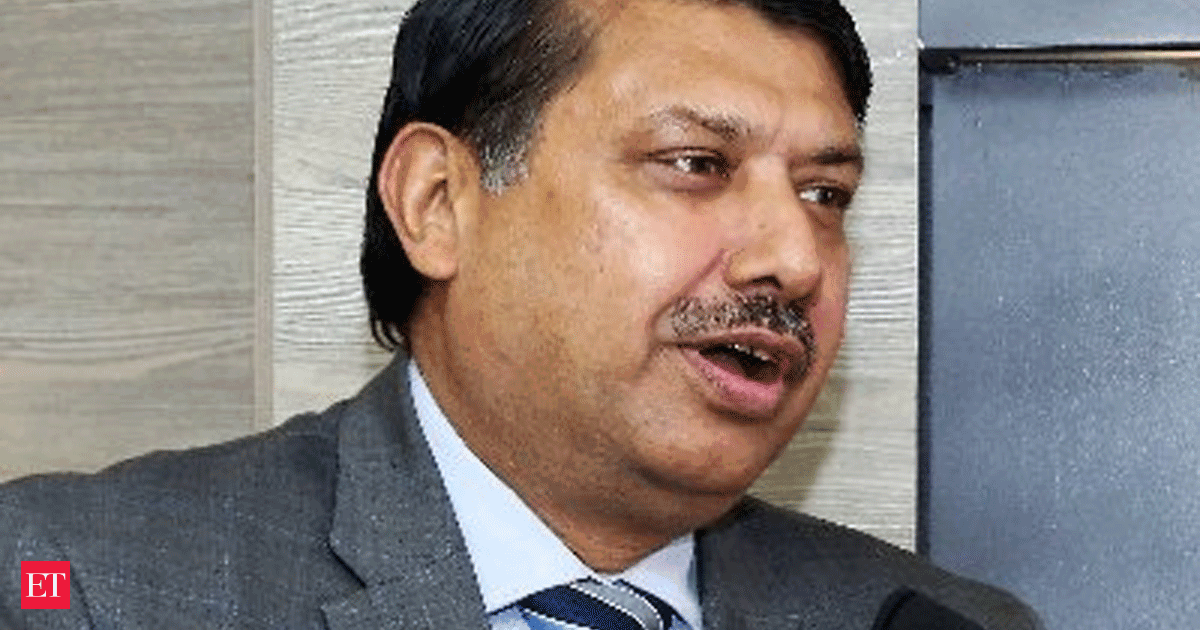
The suggestion was made by Nagesh Kumar, a member of the RBI's Monetary Policy Committee (MPC).
GK and monthly revision
Provide incentive in Budget for R&D, create specialised fin institution for long-term fund: MPC member Nagesh Kumar
RBI Monetary Policy Committee (MPC) member Nagesh Kumar has urged the government to include policy incentives for Research and Development (R&D) and establish a specialized development financing institution for manufacturing in the upcoming Union Budget. This recommendation aims to restore the 200% weighted tax deduction for R&D expenditure, thereby boosting India's manufacturing sector, enhancing competitiveness, and fostering economic growth. This is crucial for competitive exams as it highlights potential economic policy changes and the role of expert recommendations in budget formulation.
Revision structure
Monthly events and exam calendar context
Static GK and one-liner notes
Quiz and mock-test revision path
Key points
Exam-ready takeaways
He urged the government to provide policy incentives for Research and Development (R&D) in the upcoming Budget.
A key recommendation is to restore the 200% weighted tax deduction for R&D expenditure.
He also proposed creating a specialized development financing institution for long-term manufacturing capital.
The objective of these measures is to boost growth and competitiveness in India's manufacturing sector.
Detailed analysis
Full exam-oriented breakdown
The recommendation by Dr. Nagesh Kumar, a member of the Reserve Bank of India's (RBI) Monetary Policy Committee (MPC), to the government for policy incentives in Research and Development (R&D) and the establishment of a specialized development financing institution (DFI) for manufacturing capital, signals a critical focus on boosting India's industrial and innovation landscape. This suggestion comes at a time when India is striving to enhance its manufacturing capabilities, reduce import dependence, and integrate more deeply into global value chains under initiatives like 'Make in India' and 'Atmanirbhar Bharat'. **Background Context and What Happened:** Historically, India's R&D expenditure as a percentage of GDP has remained relatively low, hovering around 0.6-0.7%, significantly below the global average of 1.8% and much lower than developed economies like the US (3.4%) or South Korea (4.8%). This underinvestment has hampered India's innovation potential and global competitiveness. Recognising this, past governments had introduced incentives, notably the 200% weighted tax deduction for R&D expenditure under Section 35(2AB) of the Income Tax Act, 1961. This provision allowed companies to deduct 200% of their in-house R&D expenses from their taxable income, providing a substantial incentive for private sector investment in innovation. However, this deduction was gradually phased out, eventually reduced to 150% and then to 100% by the financial year 2020-21, effectively removing the 'weighted' benefit. Dr. Kumar's call to restore the 200% weighted tax deduction aims to reignite private sector interest and investment in R&D. Simultaneously, the manufacturing sector often faces challenges in accessing long-term, patient capital required for large-scale projects, technological upgrades, and capacity expansion. Commercial banks, due to their asset-liability mismatch concerns, are often hesitant to provide very long-term project finance. This gap was traditionally filled by Development Financial Institutions (DFIs) like IFCI, ICICI, and IDBI in the post-independence era, which provided long-term credit for industrial development. However, many of these DFIs were later converted into commercial banks. The proposal for a new specialized DFI for manufacturing acknowledges this financing gap and seeks to create an institutional mechanism to channel dedicated long-term funds into the sector, mirroring the recent establishment of the National Bank for Financing Infrastructure and Development (NaBFID) for infrastructure financing, under the NaBFID Act, 2021. **Key Stakeholders Involved:** * **RBI and MPC:** Dr. Nagesh Kumar, as an external member of the MPC, provides independent expert advice on economic policy. While the MPC primarily focuses on monetary policy, its members often offer broader economic recommendations to the government. The RBI also has a significant role in financial sector regulation and development. * **Government of India (Ministry of Finance):** This ministry is the primary recipient of such recommendations as it is responsible for formulating the Union Budget (governed by Article 112 of the Constitution, which mandates the presentation of an 'Annual Financial Statement') and overall fiscal policy, including tax incentives and establishing financial institutions. * **Manufacturing Sector and Industry Bodies:** These are the direct beneficiaries and crucial players. Their ability to invest in R&D and expand production depends heavily on policy support and access to finance. * **Research Institutions and Academia:** These entities are critical for conducting R&D and collaborating with industry, benefiting from increased funding and a more robust innovation ecosystem. **Why This Matters for India:** These recommendations are profoundly significant for India's economic future. Restoring the 200% weighted tax deduction for R&D would significantly incentivize private companies to invest more in innovation, leading to: 1. **Enhanced Competitiveness:** Indian products and services would become more competitive globally through technological advancement and superior design. 2. **Economic Growth:** Increased R&D drives productivity gains, leading to higher economic growth and job creation, especially in high-skill sectors. 3. **Self-Reliance (Atmanirbhar Bharat):** Reduced dependence on imported technology and intellectual property, strengthening India's strategic autonomy. 4. **Global Manufacturing Hub:** A robust manufacturing sector, backed by innovation and long-term finance, is essential for India to emerge as a global manufacturing hub, creating millions of jobs for its large workforce. The creation of a specialized DFI for manufacturing would address the perennial issue of long-term capital availability, enabling industries to undertake ambitious expansion and modernization projects, thereby supporting the 'Make in India' initiative's objectives of increasing manufacturing's share in GDP. **Historical Context and Future Implications:** India's journey of industrialization has always been intertwined with the availability of capital and policy support. The initial phase of industrialization post-independence relied heavily on public sector investment and DFIs. In the liberalized era, private sector-led growth became prominent, but the financing structure for long-term projects remained a challenge. The re-emphasis on DFIs, as seen with NaBFID and now proposed for manufacturing, signals a recognition of the unique financing needs of specific sectors that commercial banks cannot fully meet. Looking ahead, if these recommendations are adopted, the upcoming Union Budget could potentially include significant policy shifts. This could lead to a renewed surge in corporate R&D spending, a more vibrant innovation ecosystem, and substantial investments in the manufacturing sector. The long-term implications include accelerated economic growth, improved export performance, greater integration into global supply chains, and a more resilient and self-reliant economy. It also underscores a potential shift towards more targeted, sector-specific financial instruments and fiscal incentives to achieve national development goals, aligning with the Directive Principles of State Policy (DPSP) in the Constitution, particularly Articles 38, 39, and 43, which advocate for securing a social order for the promotion of welfare of the people, ensuring adequate means of livelihood, and securing a living wage and conditions of work ensuring a decent standard of life. These proposals, if implemented, would mark a strategic pivot in India's industrial and innovation policy, aiming to unlock its full economic potential by fostering a conducive environment for both technological advancement and capital formation in critical sectors.
How to study
Turn news into exam marks
Revise monthly events by exam family instead of reading random updates.
Pair one-liners with mock tests so mistakes become the next revision list.
Keep state job pages, calendar pages and GK packs connected in one path.