

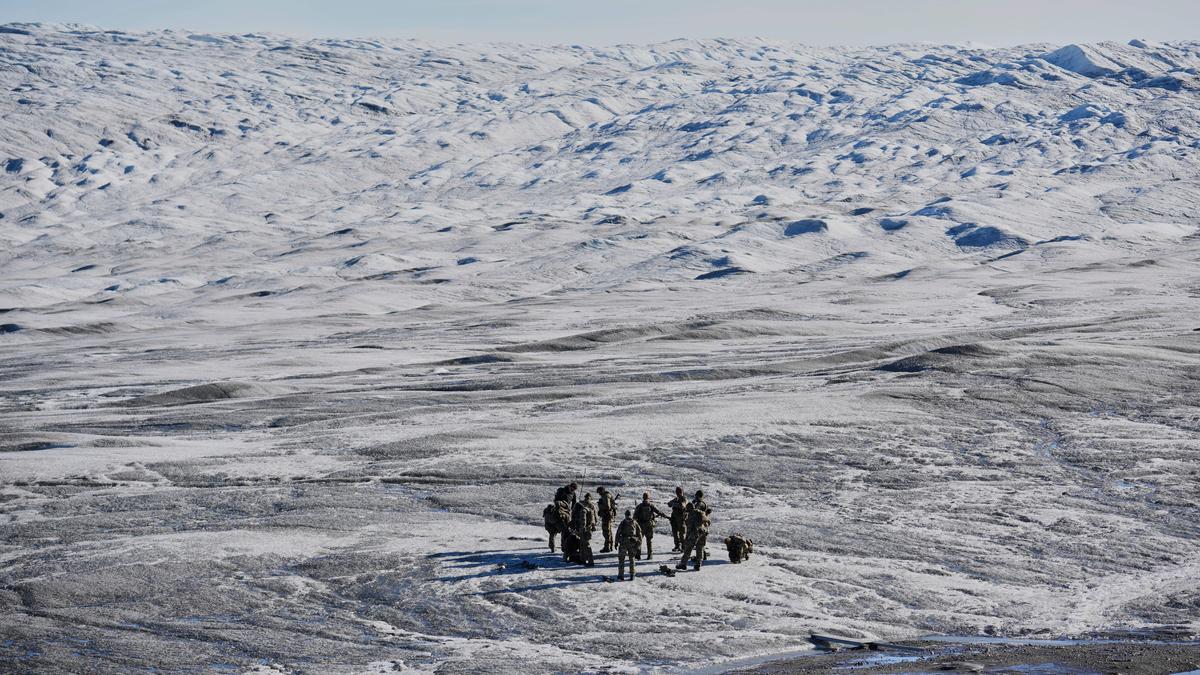
NATO military chiefs are reportedly drawing up plans for a possible mission in Greenland.
GK and monthly revision
NATO talks on deterring Russian activity around Greenland ‘business as usual’, says U.K.
NATO military chiefs, including from Britain, are reportedly discussing plans for a potential mission in Greenland to deter Russian activity. This highlights the increasing geopolitical significance of the Arctic region and Greenland's strategic location. For exams, understanding NATO's role, Arctic geopolitics, and key geographical locations like Greenland is crucial, especially given past US interest in acquiring it.
Revision structure
Monthly events and exam calendar context
Static GK and one-liner notes
Quiz and mock-test revision path
Key points
Exam-ready takeaways
The talks focus on deterring Russian activity around the strategically important Arctic region of Greenland.
Military chiefs from Britain and other European countries are involved in these discussions.
The U.K. characterized these NATO talks as 'business as usual', indicating ongoing strategic assessments.
Former U.S. President Donald Trump had previously expressed interest in acquiring Greenland.
Detailed analysis
Full exam-oriented breakdown
The recent reports of NATO military chiefs, including those from Britain and other European countries, discussing potential missions in Greenland to deter Russian activity underscore a significant shift in global geopolitics: the increasing strategic importance of the Arctic region. This is not merely 'business as usual,' as the UK suggests, but a reflection of escalating competition for resources, trade routes, and military advantage in a rapidly changing environment. **Background Context and What Happened:** The Arctic, once considered a remote and largely inaccessible area, is now at the forefront of international strategic calculations. The accelerated melting of Arctic ice, driven by climate change, is opening up new shipping lanes, notably the Northern Sea Route, and exposing vast untapped reserves of oil, natural gas, and rare earth minerals. This accessibility has ignited a scramble for influence, with Arctic littoral states like Russia, Canada, Denmark (via Greenland), Norway, and the United States asserting their claims and increasing their military presence. Russia, in particular, has been bolstering its Arctic military infrastructure, reopening Soviet-era bases, and conducting extensive military exercises, which NATO views as a potential threat to regional stability and its member states' security. The discussions among NATO military chiefs regarding Greenland are a direct response to this perceived Russian assertiveness. Greenland, an autonomous territory within the Kingdom of Denmark, holds immense strategic value due to its geographic location, acting as a crucial bridge between the Arctic, North America, and Europe. Its vast ice sheet and surrounding waters are ideal for submarine operations and missile defense systems. The historical context of U.S. interest in acquiring Greenland, notably former President Donald Trump's proposition in 2019, highlights its perceived strategic significance to global powers beyond just the Arctic states. **Key Stakeholders Involved:** * **NATO:** As a collective security alliance, NATO's primary goal is to safeguard the freedom and security of its members. The Arctic is increasingly seen as a potential theatre of operations, and protecting its northern flank, including Denmark's sovereign territory of Greenland, is becoming a priority. These talks signify a proactive approach to deterring potential adversaries. * **Greenland/Denmark:** Denmark retains sovereignty over Greenland, but Greenland enjoys significant autonomy. Its government is caught between the economic opportunities presented by resource extraction and geopolitical interest, and the desire to protect its indigenous culture and environment. Denmark, as a NATO member, plays a critical role in Arctic security. * **Russia:** Russia views the Arctic as vital for its economic future (hydrocarbons, Northern Sea Route) and national security. It has invested heavily in military modernization and infrastructure in the region, asserting its claims and projecting power. This is seen by NATO as a challenge to the existing international order in the Arctic. * **United States:** A key NATO member, the U.S. has significant strategic interests in the Arctic, including missile defense, resource access, and countering Russian and Chinese influence. Its historical interest in Greenland underscores its long-term strategic assessment of the island. * **United Kingdom and European Countries:** These nations, particularly those with Arctic coastlines or strong NATO ties, are concerned about potential disruptions to trade routes, environmental impacts, and the broader security implications of an increasingly militarized Arctic. **Why This Matters for India:** While geographically distant, the developments in the Arctic have profound implications for India. Firstly, **geopolitically**, India is an aspiring global power with growing interests in multilateral forums and international law. As an observer state in the Arctic Council since 2013, India has a stake in ensuring the region remains peaceful and governed by international norms, particularly the UN Convention on the Law of the Sea (UNCLOS). The militarization of the Arctic could destabilize global power dynamics. Secondly, **economically**, the opening of the Northern Sea Route (NSR) presents a potential alternative trade route, reducing transit times between Europe and Asia. India's future energy security could also be linked to Arctic resources. However, increased activity also brings environmental risks that could impact global climate patterns, affecting India's monsoon, coastal regions, and agricultural productivity. India's **Arctic Policy (2022)** explicitly outlines its objectives for scientific research, climate and environmental protection, economic and human development, transportation, and international cooperation in the region. Thirdly, **scientifically**, India has established research stations like 'Himadri' in Svalbard (since 2008) and the 'IndARC' mooring observatory, conducting vital studies on climate change, oceanography, and atmospheric sciences. These studies are crucial for understanding global climate patterns that directly impact India's weather and environment. India's commitment to scientific exploration in the Arctic aligns with its broader foreign policy objectives of promoting peace and scientific collaboration, as implicitly supported by the Directive Principles of State Policy in the Indian Constitution, particularly **Article 51**, which advocates for the promotion of international peace and security, maintenance of just and honourable relations between nations, and respect for international law and treaty obligations. **Future Implications:** The NATO discussions signal a likely increase in military presence and exercises in the Arctic. This could lead to a 'security dilemma' where actions taken for defensive purposes are perceived as offensive by others, potentially escalating tensions. The future of Arctic governance, particularly the role of the Arctic Council, might be challenged if geopolitical rivalries intensify. For India, navigating these complex dynamics will require diplomatic skill, balancing its economic and scientific interests with its commitment to a rules-based international order and environmental sustainability. The region could become a new frontier for technological innovation, resource extraction, and strategic competition, shaping global commerce and security for decades to come.
How to study
Turn news into exam marks
Revise monthly events by exam family instead of reading random updates.
Pair one-liners with mock tests so mistakes become the next revision list.
Keep state job pages, calendar pages and GK packs connected in one path.