

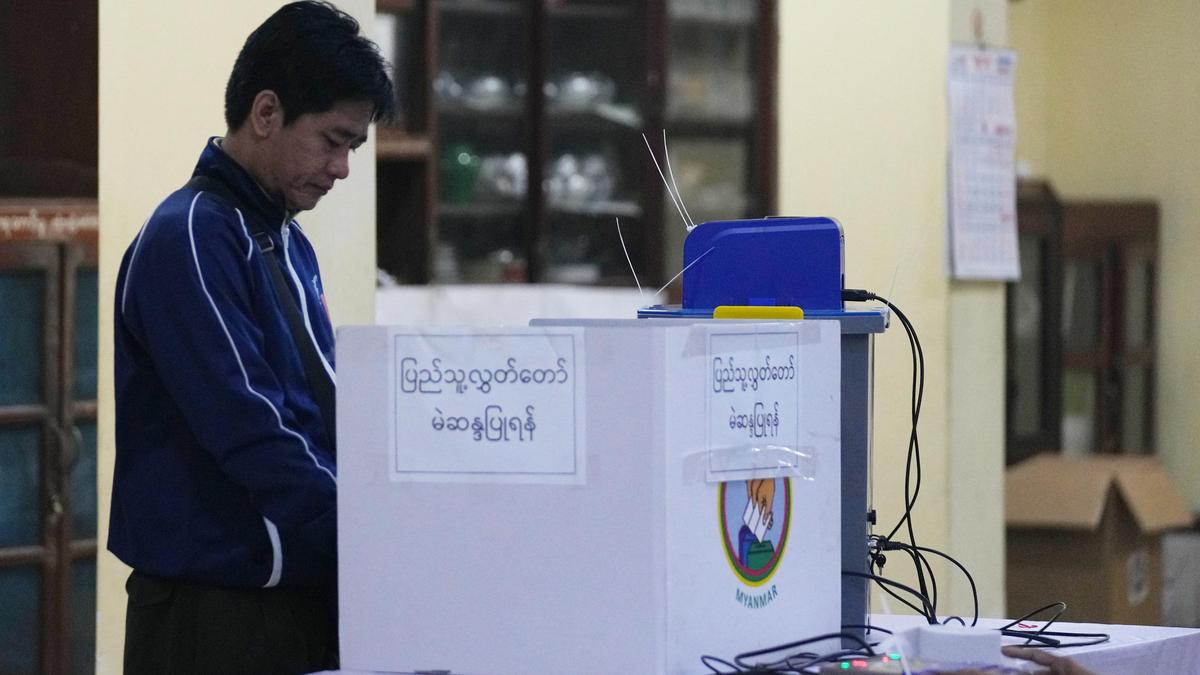
Myanmar is currently conducting the second phase of its military-run election.
GK and monthly revision
Myanmar votes in second phase of military-run election
Myanmar is conducting a second phase of its military-run election, with the military-backed Union Solidarity and Development Party (USDP) already securing 90 out of 102 lower house seats in the first phase on December 28, 2025. This significant lead, coupled with a low voter turnout of 52.13%, highlights the military's strong influence and potential implications for democratic processes in the neighboring nation, crucial for understanding regional geopolitics.
Revision structure
Monthly events and exam calendar context
Static GK and one-liner notes
Quiz and mock-test revision path
Key points
Exam-ready takeaways
The military-backed Union Solidarity and Development Party (USDP) is leading significantly.
The USDP won 90 of the 102 lower house seats contested in the first phase.
The first phase of the election took place on December 28, 2025.
Voter turnout in the first phase was 52.13%, which is lower than the 2020 and 2015 elections.
Detailed analysis
Full exam-oriented breakdown
Myanmar, a nation sharing a significant land and maritime border with India, has been embroiled in a protracted political crisis since the military (Tatmadaw) staged a coup on February 1, 2021, overthrowing the democratically elected government of Aung San Suu Kyi's National League for Democracy (NLD). This coup ended a decade-long experiment with civilian rule, plunging the country back into military dominance. The recent military-run election, with its first phase on December 28, 2025, and a second phase underway, must be understood within this turbulent context. The background to this election is crucial. Following the 2020 general election, which saw the NLD win a landslide victory, the military alleged widespread voter fraud, a claim largely unsubstantiated by independent observers. Using these allegations as a pretext, the Tatmadaw seized power, arrested key civilian leaders, and declared a state of emergency. This move sparked widespread public protests, which were brutally suppressed, leading to a civil disobedience movement and the formation of armed resistance groups, including the People's Defence Forces (PDFs), aligned with the National Unity Government (NUG) – a shadow government formed by ousted lawmakers. What is happening now is the military's attempt to legitimize its rule through a controlled electoral process. The Union Solidarity and Development Party (USDP), a political party explicitly backed by the military, has already secured a significant lead, winning 90 of the 102 lower house seats contested in the first phase. This overwhelming victory, coupled with a remarkably low voter turnout of 52.13% (significantly lower than the 2015 and 2020 elections), underscores the lack of genuine democratic participation and widespread public boycott or fear. Many political parties, including the NLD, have been either banned or their leaders imprisoned, effectively removing any credible opposition. Key stakeholders in this unfolding drama include the **Tatmadaw** and its political front, the **USDP**, which are consolidating power and seeking international recognition for their regime. The **National Unity Government (NUG)** and the **People's Defence Forces (PDFs)** represent the resistance, advocating for a return to democracy and often engaging in armed struggle against the junta. **Aung San Suu Kyi** and the **NLD** remain symbolic figures of the democratic movement, though their influence is curtailed by imprisonment and political repression. Internationally, **ASEAN** has struggled to find a unified and effective response, while Western nations have imposed sanctions. **China**, a major neighbor and investor, maintains a pragmatic approach, focusing on stability and economic interests. **India** navigates a delicate balance, engaging with the junta for strategic reasons while also expressing concerns for democracy. This situation holds immense significance for India. Myanmar is a crucial component of India's 'Neighbourhood First' policy and 'Act East' policy. A stable, democratic Myanmar is vital for India's regional security, economic connectivity, and strategic interests. The ongoing instability directly impacts India's internal security, particularly in its northeastern states, due to the influx of refugees (predominantly from the Chin state), cross-border movement of insurgents, and disruptions to vital infrastructure projects like the Kaladan Multi-Modal Transit Transport Project. The project aims to connect the eastern Indian seaport of Kolkata with Sittwe seaport in Myanmar by sea; it then links Sittwe to Paletwa in Myanmar via Kaladan riverboat, and from Paletwa to Mizoram in India by road. Instability jeopardizes its completion and operational efficiency, hindering India's access to Southeast Asia. Historically, Myanmar has a long legacy of military rule, interspersed with brief periods of civilian governance. The 2008 Constitution, drafted under military supervision, enshrined a significant role for the Tatmadaw in politics, reserving 25% of parliamentary seats for unelected military personnel and giving them veto power over constitutional amendments. This structural advantage highlights the deeply entrenched nature of military influence, making genuine democratic transition incredibly challenging. The current election is seen by many as another iteration of the military's tactic to formalize its control under a civilian façade. The future implications are stark. A military-dominated parliament, as this election is set to create, means continued authoritarian rule, likely perpetuating the civil conflict and worsening the humanitarian crisis. International isolation for Myanmar may deepen, although countries like China and Russia might continue engagement. For India, the challenge of balancing strategic engagement with democratic values will persist. India's foreign policy, guided by principles outlined in its approach to regional stability and economic integration, will need to carefully navigate the complex geopolitical landscape of a volatile Myanmar. While no specific Indian constitutional articles are directly applicable to Myanmar's internal elections, India's foreign policy decisions are rooted in the Directive Principles of State Policy (Article 51) which encourages the promotion of international peace and security, maintenance of just and honourable relations between nations, and respect for international law and treaty obligations. The continued crisis demands a nuanced diplomatic approach to safeguard India's security and economic interests while upholding its democratic principles.
How to study
Turn news into exam marks
Revise monthly events by exam family instead of reading random updates.
Pair one-liners with mock tests so mistakes become the next revision list.
Keep state job pages, calendar pages and GK packs connected in one path.