

Union Home Minister Amit Shah made the statement regarding governance in a state.
GK and monthly revision
Bhajanlal government ended 'paper leak culture' started during Congress rule: Amit Shah
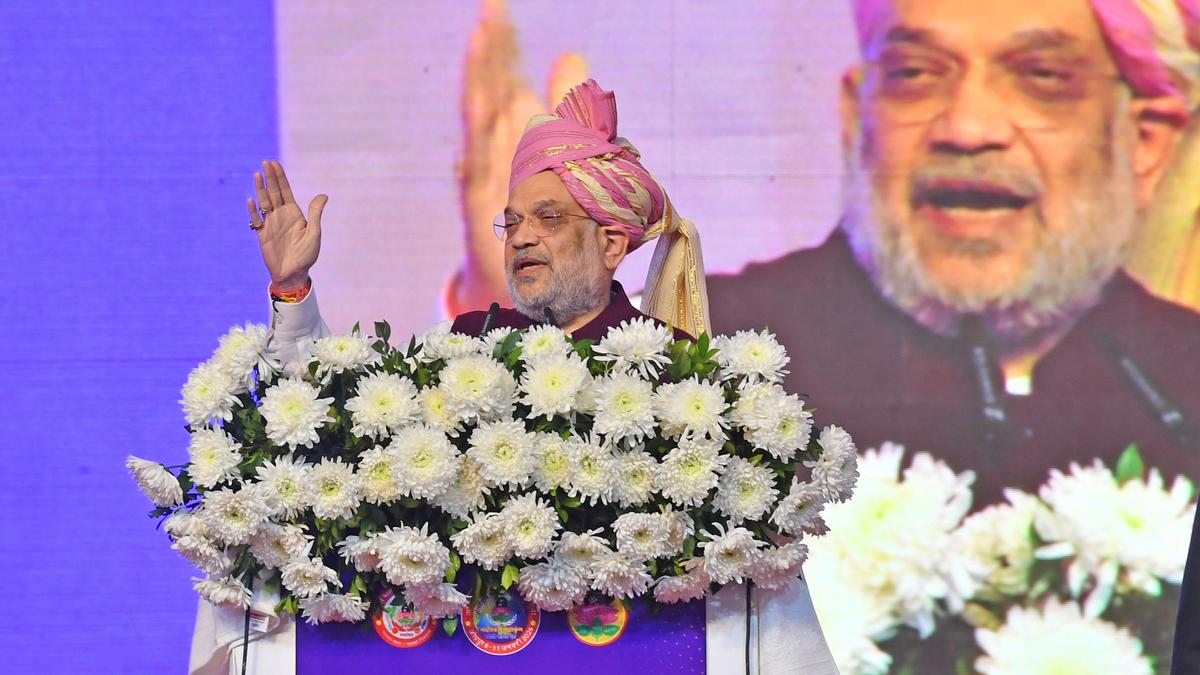
Union Home Minister Amit Shah praised the Bhajanlal government in Rajasthan for allegedly ending the 'paper leak culture' that he attributed to the previous Congress rule. Shah highlighted significant improvements in law and order, stating that serious crimes in the state declined by 19%, murders by 25%, and crimes against women by approximately 10%. This news is important for competitive exams as it covers governance, law and order statistics, and political accountability at the state level.
Revision structure
Monthly events and exam calendar context
Static GK and one-liner notes
Quiz and mock-test revision path
Key points
Exam-ready takeaways
The Bhajanlal government was credited for ending the 'paper leak culture' in the State (Rajasthan).
The 'paper leak culture' was attributed to the previous Congress rule in the State.
Serious crimes in the State reportedly declined by 19% during the Bhajanlal government's tenure.
Cases of murder decreased by 25%, and crimes against women by approximately 10% in the State.
Detailed analysis
Full exam-oriented breakdown
The statement by Union Home Minister Amit Shah, crediting the Bhajanlal government in Rajasthan for curbing the 'paper leak culture' and improving law and order, offers a multi-faceted insight into governance challenges, political discourse, and their implications for India's youth and administrative efficiency. This issue is highly relevant for competitive exams as it touches upon crucial aspects of Indian polity, governance, and social justice. **Background Context: The Scourge of Paper Leaks** The 'paper leak culture' refers to the illicit practice of question papers for competitive examinations being leaked before the actual exam, often for monetary gain. This phenomenon has plagued India's competitive examination system for decades, leading to widespread frustration, despair, and financial loss for millions of aspirants. For many, a government job is a ticket to economic stability and social mobility, making these exams intensely competitive. When papers leak, the entire process is compromised, undermining meritocracy and trust in public institutions. Rajasthan, like several other states, has witnessed numerous instances of paper leaks across various recruitment exams, impacting thousands of candidates and often leading to exam cancellations and significant delays. The previous Congress government in Rajasthan faced considerable criticism and public protests over these incidents. **What Happened: A Claim of Improved Governance** Union Home Minister Amit Shah, a prominent figure in the ruling Bharatiya Janata Party (BJP), lauded the Bhajanlal Sharma-led BJP government in Rajasthan for allegedly putting an end to this 'paper leak culture.' He explicitly attributed the origin of this problem to the preceding Congress government. Beyond exam integrity, Shah also highlighted significant improvements in the state's law and order situation, citing a 19% decline in serious crimes, a 25% reduction in murder cases, and approximately a 10% decrease in crimes against women during the Bhajanlal government's tenure. These statistics, if accurate, point towards a notable shift in the state's internal security landscape. **Key Stakeholders Involved:** 1. **Union Home Minister Amit Shah:** As a central government representative, his statements carry political weight, often setting the narrative for the ruling party's performance and accountability. His remarks reflect the BJP's focus on 'good governance' and 'law and order.' 2. **Bhajanlal Government (Rajasthan):** The incumbent state government, directly responsible for implementing policies, maintaining law and order, and ensuring fair conduct of examinations. The praise from the Home Minister boosts its image and validates its administrative efforts. 3. **Previous Congress Government (Rajasthan):** The government under scrutiny, accused of failing to curb paper leaks, highlighting the political blame game inherent in federal governance. 4. **Competitive Exam Aspirants:** The primary victims of paper leaks, whose futures are directly impacted by the integrity of the examination system. Their trust in the system is crucial for social stability. 5. **Law Enforcement Agencies (Rajasthan Police):** Tasked with preventing crime, investigating leaks, and maintaining public order. Their effectiveness is critical to achieving the stated improvements in crime statistics. 6. **State Public Service Commissions (RPSC) and other Recruitment Boards:** These autonomous bodies are responsible for conducting exams, and their integrity and operational efficiency are paramount in preventing leaks. **Significance for India:** This development holds immense significance for India. Firstly, it underscores the critical importance of **governance and accountability** at the state level. Law and order, along with public service delivery (including fair examinations), are core responsibilities of state governments. Secondly, the issue of **paper leaks directly impacts youth employment and social justice**. A fair examination system ensures that jobs are awarded on merit, preventing the disillusionment and frustration that often fuel social unrest. Thirdly, the focus on **crime reduction** highlights the fundamental role of a secure environment for economic development and citizen well-being. Finally, the political discourse reflects the dynamic nature of **Indian federalism**, where central leaders often comment on state administration, influencing public perception and inter-party competition. **Historical Context and Future Implications:** The problem of paper leaks is not new. Over the years, various states and the central government have tried to combat it through administrative reforms, technology integration, and stricter laws. The central government's recent initiative, the **Public Examinations (Prevention of Unfair Means) Bill, 2024**, which became an Act, is a landmark step. This Act aims to prevent malpractices and unfair means in public examinations and provides for a maximum imprisonment of up to 10 years and a fine of up to Rs 1 crore for those involved in paper leaks. This central law directly addresses the 'paper leak culture' and empowers states to take stringent action. The Bhajanlal government's actions, if successful, could serve as a model for other states. Future implications include greater public trust in the examination system, potentially leading to reduced protests and enhanced focus on merit. It also sets a precedent for how state governments can leverage central legislation to address state-specific issues, reinforcing the cooperative federalism framework. The sustained decline in crime rates would foster a more secure environment, attracting investment and improving the quality of life for citizens. **Related Constitutional Articles, Acts, and Policies:** * **Seventh Schedule (State List):** Entries 1 ('Public order') and 2 ('Police') clearly place the primary responsibility for law and order and policing with the state governments. This makes the state government's performance in these areas directly accountable. * **Article 355:** While not directly invoked, it outlines the duty of the Union to protect every State against external aggression and internal disturbance, subtly indicating the Centre's overarching concern for state-level law and order. * **Public Examinations (Prevention of Unfair Means) Act, 2024:** This crucial central legislation, enacted recently, provides a robust legal framework to deter and punish individuals and organizations involved in examination malpractices, including paper leaks. Its provisions include severe penalties, making it a powerful tool for state governments. * **Indian Penal Code (IPC):** Various sections of the IPC (e.g., related to cheating, criminal conspiracy) are applicable in cases of examination malpractices, though the new central Act provides more specific and stringent provisions. * **State Police Acts:** These acts govern the functioning, powers, and responsibilities of the state police forces, which are instrumental in maintaining law and order and investigating crimes.
How to study
Turn news into exam marks
Revise monthly events by exam family instead of reading random updates.
Pair one-liners with mock tests so mistakes become the next revision list.
Keep state job pages, calendar pages and GK packs connected in one path.