

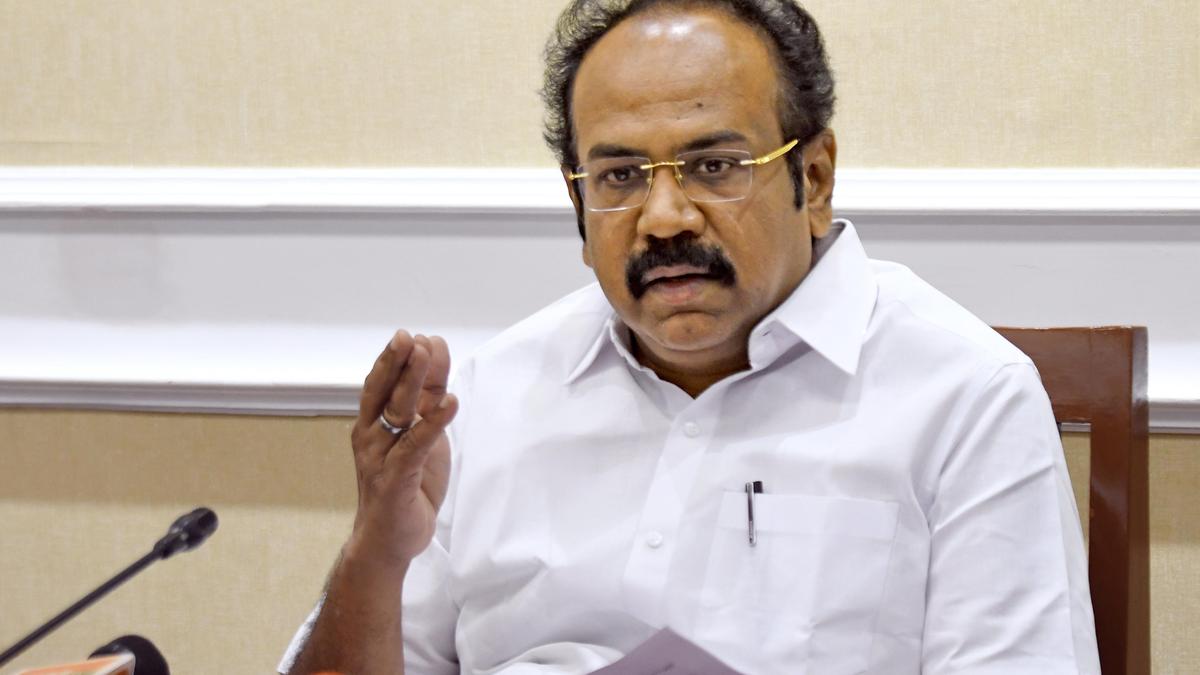
Tamil Nadu Finance Minister Thangam Thennarasu participated in a pre-Budget meeting with the Centre.
GK and monthly revision
At pre-Budget meet, Thangam Thennarasu flags GST losses, seeks release of pending dues
Tamil Nadu Finance Minister Thangam Thennarasu, at a pre-Budget meet, flagged state GST revenue losses and urged the Centre to release pending financial dues. He also sought reconsideration for Metro Rail projects in Madurai and Coimbatore, citing inconsistent approval criteria. This highlights critical aspects of fiscal federalism and state-Centre financial relations, vital for competitive exam understanding of Indian economy and governance.
Revision structure
Monthly events and exam calendar context
Static GK and one-liner notes
Quiz and mock-test revision path
Key points
Exam-ready takeaways
He highlighted the state's significant revenue losses due to the Goods and Services Tax (GST) regime.
The Minister urged the Union Government to expedite the release of pending financial dues to Tamil Nadu.
Thangam Thennarasu requested reconsideration of Metro Rail proposals specifically for Madurai and Coimbatore cities.
The rejection grounds for Madurai and Coimbatore Metro projects were cited as inconsistent with approvals granted to similar projects in other cities.
Detailed analysis
Full exam-oriented breakdown
The recent pre-Budget meeting, where Tamil Nadu Finance Minister Thangam Thennarasu flagged significant GST revenue losses and sought the release of pending financial dues, along with a reconsideration for Metro Rail projects in Madurai and Coimbatore, encapsulates critical facets of India's fiscal federalism. This event is not merely a state's demand but a recurring theme in the intricate financial relationship between the Union Government and the states, holding profound implications for India's economic stability and cooperative governance. **Background Context: The Evolution of Fiscal Federalism and GST** India operates as a quasi-federal nation, where the distribution of powers and responsibilities between the Centre and states is enshrined in the Constitution. Fiscal federalism, the division of financial powers and responsibilities, is a cornerstone of this structure. Historically, states have often felt constrained by their limited revenue-raising powers compared to their extensive expenditure responsibilities, particularly in social sectors like health, education, and public order. This imbalance necessitates transfers from the Centre to states, facilitated primarily through the recommendations of the Finance Commission (mandated by Article 280 of the Constitution) and various grants. The Goods and Services Tax (GST), implemented on July 1, 2017, marked a monumental shift in India's indirect tax regime. Envisioned as a 'one nation, one tax' system, it subsumed a multitude of central and state indirect taxes (like excise duty, service tax, VAT, luxury tax). While GST aimed to create a common national market, reduce cascading effects, and boost tax compliance, it also entailed a significant relinquishment of fiscal autonomy by states. States gave up their power to levy VAT and other indirect taxes, relying instead on GST collections and a share of central taxes. To assuage states' concerns about potential revenue losses in the initial years, the GST (Compensation to States) Act, 2017, was enacted. This Act guaranteed states compensation for any revenue shortfall below a projected 14% annual growth rate for a period of five years, ending on June 30, 2022. The compensation was to be funded through a 'GST Compensation Cess' levied on certain goods. **What Happened: Tamil Nadu's Grievances** At the pre-Budget consultation, a standard exercise where the Union Finance Minister seeks inputs from state finance ministers, Tamil Nadu's FM Thangam Thennarasu raised two primary concerns. Firstly, he highlighted the state's continued revenue losses even after the compensation period for GST ended in June 2022. Many states, including Tamil Nadu, argue that the projected 14% growth rate for compensation was unrealistic and that their own revenue growth has not kept pace, leading to a structural deficit. He urged the Centre to release pending financial dues, which could include previous GST compensation arrears or other central grants. Secondly, the Minister sought reconsideration for the proposed Metro Rail projects in Madurai and Coimbatore. The core of his argument was that the grounds cited by the Centre for rejecting these projects were inconsistent with the criteria used to approve similar projects in other cities, implying a lack of transparent or equitable decision-making in central infrastructure funding. **Key Stakeholders Involved** 1. **Union Government (Ministry of Finance)**: As the custodian of central finances and the convener of the pre-Budget meeting, it is responsible for formulating the Union Budget, managing central transfers to states, and overseeing national infrastructure projects. It also plays a dominant role in the GST Council. 2. **State Government of Tamil Nadu (and other states)**: As the recipient of central transfers and a key player in implementing development projects, states advocate for their fiscal needs and regional development priorities. Their financial health directly impacts their ability to provide public services. 3. **GST Council**: Constituted under Article 279A, this is the apex decision-making body for GST, comprising the Union Finance Minister (chairperson) and state finance ministers. Debates over GST revenue sharing, compensation mechanisms, and tax rates are deliberated here. 4. **Citizens/Taxpayers**: Ultimately, the financial health of both Centre and states, and the effective allocation of funds for infrastructure, directly impact public welfare, job creation, and quality of life. **Why This Matters for India: Significance and Implications** This episode underscores several critical aspects of Indian governance and economy: * **Challenges to Fiscal Federalism**: The continued demand for GST compensation and the dispute over pending dues highlight the ongoing tensions in Centre-state financial relations. Post-GST compensation, states are increasingly vocal about their reduced fiscal autonomy and dependence on central grants, which can sometimes come with conditionalities. * **Impact of GST on State Finances**: While GST streamlined indirect taxes, many states argue that it has made them fiscally weaker, especially after the cessation of the compensation mechanism. This can lead to reduced spending on crucial state subjects and potential debt accumulation. * **Equitable Regional Development**: The Metro Rail project dispute points to concerns about the impartial allocation of central funds for infrastructure. Discrepancies in project approvals can exacerbate regional disparities and fuel political discontent, especially in states with different ruling parties than the Centre. * **Transparency and Accountability**: The demand for consistent criteria in project approvals calls for greater transparency in central decision-making processes, ensuring that development projects are evaluated objectively rather than politically. * **Future of Cooperative Federalism**: Such issues test the spirit of cooperative federalism. Effective dialogue, mutual trust, and transparent mechanisms are essential to ensure both the fiscal health of states and the overall economic growth of the nation. **Constitutional and Policy References** * **Article 246A**: Grants concurrent power to Parliament and state legislatures to make laws with respect to GST. This unique article underscores the shared sovereignty over indirect taxation. * **Article 279A**: Establishes the GST Council, a body crucial for harmonizing GST laws and rates across the country. * **Article 280**: Mandates the President to constitute a Finance Commission every five years to recommend the distribution of net proceeds of taxes between the Union and states, and the principles governing grants-in-aid. * **GST (Compensation to States) Act, 2017**: The legal framework that guaranteed compensation to states for revenue losses due to GST implementation for five years. * **NITI Aayog**: While not a constitutional body, it replaced the Planning Commission and aims to foster cooperative federalism by involving states in policy-making, though its financial allocation powers are limited compared to its predecessor. **Future Implications** The ongoing debates over GST compensation and central funding for projects suggest that the Centre-state financial dynamics will remain a key area of policy discourse. States may continue to lobby for an extension of the compensation mechanism or a new revenue-sharing formula within the GST framework. The 16th Finance Commission, soon to be constituted, will have a crucial role in recommending new devolution formulas and grants, potentially addressing some of these structural issues. For states like Tamil Nadu, securing central support for large-scale infrastructure projects like Metro Rail is vital for urban development and economic growth. The resolution of these issues will determine the strength of India's federal structure and its ability to achieve inclusive and equitable development.
How to study
Turn news into exam marks
Revise monthly events by exam family instead of reading random updates.
Pair one-liners with mock tests so mistakes become the next revision list.
Keep state job pages, calendar pages and GK packs connected in one path.