

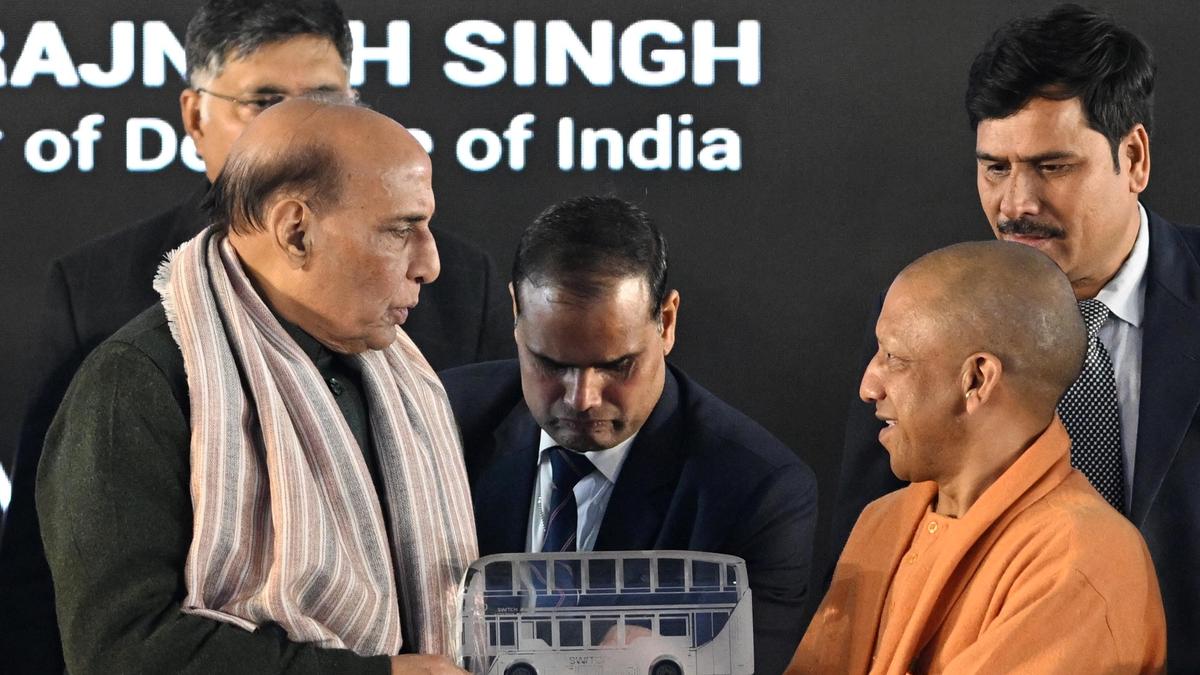
Defence Minister Rajnath Singh announced an investment of over ₹34,000 crore in the Uttar Pradesh Defence Industrial Corridor (UPEIDA) nodes.
GK and monthly revision
More than ₹34,000 crore investment made in Uttar Pradesh defence corridor nodes: Defence Minister Rajnath Singh
Defence Minister Rajnath Singh announced that over ₹34,000 crore has been invested in the Uttar Pradesh Defence Industrial Corridor (UPEIDA) nodes. This significant investment highlights the government's push for 'Aatmanirbhar Bharat' in defence manufacturing, creating jobs and boosting the state's economy. For competitive exams, this showcases major infrastructure projects, government initiatives, and economic development, crucial for General Awareness sections.
Revision structure
Monthly events and exam calendar context
Static GK and one-liner notes
Quiz and mock-test revision path
Key points
Exam-ready takeaways
The announcement was made during the inauguration of Ashok Leyland's electric vehicle manufacturing plant.
The Ashok Leyland electric vehicle plant was inaugurated in Lucknow, Uttar Pradesh.
The Uttar Pradesh Defence Industrial Corridor is a key project under the 'Aatmanirbhar Bharat' initiative for indigenous defence manufacturing.
The corridor aims to attract investment and foster defence production across various nodes in Uttar Pradesh.
Detailed analysis
Full exam-oriented breakdown
The announcement by Defence Minister Rajnath Singh regarding an investment of over ₹34,000 crore in the Uttar Pradesh Defence Industrial Corridor (UPEIDA) nodes marks a significant milestone in India's journey towards self-reliance in defence manufacturing. This development, highlighted during the inauguration of Ashok Leyland's electric vehicle manufacturing plant in Lucknow, underscores the government's unwavering commitment to the 'Aatmanirbhar Bharat' initiative, particularly in the critical defence sector. For competitive exam aspirants, understanding this event requires delving into its background, implications, and linkages to broader national policies. **Background Context and Historical Trajectory:** India has historically been one of the world's largest importers of defence equipment. This dependence posed significant strategic vulnerabilities, impacting national security and draining foreign exchange reserves. To address this, successive governments have emphasized indigenization. The 'Make in India' initiative, launched in 2014, provided a renewed thrust, aiming to transform India into a global manufacturing hub. Within 'Make in India', defence was identified as a core sector for domestic production. The concept of Defence Industrial Corridors emerged from this vision, with two such corridors announced: one in Tamil Nadu and the other in Uttar Pradesh. These corridors are designed to create an ecosystem for defence manufacturing by attracting investments, fostering innovation, and providing necessary infrastructure. **What Happened and Key Stakeholders:** Defence Minister Rajnath Singh announced that the UPEIDA has attracted investments exceeding ₹34,000 crore. This substantial figure reflects the growing confidence of both domestic and international players in India's defence manufacturing potential. The announcement coincided with the inauguration of Ashok Leyland's electric vehicle manufacturing plant in Lucknow, a testament to the private sector's active participation. Key stakeholders in this endeavour include: 1. **Ministry of Defence, Government of India:** Responsible for policy formulation, strategic direction, and creating a conducive environment for defence production through initiatives like the Defence Acquisition Procedure (DAP) 2020 and the negative import list for various defence items. 2. **Uttar Pradesh Government (through UPEIDA):** Plays a crucial role in land acquisition, developing necessary infrastructure (roads, power, water), and providing incentives to attract investors. UPEIDA acts as the nodal agency for facilitating these investments. 3. **Private Sector Companies (e.g., Ashok Leyland):** These companies are the actual investors and manufacturers, bringing in capital, technology, and creating employment opportunities. Their participation is vital for achieving the scale and technological advancement required. 4. **Public Sector Undertakings (PSUs) and Ordnance Factory Board (OFB):** While the focus is on private investment, existing PSUs and the corporatized entities of OFB also contribute to the defence ecosystem. **Significance for India:** This investment holds immense significance across multiple dimensions for India: * **Economic Boost:** The ₹34,000 crore investment translates into significant job creation, both direct and indirect, across various skill levels. It will boost the state's economy, contribute to GDP growth, and foster ancillary industries, especially MSMEs, which form the backbone of the supply chain. * **Strategic Autonomy:** Reducing reliance on imports enhances India's strategic autonomy, making it less vulnerable to geopolitical pressures and supply chain disruptions during conflicts. It ensures a consistent supply of critical defence equipment. * **Technological Advancement:** The corridor will encourage research and development (R&D) and technology absorption, fostering innovation in cutting-edge defence technologies, including electric vehicles, drones, cybersecurity, and advanced weaponry. * **Regional Development:** The six nodes identified in UPEIDA (Aligarh, Agra, Jhansi, Chitrakoot, Lucknow, and Kanpur) will see concentrated industrial development, leading to balanced regional growth and better infrastructure. * **Export Potential:** As India's defence manufacturing capabilities mature, it can transition from an importer to an exporter of defence equipment, contributing to foreign exchange earnings and strengthening diplomatic ties. **Constitutional and Policy Framework:** Defence is a subject under the **Union List** (Entry 1 of the Seventh Schedule) of the Indian Constitution, as per **Article 246**, underscoring the central government's primary role in defence policy and procurement. The investment aligns with the overarching **'Aatmanirbhar Bharat Abhiyan'** (Self-Reliant India Campaign), launched in May 2020, which emphasizes local manufacturing and global competitiveness. Specific policies driving this include the **Defence Acquisition Procedure (DAP) 2020**, which prioritizes 'Buy (Indian – IDDM)' (Indigenously Designed, Developed and Manufactured) and 'Make' categories, and the gradual **negative import list** for defence items, mandating their indigenous procurement over time. These policies provide the regulatory and financial incentives necessary for private sector participation. **Future Implications:** The successful implementation of the UPEIDA, along with the Tamil Nadu Defence Corridor, could transform India into a significant global player in defence manufacturing. It will foster a robust R&D ecosystem, attract further foreign direct investment (FDI) in defence (which was liberalized up to 74% through the automatic route in 2020), and lead to the development of state-of-the-art defence technologies. The focus on electric vehicles, as evidenced by the Ashok Leyland plant, also signals a move towards sustainable and futuristic defence solutions. The corridor's success will be crucial for India's long-term national security, economic prosperity, and technological leadership.
How to study
Turn news into exam marks
Revise monthly events by exam family instead of reading random updates.
Pair one-liners with mock tests so mistakes become the next revision list.
Keep state job pages, calendar pages and GK packs connected in one path.