

The Aravalli hills are one of the world's oldest mountain ranges, estimated to be approximately 2 billion years old.
GK and monthly revision
The Aravalli hills are shaken with the sound of machinery
The ancient Aravalli hills, aged 2 billion years, face severe threats from mining, waste dumping, and encroachment. A Supreme Court order accepting a changed definition of the Aravallis, which caused environmental concern, has since been stayed. This issue is crucial for exams, highlighting environmental protection, judicial intervention, and the significance of community participation in India's geographical heritage.
Revision structure
Monthly events and exam calendar context
Static GK and one-liner notes
Quiz and mock-test revision path
Key points
Exam-ready takeaways
The Aravalli range is currently facing significant environmental degradation due to mining, waste dumping, and encroachment.
The Supreme Court had initially issued an order accepting a revised definition of the Aravalli hills, which raised environmental concerns.
The Supreme Court's controversial order regarding the changed definition of the Aravalli hills has subsequently been stayed.
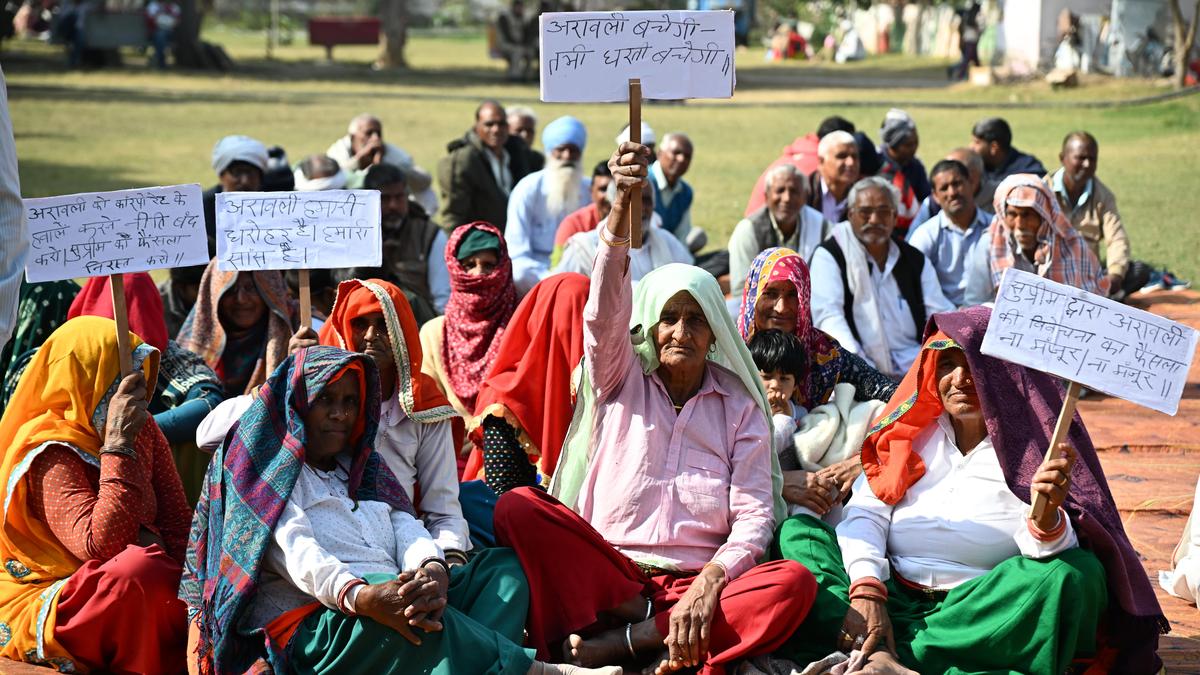
Environmentalists and local communities emphasize the need for decisions concerning the Aravallis to involve and benefit the people living in its foothills.
Detailed analysis
Full exam-oriented breakdown
The Aravalli hills, one of the world's oldest fold mountain ranges, stand as a geological marvel, estimated to be approximately 2 billion years old. Stretching across Gujarat, Rajasthan, Haryana, and Delhi, this ancient range plays a critical ecological role, acting as a natural barrier against desertification from the Thar Desert, a crucial groundwater recharge zone for the water-stressed National Capital Region, and a biodiversity hotspot. Historically, the Aravallis have been a lifeline for communities, providing forest produce, water, and traditional livelihoods. However, this invaluable natural heritage is currently under immense threat. The primary culprits are rampant illegal mining of stone, sand, and other minerals, unregulated waste dumping (including municipal solid waste and construction & demolition debris), and extensive encroachment driven by rapid urbanization and agricultural expansion. These activities have led to severe environmental degradation, including deforestation, soil erosion, depletion of groundwater tables, and loss of biodiversity. The very existence of this green lung, particularly for the Delhi-NCR region, is being compromised, leading to increased air pollution and a heightened risk of dust storms. A significant development that stirred environmental concern was a Supreme Court order that initially accepted a changed definition of the Aravalli hills. While the specifics of this redefinition were not detailed in the public domain, environmentalists and concerned citizens feared that a narrower interpretation of what constitutes 'Aravalli' for protection purposes could exclude vast tracts of land from conservation efforts. This could potentially open up previously protected areas to further mining, construction, and other destructive activities. Fortunately, the Supreme Court subsequently stayed its own controversial order, offering a temporary reprieve and renewed hope for conservationists. Numerous stakeholders are involved in this complex issue. Environmentalists and Non-Governmental Organizations (NGOs) like the Centre for Science and Environment and local Aravalli Bachao Abhiyans are at the forefront, advocating for stricter enforcement of environmental laws and filing petitions in courts. Local communities residing in the foothills are direct stakeholders; their livelihoods, access to water, and overall well-being are intrinsically linked to the health of the Aravallis. They emphasize the need for participatory decision-making, ensuring that conservation efforts involve and benefit those who live closest to the range. State governments (Rajasthan, Haryana, Gujarat, Delhi) are crucial players, responsible for policy formulation, land use planning, and enforcement, often balancing developmental pressures with environmental imperatives. Mining lobbies and real estate developers represent economic interests, often pushing for relaxed regulations. Lastly, the Judiciary, particularly the Supreme Court and the National Green Tribunal, plays a pivotal role in interpreting environmental laws, issuing directives, and holding authorities accountable. This issue holds profound significance for India. Ecologically, the Aravallis are vital for water security, acting as a watershed for numerous rivers and recharging aquifers crucial for millions. Their degradation exacerbates water scarcity in an already water-stressed region. Economically, while mining provides revenue, illegal mining leads to massive revenue losses and irreversible environmental damage. Socially, the health impacts of pollution and resource depletion disproportionately affect vulnerable communities. From a governance perspective, the Aravalli situation highlights challenges in inter-state coordination for environmental protection, enforcement of laws, and the persistent struggle to balance economic development with ecological sustainability. The Indian Constitution provides a framework for environmental protection. Article 48A, a Directive Principle of State Policy, mandates that "The State shall endeavor to protect and improve the environment and to safeguard the forests and wild life of the country." Furthermore, Article 51A(g) enshrines a Fundamental Duty for every citizen "to protect and improve the natural environment including forests, lakes, rivers and wild life, and to have compassion for living creatures." Key legislation includes the Environment (Protection) Act, 1986, the Forest (Conservation) Act, 1980, and the Mines and Minerals (Development and Regulation) Act, 1957. The National Green Tribunal Act, 2010, established a specialized body for effective and expeditious disposal of cases relating to environmental protection. The historical context of Aravalli exploitation dates back decades, with increasing pressure post-independence due to industrialization and urbanization. The future implications are stark: continued degradation could lead to irreversible ecological damage, severe water crises, increased desertification, and a decline in public health. The stay on the Supreme Court order offers a window of opportunity to strengthen conservation efforts. Moving forward, there is a critical need for a comprehensive, scientifically robust definition of the Aravalli range, stricter enforcement of environmental laws, satellite monitoring to curb illegal activities, and, most importantly, meaningful community participation in conservation strategies. Sustainable mining practices, eco-tourism, and reforestation initiatives must be promoted to ensure the long-term health of this ancient mountain range for future generations.
How to study
Turn news into exam marks
Revise monthly events by exam family instead of reading random updates.
Pair one-liners with mock tests so mistakes become the next revision list.
Keep state job pages, calendar pages and GK packs connected in one path.