

The Southern Transitional Council (STC) is the separatist group driving the independence plan in Yemen.
GK and monthly revision
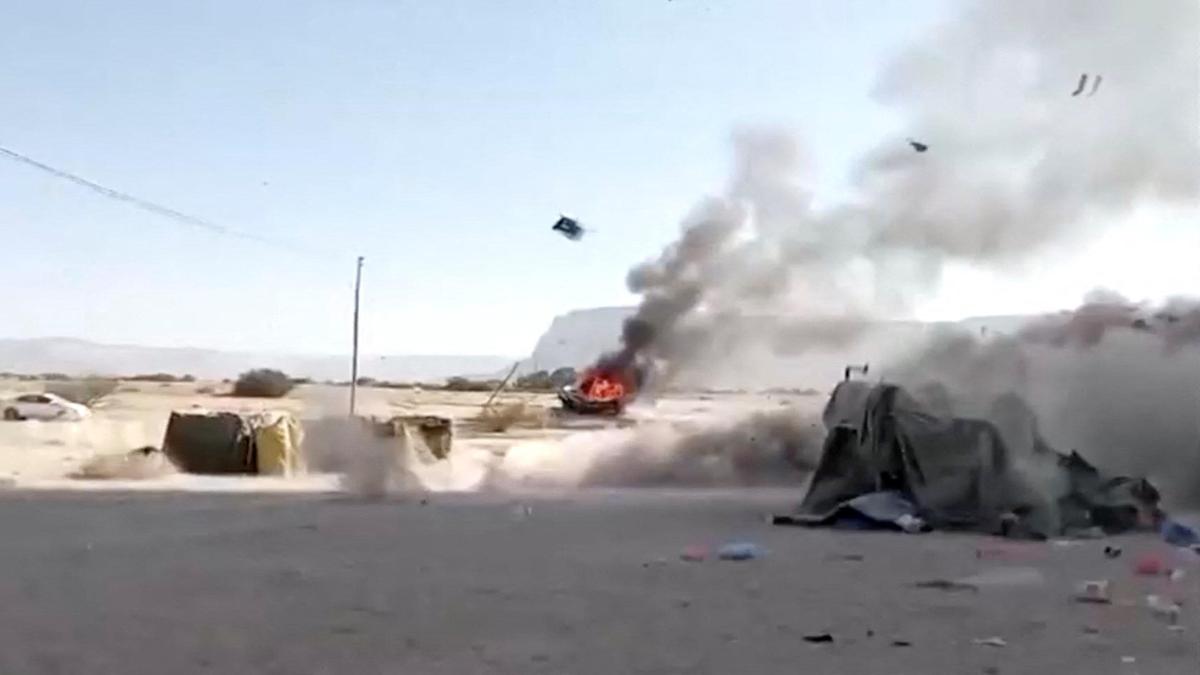
Yemen separatists launch two-year independence transition as strikes kill 20
Yemen's Southern Transitional Council (STC) has initiated a two-year plan for independence, aiming to split the country into North and South Yemen once again. This move is significant for competitive exams as it highlights ongoing geopolitical instability in the Middle East, the historical context of Yemen's division from 1967-1990, and the role of separatist movements in international relations. The potential re-division could reshape regional dynamics and humanitarian crises.
Revision structure
Monthly events and exam calendar context
Static GK and one-liner notes
Quiz and mock-test revision path
Key points
Exam-ready takeaways
The STC has launched a two-year transition plan aiming for the independence of South Yemen.
Yemen was historically divided into North and South from 1967 until its unification in 1990.
The ongoing conflict in Yemen, exacerbated by these separatist moves, has led to significant casualties, with strikes recently killing 20 people.
The potential re-division of Yemen into North and South has major implications for regional stability in the Middle East.
Detailed analysis
Full exam-oriented breakdown
Yemen, a nation often termed the 'forgotten war,' finds itself at another critical juncture with the Southern Transitional Council (STC) announcing a two-year plan for the independence of South Yemen. This move threatens to re-carve the country along historical lines, potentially exacerbating an already catastrophic humanitarian crisis and significantly altering the geopolitical landscape of the Arabian Peninsula and the wider Middle East. To truly grasp the gravity of this development, we must first delve into Yemen's complex past. From 1967 to 1990, Yemen was indeed two distinct entities: the Yemen Arab Republic (North Yemen), with its capital in Sana'a, and the People's Democratic Republic of Yemen (South Yemen), a socialist state with Aden as its capital. This division was a legacy of colonial influences, with the North influenced by Ottoman rule and the South by British rule. The unification in 1990 was initially hailed as a triumph, but underlying tensions, primarily southern grievances over perceived marginalization and economic disparity by the northern-dominated government, simmered. These grievances eventually boiled over, leading to a brief civil war in 1994, which the South lost, further entrenching northern dominance. The current crisis is a direct offshoot of the broader Yemeni civil war, which escalated dramatically in 2014-2015. The Houthi rebels, an Iran-aligned group from the North, overran the capital Sana'a and ousted the internationally recognized government of President Abdrabbuh Mansur Hadi. This prompted a Saudi Arabia-led coalition, backed by the United Arab Emirates (UAE) and Western powers, to intervene in March 2015 to restore Hadi's government. Amidst this chaos, the STC emerged in 2017, consolidating various southern separatist factions. While initially fighting alongside the Saudi-led coalition against the Houthis, the STC's primary objective has always been the restoration of an independent South Yemen. The recent announcement of a two-year transition period for independence, coupled with reports of strikes killing 20 people, underscores the STC's resolve and the escalating violence. Key stakeholders in this intricate conflict include the **Southern Transitional Council (STC)**, which represents southern secessionist aspirations and enjoys significant support from the UAE. The **internationally recognized Yemeni government** (currently exiled and led by President Hadi) staunchly opposes secession, advocating for a unified Yemen. The **Houthi rebels** control a large portion of northern Yemen, including Sana'a, and their primary focus is consolidating their power against the Hadi government and the Saudi-led coalition. **Saudi Arabia** leads the intervention, aiming to counter Iranian influence and restore the Hadi government, but its interests are complicated by the STC's secessionist push, especially given the UAE's support for the STC. **The United Arab Emirates (UAE)** has been a crucial backer of the STC, viewing them as an effective counter-terrorism force and a strategic ally in the southern regions. **Iran** supports the Houthi rebels, using the conflict as a proxy battleground against Saudi Arabia. Finally, the **United Nations** and various international aid organizations are heavily involved, primarily focusing on humanitarian relief and peace mediation efforts, which have largely been unsuccessful. For India, the potential re-division of Yemen carries significant implications. Firstly, **energy security** is paramount. India is heavily reliant on oil and gas imports from the Middle East. Instability in Yemen directly threatens the critical Bab-el-Mandeb Strait, a narrow maritime choke point connecting the Red Sea to the Gulf of Aden and the Indian Ocean. Any disruption here could impact global shipping and cause crude oil price volatility, directly affecting India's economy. Secondly, the **Indian diaspora** in the Gulf region, numbering millions, is a constant concern. While direct presence in Yemen has significantly reduced since Operation Raahat in 2015, which successfully evacuated nearly 5,000 Indian nationals and foreign citizens, regional instability always poses a threat to their safety and livelihoods, potentially leading to future evacuation needs. Thirdly, **trade routes** through the Arabian Sea are vital for India's commerce, and maritime security is a national interest. India's foreign policy, guided by principles enshrined in Article 51 of its Constitution (promoting international peace and security, fostering respect for international law, and encouraging settlement of international disputes by arbitration), dictates a non-interventionist but concerned approach. India advocates for a peaceful, negotiated settlement and has consistently provided humanitarian assistance to Yemen. The broader theme of **regional stability** in India's extended neighborhood is crucial for its economic growth and geopolitical influence. The future implications are dire. The STC's move could lead to a further fragmentation of Yemen, potentially creating new zones of conflict and empowering various armed groups. It risks deepening the existing humanitarian catastrophe, which the UN has termed the world's worst, with millions facing starvation and displacement. A re-divided Yemen could become a permanent hotbed for regional proxy conflicts, further entrenching the Saudi-Iran rivalry. It also poses challenges to the international norm of territorial integrity versus the right to self-determination, a principle with complex historical precedents. The international community, especially the UN, will face immense pressure to navigate these competing claims while prioritizing peace and humanitarian aid. In conclusion, the STC's push for South Yemen's independence is not merely an internal Yemeni affair; it is a critical geopolitical development with profound regional and international ramifications. For India, it underscores the need for robust foreign policy engagement, continued focus on energy security, and vigilance regarding maritime trade routes and the welfare of its diaspora. Understanding this complex interplay of history, local grievances, and international power dynamics is essential for any aspiring civil servant.
How to study
Turn news into exam marks
Revise monthly events by exam family instead of reading random updates.
Pair one-liners with mock tests so mistakes become the next revision list.
Keep state job pages, calendar pages and GK packs connected in one path.