

The final bullet train tunnel breakthrough occurred in Palghar, Maharashtra, for the Mumbai-Ahmedabad High-Speed Rail (MAHSR) project.
GK and monthly revision
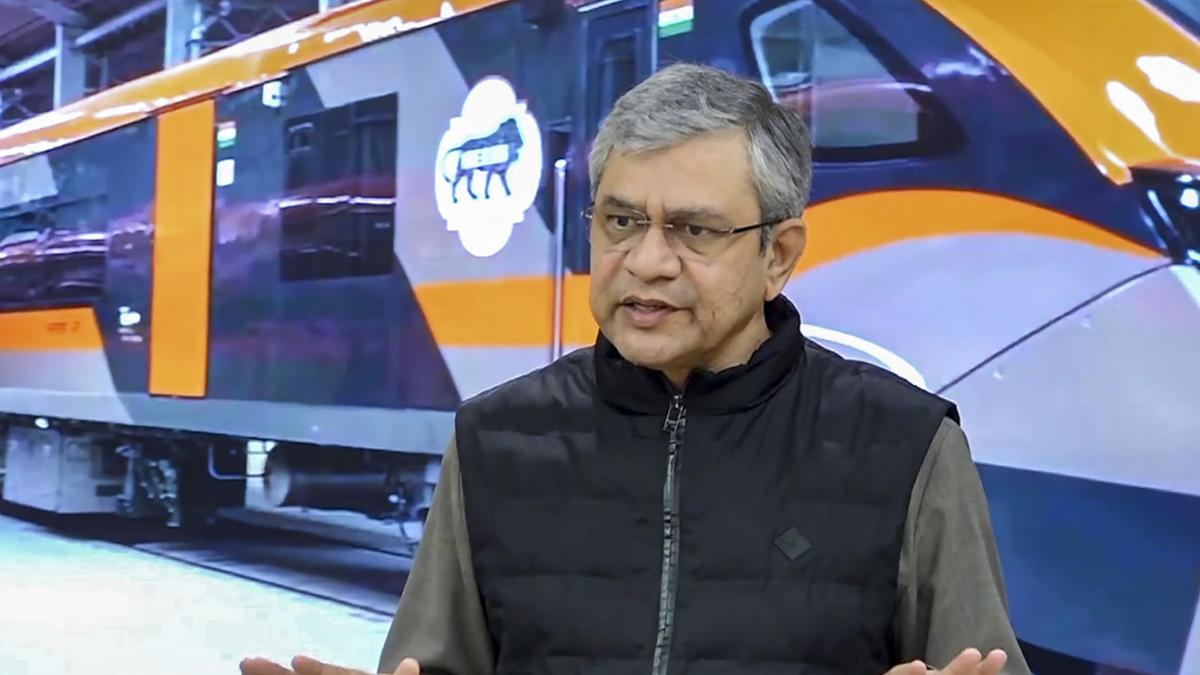
Ashwini Vaishnaw virtually witnesses final bullet train tunnel breakthrough in Maharashtra’s Palghar
Union Minister Ashwini Vaishnaw virtually witnessed the final tunnel breakthrough for the Mumbai-Ahmedabad High-Speed Rail (MAHSR) project in Palghar, Maharashtra. This 508-km project is India's first and only bullet train initiative, designed to operate at 320 kmph, significantly reducing travel time to 2 hours 17 minutes. Its completion marks a major milestone in India's infrastructure development and is crucial for competitive exams focusing on national projects and transport.
Revision structure
Monthly events and exam calendar context
Static GK and one-liner notes
Quiz and mock-test revision path
Key points
Exam-ready takeaways
Union Minister Ashwini Vaishnaw virtually witnessed this significant milestone.
The Mumbai-Ahmedabad High-Speed Rail (MAHSR) project is 508 km long.
It is India's only high-speed rail project designed to operate bullet trains at a speed of 320 kmph.
The project aims to cover the entire 508 km distance in 2 hours and 17 minutes.
Detailed analysis
Full exam-oriented breakdown
The recent virtual witnessing of the final tunnel breakthrough for the Mumbai-Ahmedabad High-Speed Rail (MAHSR) project by Union Minister Ashwini Vaishnaw marks a monumental leap in India's infrastructure ambitions. This event, occurring in Palghar, Maharashtra, signifies a critical milestone for what is touted as India's first 'bullet train' project, setting the stage for a new era of high-speed connectivity. **Background Context and What Happened:** India, with one of the world's largest railway networks, has long relied on conventional rail for passenger and freight movement. However, the dream of high-speed rail, capable of dramatically reducing travel times and fostering economic growth, gained significant traction in the early 21st century. The vision for a 'Diamond Quadrilateral' of high-speed rail corridors connecting India's major metros was articulated, with the Mumbai-Ahmedabad corridor identified as the pilot project. This corridor was chosen due to its high traffic density, economic significance, and the presence of two major industrial hubs. The project officially commenced in 2017 with the laying of the foundation stone by Prime Minister Narendra Modi and then Japanese Prime Minister Shinzo Abe. The specific event highlighted is the successful breakthrough of the final tunnel section in Palghar. This 508-km project is meticulously designed to allow trains to operate at a maximum speed of 320 kmph, aiming to slash the travel time between Mumbai and Ahmedabad from the current 7-8 hours to a mere 2 hours and 17 minutes. The construction involves complex engineering feats, including numerous bridges, viaducts, and tunnels, traversing diverse terrains. **Key Stakeholders Involved:** Several crucial entities are driving this colossal project. The **Government of India**, primarily through the **Ministry of Railways**, provides the overarching policy framework, strategic direction, and a significant portion of the funding. The **National High-Speed Rail Corporation Limited (NHSRCL)** is the dedicated implementing agency, responsible for planning, construction, and operation of the high-speed rail network. A pivotal international partner is the **Government of Japan** and its financing arm, the **Japan International Cooperation Agency (JICA)**. Japan is providing substantial financial assistance, amounting to approximately 81% of the project cost through a soft loan (Official Development Assistance - ODA) at an interest rate of 0.1% with a 50-year repayment period and a 15-year grace period. Crucially, Japan is also transferring its advanced Shinkansen technology, known for its safety and reliability. The **State Governments of Maharashtra and Gujarat** are vital stakeholders, responsible for facilitating land acquisition, providing necessary clearances, and ensuring local coordination. Various **Indian and international construction companies** (e.g., L&T, Afcons Infrastructure) are the execution arm, undertaking the demanding civil, electrical, and signaling works. Lastly, **local communities** along the alignment are stakeholders, directly impacted by land acquisition and subsequently benefiting from improved connectivity and potential economic opportunities. **Significance for India:** This project holds immense significance for India across multiple dimensions. **Economically**, it is expected to generate significant employment during construction and operation, foster the growth of ancillary industries, and boost manufacturing, aligning with the 'Make in India' initiative. The Mumbai-Ahmedabad corridor is a vital industrial and commercial artery, and improved connectivity will enhance business efficiency, facilitate faster movement of goods (though primarily a passenger service, its impact on overall logistics is indirect), and potentially spur real estate development in towns along the route. **Socially**, it promises enhanced passenger comfort, safety, and a substantial reduction in travel time, making inter-city travel more convenient and efficient. **Technologically**, it represents a major leap forward, bringing state-of-the-art railway technology to India, promoting skill development, and establishing a benchmark for future high-speed rail projects. This also strengthens **India-Japan strategic ties**, showcasing a successful collaboration on a large-scale infrastructure project. Politically, it is a testament to India's commitment to modernizing its infrastructure and fulfilling its aspirations as a major global economic power. **Historical Context and Future Implications:** India's railway history dates back to 1853, forming the backbone of its transport system. While significant advancements have been made in conventional rail, the move towards high-speed rail marks a paradigm shift, mirroring developments in advanced economies. The success of the MAHSR project is crucial as it will serve as a blueprint for other proposed high-speed corridors across the country, such as Delhi-Varanasi, Delhi-Ahmedabad, and Chennai-Mysuru. It will also influence urban planning and regional development, potentially creating new economic growth centers. However, challenges like land acquisition, environmental clearances, and cost overruns remain critical lessons for future projects. The project aligns with the broader **National Rail Plan 2030**, which envisions a future-ready railway system that is safe, efficient, and sustainable. **Related Constitutional Articles, Acts, or Policies:** Railways fall under **Entry 22 of the Union List** in the **Seventh Schedule of the Indian Constitution**, granting the central government exclusive legislative power over them. Land acquisition for such large-scale projects is governed by the **Right to Fair Compensation and Transparency in Land Acquisition, Rehabilitation and Resettlement Act, 2013**, which aims to ensure fair compensation and rehabilitation for affected persons. The 'Make in India' policy is relevant as the project aims for indigenization of components and technology over time. Furthermore, the project contributes to **Sustainable Development Goal 9 (Industry, Innovation, and Infrastructure)** by building resilient infrastructure and promoting inclusive and sustainable industrialization.
How to study
Turn news into exam marks
Revise monthly events by exam family instead of reading random updates.
Pair one-liners with mock tests so mistakes become the next revision list.
Keep state job pages, calendar pages and GK packs connected in one path.