

Government kept interest rates unchanged for 12 small savings schemes for the March quarter.
GK and monthly revision
Govt keeps small savings interest rates unchanged for March quarter
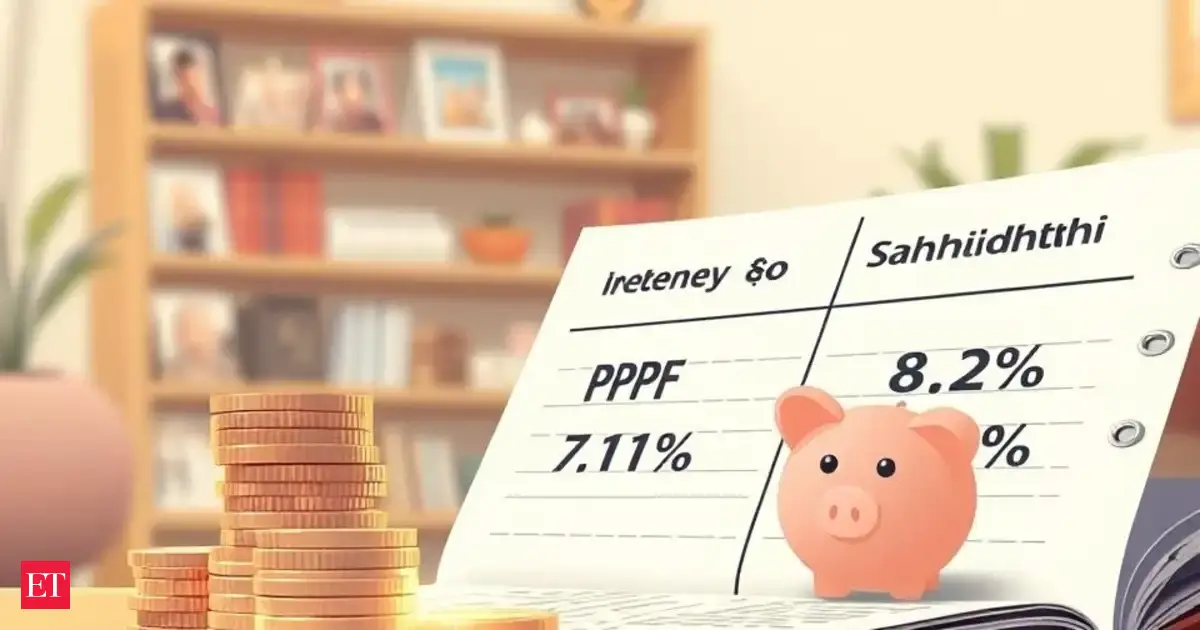
The Indian government has kept interest rates on twelve small savings schemes, including PPF and Sukanya Samriddhi, unchanged for the March quarter. This marks the eighth consecutive quarter without any revision, despite repo rate fluctuations. This decision is significant as collections from these schemes are vital for financing the government's fiscal deficit, impacting millions of small investors and reflecting the government's fiscal management strategy.
Revision structure
Monthly events and exam calendar context
Static GK and one-liner notes
Quiz and mock-test revision path
Key points
Exam-ready takeaways
This marks the eighth consecutive quarter that small savings interest rates have remained unchanged.
Key schemes like Public Provident Fund (PPF) and Sukanya Samriddhi Yojana are included in this decision.
The interest rates were maintained despite reductions in the central bank's repo rate.
Collections from small savings schemes are crucial for financing the government's fiscal deficit.
Detailed analysis
Full exam-oriented breakdown
The government's decision to maintain interest rates on twelve small savings schemes, including popular ones like the Public Provident Fund (PPF) and Sukanya Samriddhi Yojana, for the eighth consecutive quarter for the March quarter, is a significant move with far-reaching implications for India's economy and its citizens. This continuity in rates, despite fluctuations in the central bank's repo rate, highlights a complex balancing act by the Ministry of Finance. **Background Context and What Happened:** Small savings schemes are a vital component of India's financial architecture. Introduced decades ago, these schemes aim to mobilize savings from households, especially from rural and semi-urban areas, by offering safe, government-backed investment avenues with assured returns. Schemes like PPF (Public Provident Fund), National Savings Certificates (NSC), Kisan Vikas Patra (KVP), Senior Citizen's Savings Scheme (SCSS), and Sukanya Samriddhi Yojana (SSY) cater to diverse savings needs, from long-term retirement planning to specific goals like girl child education or marriage. Historically, the interest rates on these schemes were often determined administratively. However, following the recommendations of the Shyamala Gopinath Committee in 2011, the government adopted a market-linked formula in 2016. Under this formula, the interest rates for small savings schemes are reset quarterly and are linked to the yields of government securities (G-Secs) of comparable maturities, with a small spread over them. The current decision means that despite the Reserve Bank of India (RBI) making changes to its benchmark repo rate, which influences commercial bank lending and deposit rates, the government has chosen not to adjust the small savings rates. This marks a divergence from the market-linked formula, reflecting a deliberate policy choice. **Key Stakeholders Involved:** 1. **Government of India (Ministry of Finance):** As the administrator of these schemes, the Ministry of Finance is the primary decision-maker. It has to balance the need to offer attractive returns to savers with its own borrowing costs, as collections from these schemes are a significant source of financing for the government's fiscal deficit. Keeping rates stable might be seen as a way to ensure predictable inflows and manage borrowing costs. 2. **Reserve Bank of India (RBI):** The central bank sets the repo rate and conducts monetary policy to manage inflation and support economic growth. When small savings rates remain unchanged despite repo rate reductions, it can impede the full transmission of monetary policy signals to the broader economy, making commercial bank deposits less competitive. 3. **Small Investors/Households:** Millions of Indians, particularly those seeking assured and safe returns, invest in these schemes. For them, stable rates provide predictability and security, especially in times of market volatility. However, if inflation rises, unchanged nominal rates might erode real returns. 4. **Commercial Banks:** Banks compete with small savings schemes for deposits. If small savings rates are significantly higher than bank deposit rates, it can divert funds away from banks, impacting their deposit mobilization and, consequently, their ability to lend. **Significance for India:** This decision holds immense significance for India's economic landscape. Firstly, small savings collections are a crucial non-market source of financing for the government's **fiscal deficit**. By keeping rates stable, the government ensures a steady flow of funds, reducing its reliance on potentially more expensive market borrowings. This directly impacts the government's fiscal management and adherence to targets set under the **Fiscal Responsibility and Budget Management (FRBM) Act, 2003**. These funds are part of the **Public Account of India**, distinct from the Consolidated Fund of India. Secondly, these schemes play a vital role in **financial inclusion** and promoting a savings culture, especially among lower and middle-income groups. They provide a secure avenue for long-term savings for retirement (PPF), education (Sukanya Samriddhi), and other life goals, contributing to household financial security and capital formation. The stability of rates can be a comfort to these investors, who prioritize safety and assured returns over market-linked volatility. Thirdly, the decision impacts **monetary policy transmission**. When small savings rates remain sticky, it can create a floor for bank deposit rates, thereby slowing down the transmission of RBI's interest rate cuts to borrowers. This can affect the overall cost of credit in the economy and, consequently, investment and consumption. **Historical Context and Future Implications:** Historically, small savings rates have often been influenced by political considerations, with governments being reluctant to cut rates due to the potential backlash from a large voter base of savers. The move to link rates to G-Sec yields was intended to depoliticize this decision. However, the current eight-quarter freeze suggests a return to administrative discretion, potentially influenced by the need to maintain fiscal stability and provide predictable returns to savers, especially amidst global economic uncertainties. Looking ahead, the implications are multi-faceted. If G-Sec yields continue to rise, the government might face pressure to increase small savings rates to align with the formula, or risk making these schemes less attractive in comparison to market instruments. Conversely, keeping rates artificially high could burden the exchequer with higher interest payments. The decision also reflects the government's priority to ensure stable funding for its expenditure and maintain a degree of predictability for small savers. This strategy will continue to be a crucial element in India's public finance management, navigating the complex interplay between fiscal prudence, monetary policy objectives, and the welfare of its vast investor base. **Related Constitutional Articles, Acts, or Policies:** * **Fiscal Responsibility and Budget Management (FRBM) Act, 2003:** Directly relevant for understanding the government's commitment to fiscal discipline and how small savings contribute to managing the fiscal deficit. * **Public Account of India:** Small savings collections are credited to the National Small Savings Fund (NSSF) in the Public Account of India. The government utilizes these funds to finance its deficit. * **Article 292 & 293 of the Indian Constitution:** These articles deal with the borrowing powers of the Union and States, respectively. While not directly about small savings, they form the constitutional framework for government borrowing, which small savings schemes facilitate. * **RBI Act, 1934:** Indirectly relevant as the RBI's monetary policy decisions (repo rate) influence the broader interest rate environment that small savings rates sometimes diverge from.
How to study
Turn news into exam marks
Revise monthly events by exam family instead of reading random updates.
Pair one-liners with mock tests so mistakes become the next revision list.
Keep state job pages, calendar pages and GK packs connected in one path.