

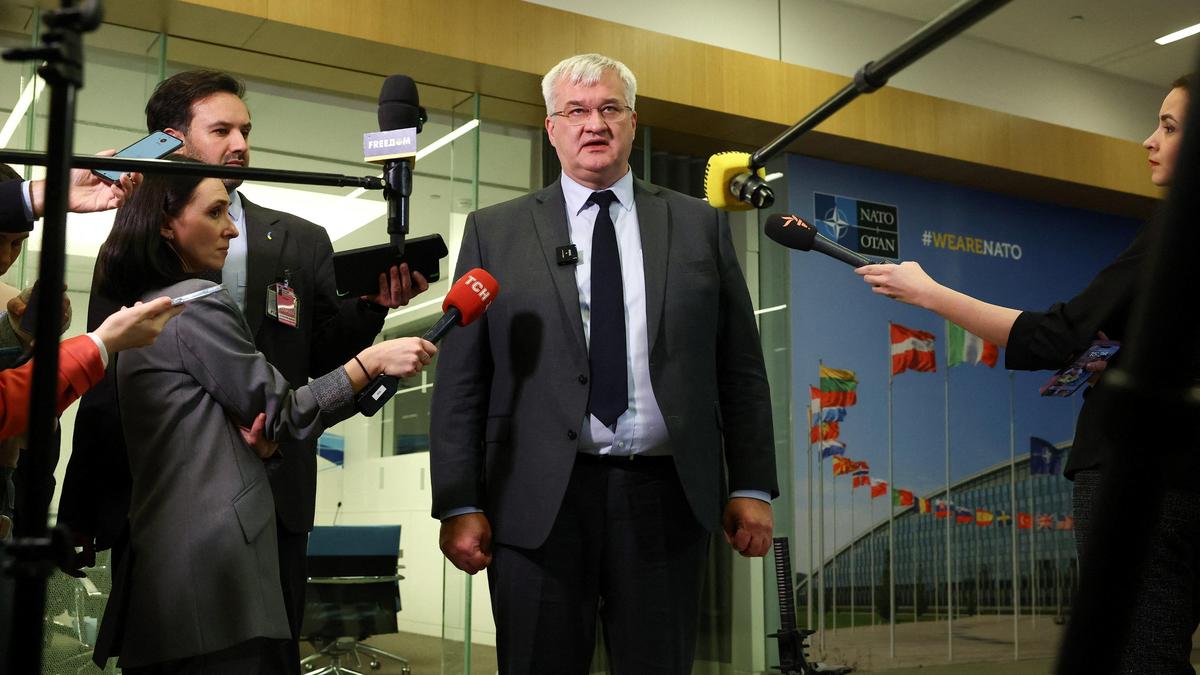
Ukraine's Foreign Minister stated that Russian reports of an attack on President Putin's residence were 'false'.
GK and monthly revision
Ukraine says ‘false’ Russian reports of attack on Putin’s residence undermine peace process
Ukraine's Foreign Minister has publicly refuted Russian claims of an attack on President Putin's residence, labeling them as "false" and asserting that the incident never occurred. Ukraine expressed disappointment over concerns voiced by Emirati, Indian, and Pakistani sides based on these reports. This event is crucial for competitive exams as it highlights the ongoing information warfare in the Russia-Ukraine conflict and the diplomatic complexities involving key international players, potentially undermining the peace process.
Revision structure
Monthly events and exam calendar context
Static GK and one-liner notes
Quiz and mock-test revision path
Key points
Exam-ready takeaways
Ukraine expressed disappointment and concern over statements made by Emirati, Indian, and Pakistani sides regarding the alleged attack.
The Ukrainian government explicitly clarified that the reported attack 'never happened'.
Ukraine believes these 'false' Russian reports undermine the ongoing peace process related to the conflict.
The incident underscores the prevalence of information warfare and diplomatic challenges in the Russia-Ukraine conflict.
Detailed analysis
Full exam-oriented breakdown
The recent statement by Ukraine's Foreign Minister, refuting Russian claims of an attack on President Putin's residence and expressing disappointment over concerns voiced by India, UAE, and Pakistan, highlights the complex web of information warfare and diplomatic challenges inherent in the ongoing Russia-Ukraine conflict. This incident serves as a crucial case study for understanding international relations, the nuances of foreign policy, and the impact of geopolitical events on global actors, including India. **Background Context: The Russia-Ukraine Conflict and Information Warfare** The conflict between Russia and Ukraine escalated significantly with Russia's full-scale invasion in February 2022, building upon the 2014 annexation of Crimea and support for separatists in eastern Ukraine. Beyond conventional warfare, the conflict is characterized by intense information warfare, where both sides actively seek to control narratives, influence public opinion, and garner international support or condemnation. False flag operations, propaganda, and disinformation campaigns are common tactics. In this environment, every statement, every claim, and every international reaction is scrutinized for its potential impact on the conflict's trajectory and the broader geopolitical landscape. **What Happened: A Disputed Attack and Diplomatic Repercussions** Russia had claimed that Ukraine launched a drone attack on the Kremlin, President Putin's official residence, in early May 2023, labeling it a terrorist act and an attempt on Putin's life. Moscow vowed retaliation. Ukraine swiftly denied any involvement, asserting it had no interest in escalating the conflict or attacking Russian territory, focusing instead on liberating its own occupied lands. Subsequently, Ukraine's Foreign Minister expressed disappointment and concern that countries like India, the United Arab Emirates (UAE), and Pakistan had voiced concerns based on these alleged 'false' Russian reports. Ukraine's position was that these 'false' reports, and the international reactions to them, serve to undermine any potential peace process by creating a pretext for further Russian aggression or by diverting attention from the real issues of invasion and occupation. **Key Stakeholders and Their Motivations** 1. **Ukraine:** Its primary goal is to maintain international support, expose Russian disinformation, and prevent any narrative that legitimizes Russian actions. By calling out the 'false' reports and criticizing the reactions of certain nations, Ukraine aims to keep the focus on Russia's aggression and the need for a just peace. 2. **Russia:** Its objective in propagating such claims is multifaceted: to justify military actions, rally domestic support, portray Ukraine as an aggressor, and potentially deter further Western aid to Kyiv by painting the conflict as a direct threat to Russia's leadership. 3. **India, UAE, and Pakistan:** These nations generally maintain a neutral or non-aligned stance on the conflict, focusing on their respective national interests. For India, this involves balancing historical defence ties with Russia, securing energy supplies, and maintaining strategic autonomy while also engaging with Western partners. Their expressions of concern, while seemingly benign, are interpreted by Ukraine as lending credence to Russian narratives, even if unintentionally. These countries often prioritize stability and de-escalation, but their responses can be seen through different lenses by the warring parties. **Significance for India: A Tightrope Walk in Foreign Policy** This incident underscores India's delicate diplomatic balancing act. India has consistently called for a peaceful resolution through dialogue and diplomacy, abstaining from UN votes condemning Russia, yet emphasizing respect for sovereignty and territorial integrity. This 'strategic autonomy' is rooted in India's foreign policy principles, particularly those enshrined in **Article 51 of the Constitution**, which directs the state to promote international peace and security, maintain just and honourable relations between nations, foster respect for international law, and encourage settlement of international disputes by arbitration. India's response to the alleged Kremlin attack, even if a generic call for de-escalation, was perceived by Ukraine as insufficient in its neutrality, potentially due to the context of disinformation. For India, the challenge lies in navigating complex geopolitical fault lines without alienating key partners, ensuring its energy security, and safeguarding its defence interests, particularly when dealing with information warfare where facts are often contested. India's global standing means its every move is keenly observed, and its 'neutrality' is constantly under scrutiny. **Historical Context and Broader Themes** India's foreign policy has historically been shaped by its non-alignment movement during the Cold War. While the world order has changed, the principle of strategic autonomy – making decisions based on national interest rather than aligning with any single bloc – remains central. This incident links to broader themes of global governance, the erosion of trust in international institutions, and the increasing weaponization of information. It also highlights the challenges of maintaining peace and stability in a multipolar world where major powers are engaged in direct or proxy conflicts. **Future Implications** The incident suggests that information warfare will continue to be a dominant feature of the Russia-Ukraine conflict, complicating any genuine peace efforts. For India, it means continued challenges in maintaining its strategic autonomy and balancing its relationships. India will need to be increasingly discerning in its responses to such incidents, ensuring its statements are carefully worded to reflect its core principles without inadvertently validating contested narratives. The episode also reinforces the need for robust diplomatic engagement and clear communication channels to prevent misunderstandings and contribute constructively to de-escalation. The international community, including India, will face ongoing pressure to take clearer stances as the conflict evolves, testing the limits of strategic ambiguity.
How to study
Turn news into exam marks
Revise monthly events by exam family instead of reading random updates.
Pair one-liners with mock tests so mistakes become the next revision list.
Keep state job pages, calendar pages and GK packs connected in one path.