

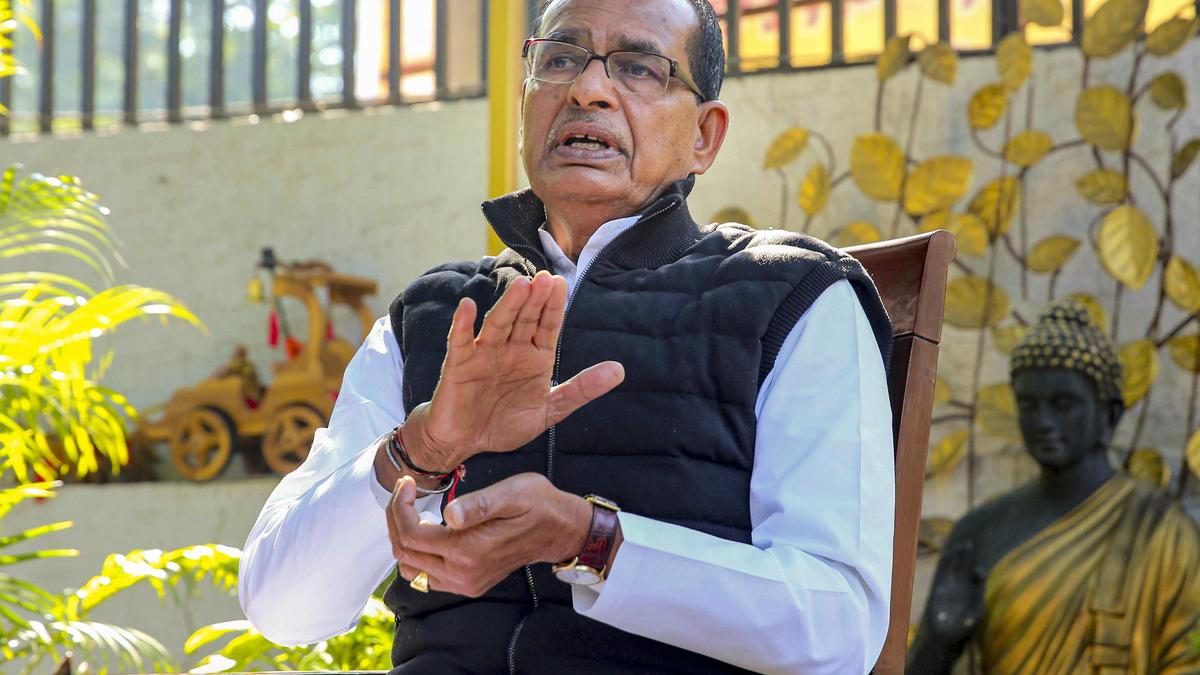
Union Minister Shivraj Singh Chouhan accused the Aam Aadmi Party (AAP) government in Punjab of defying Parliament.
GK and monthly revision
Punjab resolution against VB-G RAM G Act ‘undemocratic’, says Chouhan
Union Minister Shivraj Singh Chouhan criticized the Punjab government's resolution against a central act, labeling it 'undemocratic' and an act of 'defying Parliament'. This incident highlights the ongoing Centre-State relations and legislative conflicts, particularly concerning the implementation of central schemes like MGNREGA. For competitive exams, this underscores the importance of understanding India's federal structure and the constitutional provisions governing state and central legislative powers.
Revision structure
Monthly events and exam calendar context
Static GK and one-liner notes
Quiz and mock-test revision path
Key points
Exam-ready takeaways
The criticism was directed at a resolution passed by the Punjab government against a central act.
Chouhan explicitly termed Punjab's resolution as 'undemocratic'.
The Union Minister also flagged alleged irregularities in the implementation of the Mahatma Gandhi National Rural Employment Guarantee Act (MGNREGA) in Punjab.
This event highlights the legislative and administrative conflicts between the Central government and state governments, crucial for understanding federalism.
Detailed analysis
Full exam-oriented breakdown
India's federal structure is a dynamic and often contentious relationship between the Union government and its constituent states. The recent criticism by Union Minister Shivraj Singh Chouhan against the Punjab government's resolution challenging a central act, labeling it 'undemocratic' and an act of 'defying Parliament,' perfectly encapsulates these ongoing tensions. This incident, coupled with allegations of irregularities in the implementation of the Mahatma Gandhi National Rural Employment Guarantee Act (MGNREGA) in Punjab, brings to the forefront critical aspects of India's governance, constitutional framework, and the practice of cooperative federalism. At its core, this issue stems from the constitutional distribution of powers. India operates as a 'Union of States,' where legislative, administrative, and financial powers are divided between the Centre and the states, as primarily outlined in the Seventh Schedule of the Constitution. The Union List (List I) grants exclusive powers to the Parliament, the State List (List II) to state legislatures, and the Concurrent List (List III) allows both to legislate, with central law prevailing in case of conflict (Article 246). When a state government passes a resolution against a central act, it essentially signals its dissent or opposition to a law enacted by the national Parliament, which holds legislative supremacy on subjects within its domain. Union Minister Chouhan's remarks highlight the central government's view that such resolutions, while a form of political protest, can be seen as undermining the democratic process through which central laws are enacted. The key stakeholders in this conflict include the **Union Government**, represented by its ministers who advocate for the supremacy of central legislation and the uniform implementation of national policies. The **Punjab State Government**, led by the Aam Aadmi Party (AAP), represents the interests and perspectives of the state, often asserting its autonomy and right to dissent against central dictates, especially when perceived to infringe upon state powers or local needs. **The Parliament of India** itself is a stakeholder, as its legislative authority is implicitly questioned by state resolutions. Finally, the **citizens of Punjab**, particularly the beneficiaries of schemes like MGNREGA, are indirectly involved as their welfare can be affected by administrative inefficiencies or political stalemates. This dispute holds significant implications for India's federal polity. Firstly, it underscores the persistent challenges to **cooperative federalism**, a principle that emphasizes collaboration between the Centre and states for national development. When states pass resolutions against central laws, it often indicates a breakdown in dialogue and a shift towards confrontational federalism. Secondly, it raises questions about **constitutional supremacy** and the role of state legislatures. While states have a right to express dissent, the constitutional mechanism for challenging central laws is through judicial review or seeking amendments in Parliament, not through state legislative resolutions that lack legal binding force against a valid central law. Historically, states have passed resolutions against central laws on various occasions, such as the resolutions passed by several state assemblies against the Citizenship Amendment Act (CAA) in 2020 or against the contentious farm laws in 2020-21, indicating a recurring pattern of Centre-State friction on legislative matters. The accusation of irregularities in **MGNREGA implementation** adds another layer of complexity. The Mahatma Gandhi National Rural Employment Guarantee Act, 2005, is a flagship centrally sponsored scheme aimed at enhancing livelihood security in rural areas by providing at least 100 days of wage employment in a financial year to every household whose adult members volunteer to do unskilled manual work. While funded by the Centre, its implementation primarily rests with the state governments and local bodies. Allegations of irregularities, such as ghost beneficiaries, delayed wage payments, or diversion of funds, are serious and impact the scheme's effectiveness and accountability. This points to the administrative dimension of Centre-State relations, where the Centre provides funding and policy direction, but states are responsible for on-ground execution, often leading to monitoring and accountability issues. Constitutional provisions like **Article 256** (Obligation of States and the Union) and **Article 257** (Control of the Union over States in certain cases) mandate states to comply with Union laws and executive directions, and the Centre has powers to issue directives to states for ensuring compliance. Looking ahead, such incidents could lead to increased political polarization and potentially strain Centre-State financial relations, especially concerning centrally sponsored schemes. The Union government might intensify its oversight mechanisms for such schemes, potentially leading to more audits or conditions for fund releases. States, in turn, might continue to use legislative resolutions as a political tool to voice dissent and rally public support. For India, maintaining a balance between a strong Centre and autonomous states is crucial for democratic stability and effective governance. The recommendations of commissions like the Sarkaria Commission (1988) and the Punchhi Commission (2010) on Centre-State relations remain highly relevant, advocating for greater consultation, mutual respect, and clarity in the division of powers to foster cooperative federalism.
How to study
Turn news into exam marks
Revise monthly events by exam family instead of reading random updates.
Pair one-liners with mock tests so mistakes become the next revision list.
Keep state job pages, calendar pages and GK packs connected in one path.