

The newly discovered implausibly old spiral galaxy has been named 'Alaknanda'.
GK and monthly revision
Alaknanda: Indian astronomers spot implausibly old spiral galaxy
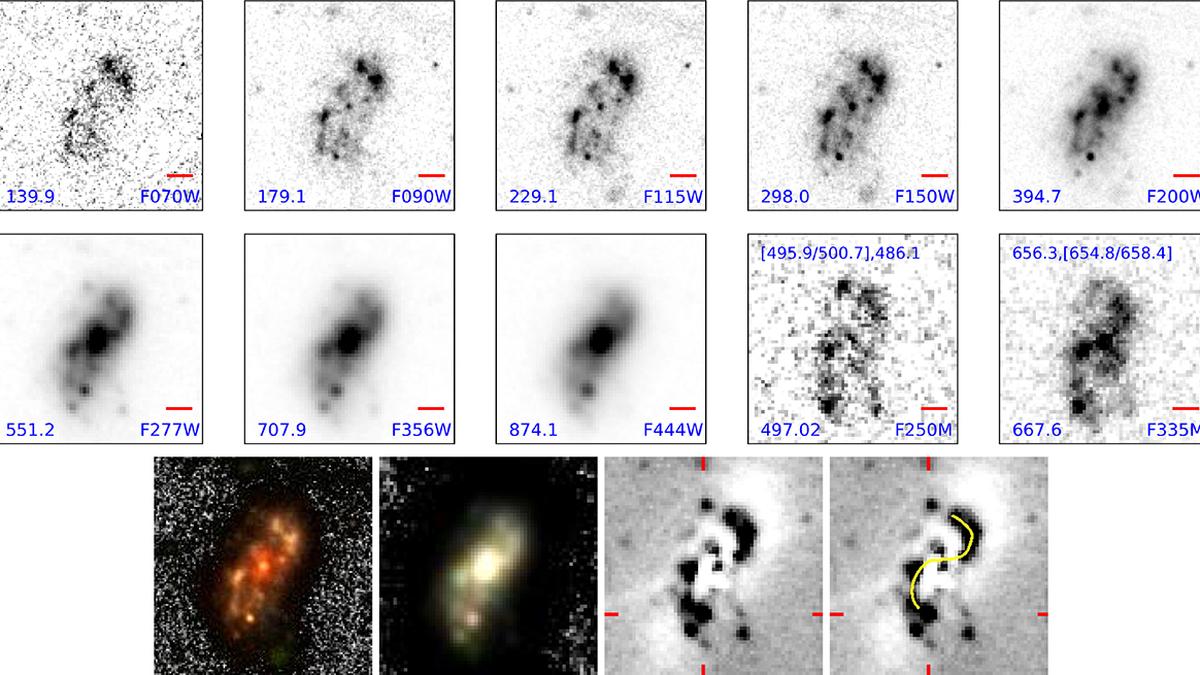
Indian astronomers have discovered an implausibly old spiral galaxy named 'Alaknanda', which formed when the universe was approximately 1.5 billion years old. This discovery significantly challenges current models of galaxy formation, posing a puzzle for astrophysicists. Its existence highlights advancements in Indian astronomical research and is crucial for understanding the early universe and galactic evolution, making it relevant for science and technology sections in competitive exams.
Revision structure
Monthly events and exam calendar context
Static GK and one-liner notes
Quiz and mock-test revision path
Key points
Exam-ready takeaways
It was spotted by Indian astronomers, indicating a significant contribution from India to astrophysics.
The galaxy took shape when the universe was only about 1.5 billion years old.
Alaknanda's existence defies current scientific models regarding galaxy formation and evolution.
Possible explanations include steady growth by drawing in cold gas or interaction/merger with a smaller companion galaxy.
Detailed analysis
Full exam-oriented breakdown
The recent discovery of the 'Alaknanda' galaxy by Indian astronomers marks a significant milestone in astrophysics, challenging established theories of galaxy formation and evolution. This find is particularly remarkable because Alaknanda is an 'implausibly old' spiral galaxy, observed to have taken shape when the universe was only about 1.5 billion years old. To truly grasp the magnitude of this discovery, we must delve into the background of cosmic evolution and galaxy formation. Our universe began approximately 13.8 billion years ago with the Big Bang. Following this cataclysmic event, the universe was a hot, dense plasma that gradually cooled, allowing fundamental particles to form. Over millions of years, gravity began to pull together concentrations of dark matter and gas, leading to the formation of the first stars and eventually, the earliest galaxies, often referred to as 'proto-galaxies.' Current cosmological models, primarily the hierarchical model of galaxy formation, suggest that galaxies grow over time through a series of mergers and accretion of smaller structures. Spiral galaxies, with their distinct disk-like shape, central bulge, and prominent spiral arms, are generally believed to be relatively 'mature' structures that form later in the universe's history, after numerous interactions and the stable accretion of cold gas. The early universe, being much denser and more chaotic, was thought to be conducive to the formation of irregular or elliptical galaxies rather than well-ordered spirals. The discovery of Alaknanda directly contradicts this prevailing understanding. Indian astronomers, through their meticulous observations, identified this spiral galaxy existing at a redshift corresponding to an epoch when the universe was merely 1.5 billion years old. This means Alaknanda already possessed the complex structure of a spiral galaxy much earlier than current models predict is possible. This 'implausibility' is what makes the discovery so profound; it compels astrophysicists to reconsider the mechanisms and timescales of early galaxy formation. Researchers are now exploring alternative explanations, such as the galaxy growing steadily by drawing in large amounts of cold gas from its surroundings, or undergoing an early, rapid merger with a smaller companion galaxy that somehow preserved or quickly established its spiral morphology. Key stakeholders in this groundbreaking discovery primarily include the Indian scientific community, specifically the astronomers and researchers from institutions like the Aryabhatta Research Institute of Observational Sciences (ARIES), the National Centre for Radio Astrophysics (NCRA), and the Indian Institute of Astrophysics (IIA), among others. These institutions, often supported by the Department of Science & Technology (DST) and the Department of Space (DoS) under the Government of India, provide the necessary infrastructure, funding, and intellectual environment for such high-level research. Their dedication and expertise have positioned India as a significant contributor to global astrophysics. The international astronomical community also serves as a crucial stakeholder, as such discoveries undergo rigorous peer review and contribute to the collective human understanding of the cosmos. For India, the significance of the Alaknanda discovery is multi-faceted. Firstly, it elevates India's standing in cutting-edge scientific research on the global stage. It demonstrates the nation's indigenous capabilities in observational astronomy and data analysis, reinforcing its image as a hub for scientific innovation. This achievement can inspire a new generation of Indian scientists and engineers, fostering a 'scientific temper' – a core value enshrined in Article 51A(h) of the Indian Constitution, which mandates every citizen to develop scientific temper, humanism, and the spirit of inquiry and reform. Such discoveries underscore the importance of public investment in fundamental research, which, while not immediately yielding economic returns, expands the frontiers of human knowledge and can have long-term societal benefits through technological spin-offs and a culture of innovation. India's commitment to science is further reflected in policies like the Science, Technology, and Innovation Policy (STIP) 2020, which aims to promote research and development and position India among the top scientific nations. Historically, India has a rich tradition in astronomy, from ancient texts like the Surya Siddhanta to the medieval observatories like Jantar Mantar. Post-independence, Prime Minister Jawaharlal Nehru laid the foundation for a robust scientific infrastructure, leading to the establishment of numerous research institutions and organizations like ISRO. This historical trajectory provides a strong base for contemporary achievements like the Alaknanda discovery. The future implications of this find are profound. It will undoubtedly lead to a re-evaluation of current cosmological models and stimulate new theoretical frameworks for galaxy formation. It will also drive the development of more powerful telescopes and observational techniques to probe the early universe with greater precision. For India, it signifies continued opportunities for international collaboration, talent retention, and further contributions to fundamental science, solidifying its role as a key player in unraveling the universe's mysteries.
How to study
Turn news into exam marks
Revise monthly events by exam family instead of reading random updates.
Pair one-liners with mock tests so mistakes become the next revision list.
Keep state job pages, calendar pages and GK packs connected in one path.