

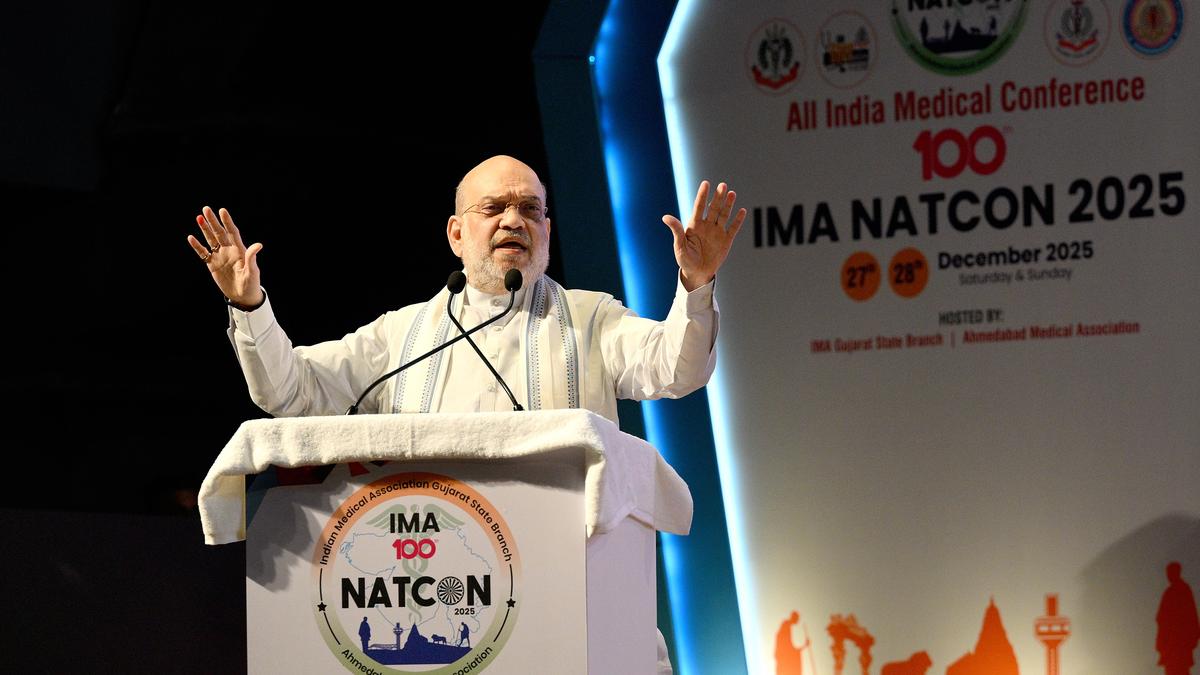
Union Home Minister Amit Shah stated India's goal to eradicate malaria.
GK and monthly revision
With 97% drop in cases, India to eradicate malaria in short time: Amit Shah
Union Home Minister Amit Shah announced India's commitment to eradicate malaria, citing a significant 97% drop in cases. He stressed the importance of aligning doctors' efforts with existing health infrastructure and schemes to achieve this national goal effectively. This highlights a major public health objective and progress, crucial for competitive exams focusing on government initiatives and health policies.
Revision structure
Monthly events and exam calendar context
Static GK and one-liner notes
Quiz and mock-test revision path
Key points
Exam-ready takeaways
India has achieved a 97% drop in malaria cases.
The Home Minister emphasized aligning doctors' efforts with existing infrastructure.
The strategy involves leveraging current schemes to ensure better results in malaria eradication.
India aims to eradicate malaria 'in a short time'.
Detailed analysis
Full exam-oriented breakdown
India's ambitious goal to eradicate malaria, as articulated by Union Home Minister Amit Shah, marks a significant milestone in the nation's public health journey. The reported 97% drop in malaria cases is a testament to sustained efforts over the past few decades, highlighting a renewed commitment to eliminate a disease that has historically plagued the country. This initiative is not merely a health target but a critical component of India's broader development agenda, impacting economic productivity, social equity, and global health standing. Historically, malaria has been a formidable public health challenge in India. Post-independence, the National Malaria Control Programme (NMCP) was launched in 1953, which was subsequently transformed into the National Malaria Eradication Programme (NMEP) in 1958, aiming for complete elimination. These early efforts saw remarkable success, reducing cases significantly. However, challenges like insecticide resistance, drug resistance, and administrative issues led to a resurgence of the disease in the 1970s. This period underscored the complexity of eradication and the need for sustained vigilance and adaptive strategies. The current push builds upon lessons learned, integrating new technologies and community involvement. The recent success, indicated by the 97% drop in cases, is largely attributable to the intensified efforts under the National Framework for Malaria Elimination (NFME) launched in 2016, followed by the National Strategic Plan for Malaria Elimination (NSPME) for 2017-2022. These plans aligned with the World Health Organization's (WHO) Global Technical Strategy for Malaria 2016-2030, which targets a 90% reduction in malaria incidence and mortality by 2030. India's strategy focuses on robust surveillance, early diagnosis and complete treatment, vector control measures (like Long-Lasting Insecticidal Nets - LLINs, and Indoor Residual Spraying - IRS), and strengthening public health infrastructure, particularly in high-burden and hard-to-reach areas. Key stakeholders in this monumental task include the Ministry of Health and Family Welfare (MoHFW) and its nodal agency, the National Centre for Vector Borne Disease Control (NCVBDC), which spearhead policy formulation and implementation. State Health Departments play a crucial role in localized planning and execution. At the grassroots level, Accredited Social Health Activists (ASHAs), Auxiliary Nurse Midwives (ANMs), and other frontline health workers are indispensable for surveillance, case detection, and treatment adherence, especially in rural and tribal regions where malaria prevalence is often higher. Medical professionals, researchers, and international organizations like the WHO and the Global Fund also contribute significantly through technical guidance, funding, and research on new diagnostics and treatments. Eradicating malaria holds immense significance for India. Economically, it can unlock significant productivity gains by reducing absenteeism from work and school, and alleviating the burden on the healthcare system. The economic cost of malaria, including treatment, lost wages, and productivity, is substantial. Socially, it improves the quality of life, reduces child mortality, and promotes health equity, particularly for vulnerable populations who disproportionately bear the brunt of the disease. It also enhances India's global standing as a nation committed to achieving Sustainable Development Goal (SDG) 3: Good Health and Well-being, specifically Target 3.3, which aims to end the epidemics of AIDS, tuberculosis, malaria, and neglected tropical diseases by 2030. From a constitutional perspective, public health falls primarily under the State List (Entry 6) of the Seventh Schedule, but the Union government plays a significant role in policy, funding, and coordination. Article 47 of the Directive Principles of State Policy (DPSP) mandates that the "State shall regard the raising of the level of nutrition and the standard of living of its people and the improvement of public health as among its primary duties." This article provides the constitutional underpinning for government initiatives like malaria eradication. Furthermore, the 73rd and 74th Constitutional Amendments empower Panchayati Raj Institutions and Urban Local Bodies to plan and implement public health programs at the local level, making them crucial partners in last-mile delivery of health services. The future implications of this commitment are profound. Achieving malaria eradication will require sustained political will, consistent funding, and adaptive strategies to counter emerging challenges such as drug and insecticide resistance, climate change-induced vector migration, and population movement. Strengthening surveillance systems, investing in research for new tools (e.g., vaccines like RTS,S), and ensuring equitable access to diagnosis and treatment will be paramount. India's success could serve as a model for other malaria-endemic countries, demonstrating the possibility of overcoming a persistent public health threat through concerted national and international efforts, thereby contributing significantly to global health security.
How to study
Turn news into exam marks
Revise monthly events by exam family instead of reading random updates.
Pair one-liners with mock tests so mistakes become the next revision list.
Keep state job pages, calendar pages and GK packs connected in one path.