

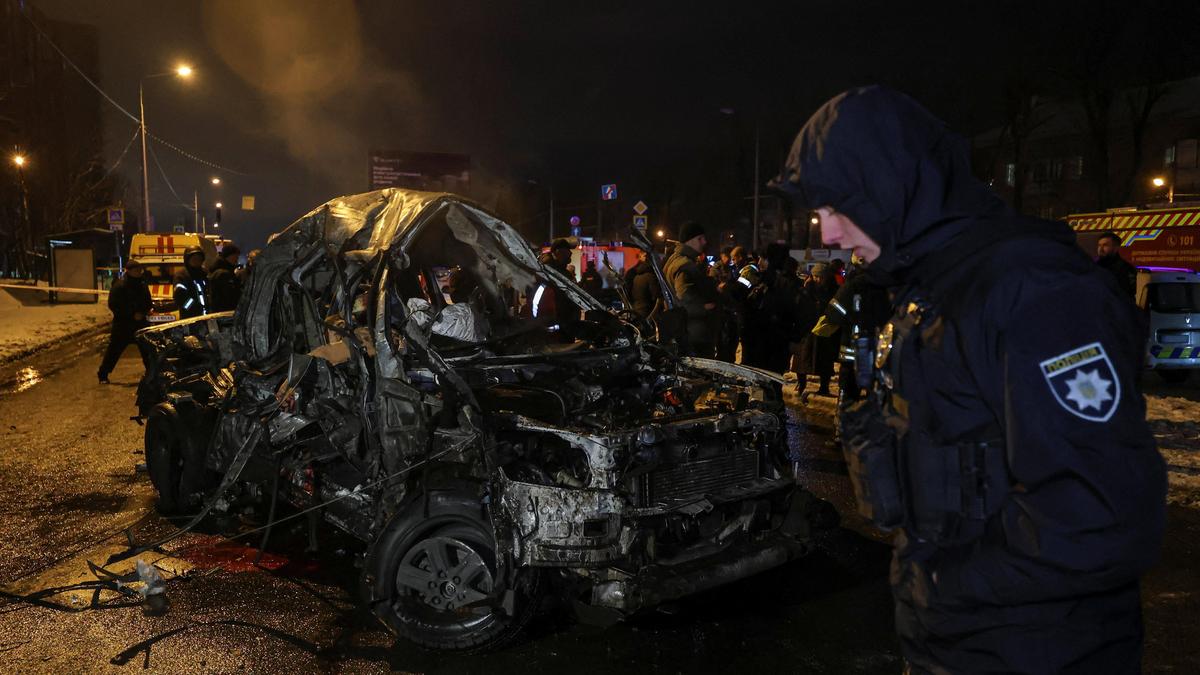
The Ukrainian capital, Kyiv, was subjected to a massive Russian attack.
GK and monthly revision
Ukrainian capital Kyiv under massive Russian attack, officials say
Ukrainian capital Kyiv faced a massive Russian attack, occurring two days before a crucial meeting between Ukrainian President Volodymyr Zelenskyy and US President Donald Trump. This attack highlights escalating tensions in the nearly four-year-old Russia-Ukraine war, potentially impacting diplomatic efforts for a peace accord. For competitive exams, this event is significant for understanding international relations, geopolitical conflicts, and key global leaders.
Revision structure
Monthly events and exam calendar context
Static GK and one-liner notes
Quiz and mock-test revision path
Key points
Exam-ready takeaways
The attack occurred two days prior to a scheduled meeting between Ukrainian President Volodymyr Zelenskyy and US President Donald Trump.
The purpose of the meeting was to work out details for settling the nearly four-year-old war between Russia and Ukraine.
Ukrainian President Volodymyr Zelenskyy was due to meet US President Donald Trump in the United States.
The conflict between Russia and Ukraine has been ongoing for nearly four years.
Detailed analysis
Full exam-oriented breakdown
The news of a massive Russian attack on Kyiv, occurring just two days before a crucial meeting between Ukrainian President Volodymyr Zelenskyy and then-US President Donald Trump, provides a stark illustration of the complex and often volatile nature of international diplomacy amidst ongoing conflict. This event, taking place within the framework of a "nearly four-year-old war" (dating back to 2014), underscores Russia's strategic maneuvering and its willingness to exert military pressure even as diplomatic channels are being pursued. The background to this conflict is deeply rooted in post-Cold War geopolitics. Following the dissolution of the Soviet Union in 1991, Ukraine, a former Soviet republic, pursued closer ties with the West, including aspirations for membership in NATO and the European Union. Russia, under President Vladimir Putin, views NATO's eastward expansion as a direct threat to its security interests and a historical encroachment on its sphere of influence. The initial phase of the conflict began in 2014 with Russia's annexation of Crimea after a pro-Russian uprising and a controversial referendum, followed by its support for separatists in the Donbas region (Luhansk and Donetsk) of eastern Ukraine. This led to a simmering conflict, punctuated by periods of intense fighting and attempts at peace, notably through the Minsk Agreements (Minsk I in 2014 and Minsk II in 2015), which aimed to establish a ceasefire and a roadmap for political settlement but largely failed to achieve lasting peace. In this specific instance, the attack on Kyiv immediately preceding a high-stakes diplomatic meeting serves multiple purposes for Russia. It could be interpreted as an attempt to gain leverage at the negotiating table, to demonstrate resolve, or to undermine Ukraine's confidence and international support. For Ukraine, such an attack reinforces the existential threat it faces and highlights the urgency of securing international backing. President Zelenskyy's planned meeting with President Trump was likely aimed at garnering stronger US support, both political and military, and exploring pathways for a peace accord to end the protracted conflict. Key stakeholders involved in this scenario include Russia, led by President Vladimir Putin, whose primary motivations revolve around perceived national security, preventing Ukraine's full integration into Western alliances, and maintaining regional dominance. Ukraine, under President Volodymyr Zelenskyy, is fighting for its sovereignty, territorial integrity, and its right to self-determination. The United States, under President Donald Trump at that time, played a critical role as a major global power and a key ally to Ukraine, providing military aid and diplomatic support, albeit with a foreign policy approach that often prioritized transactional diplomacy. Other significant stakeholders include NATO allies and the European Union, which have largely condemned Russian aggression and supported Ukraine through various sanctions and assistance packages. For India, such international developments carry significant implications. Economically, conflicts involving major energy producers like Russia can lead to volatility in global crude oil prices, which directly impacts India's import bill and domestic inflation. Disruptions in supply chains for essential commodities like fertilizers, edible oils (sunflower oil from Ukraine), and even certain defence equipment can have far-reaching consequences. Politically, India navigates a complex geopolitical landscape, balancing its historical strategic partnership with Russia (especially in defence and energy) with its growing ties with Western nations. India's foreign policy, guided by principles of strategic autonomy and non-alignment 2.0, necessitates a careful approach, often involving calls for de-escalation and peaceful resolution through dialogue, as reflected in its stance at international forums like the UN Security Council. This event underscores the challenges of maintaining a neutral yet principled position in a polarized world. Historically, this conflict can be viewed as a continuation of post-Cold War power struggles and a challenge to the established international order. Russia's actions question the principles of national sovereignty and territorial integrity, which are cornerstones of international law. India's constitutional provisions, particularly Article 51 of the Directive Principles of State Policy, guide its foreign policy by promoting international peace and security, fostering respect for international law, and encouraging settlement of international disputes by arbitration. India's consistent advocacy for dialogue and diplomacy aligns with these constitutional tenets. The future implications of such events are profound. They indicate the potential for prolonged conflict, significant humanitarian crises, and further instability in Eastern Europe. They also challenge the effectiveness of international institutions like the United Nations in preventing and resolving conflicts. For the global order, it signifies a potential shift towards a more multipolar world, where geopolitical alliances are constantly being reshaped. For India, it reiterates the need for robust economic diversification, energy security strategies, and a dynamic foreign policy that can adapt to rapid global changes while upholding its core values and national interests.
How to study
Turn news into exam marks
Revise monthly events by exam family instead of reading random updates.
Pair one-liners with mock tests so mistakes become the next revision list.
Keep state job pages, calendar pages and GK packs connected in one path.