

The award mentioned is the PM Rashtriya Bal Puraskar.
GK and monthly revision
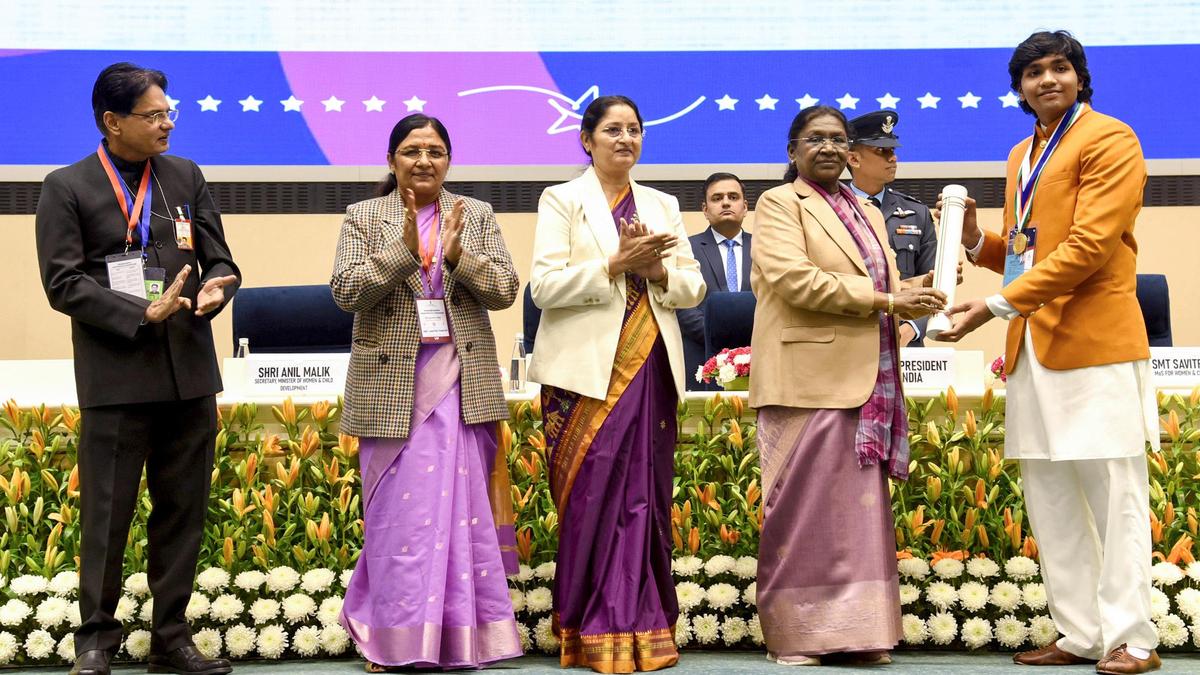
PM Rashtriya Bal Puraskar winners: check full list
The PM Rashtriya Bal Puraskar, a prestigious national award, recognizes children aged 5-18 for exceptional achievements in various fields. This year's list includes young prodigy Vaibhav Sooryavanshi and two posthumous recipients from Tamil Nadu and Bihar, highlighting the government's initiative to honor outstanding young talent. Knowledge of such awards and their notable recipients is crucial for the general awareness section of competitive examinations.
Revision structure
Monthly events and exam calendar context
Static GK and one-liner notes
Quiz and mock-test revision path
Key points
Exam-ready takeaways
Young prodigy Vaibhav Sooryavanshi is among the recipients of the award.
This year's list includes two posthumous recipients.
The posthumous recipients are from the states of Tamil Nadu and Bihar.
The PM Rashtriya Bal Puraskar recognizes children for exceptional achievements in various fields.
Detailed analysis
Full exam-oriented breakdown
The Prime Minister Rashtriya Bal Puraskar (PMRBP) stands as a beacon of national recognition for exceptional children in India, celebrating their extraordinary achievements and inspiring a generation. This prestigious award, conferred by the President of India, acknowledges children aged 5-18 years for their prowess in seven distinct categories: Bravery, Sports, Social Service, Science & Technology, Environment, Arts & Culture, and Innovation. The recent announcement, highlighting young prodigy Vaibhav Sooryavanshi and two posthumous recipients from Tamil Nadu and Bihar, underscores the government's commitment to identifying and nurturing young talent across the nation. **Background Context and Evolution:** The concept of recognizing children for their exceptional talents is deeply rooted in India's developmental philosophy. The PMRBP is not a new initiative but a revamped and more comprehensive version of the 'National Child Award for Exceptional Achievement', which was instituted in 1996. In 2018, the award was rebranded as the 'Pradhan Mantri Rashtriya Bal Puraskar' to elevate its stature and broaden its scope, aligning it more closely with the Prime Minister's vision for child development. This evolution reflects a growing national emphasis on appreciating and encouraging young minds, acknowledging that children are not just future citizens but active contributors to society's progress. The award aims to motivate children to push their boundaries, while also inspiring their peers and society at large to support such endeavors. **Key Stakeholders Involved:** Several entities play crucial roles in the successful implementation and recognition associated with the PMRBP. The primary stakeholder is the **Ministry of Women and Child Development (MWCD)**, which serves as the nodal ministry. It is responsible for formulating policies, receiving nominations, scrutinizing applications through a robust selection committee, and coordinating the entire award process. The **President of India** is the ultimate authority who confers these awards in a ceremonial event, lending immense prestige to the recognition. The **Prime Minister**, whose name is associated with the award, often interacts with the recipients, further boosting their morale and publicizing their achievements. Most importantly, the **children themselves** are the central figures, whose exceptional talents, dedication, and courage are being celebrated. Their **parents, guardians, and teachers** are also indirect stakeholders, as their support and guidance are often instrumental in the children's achievements. Finally, the **general public** acts as an appreciative audience, drawing inspiration from these young achievers. **Significance for India:** The PMRBP holds profound significance for India across social, cultural, and developmental dimensions. Socially, it creates powerful role models, demonstrating that age is no bar to excellence. This encourages other children to pursue their passions, whether in academics, sports, arts, or social service. By recognizing bravery, it fosters a culture of courage and selflessness among the youth. Culturally, the award helps preserve and promote diverse talents, including traditional art forms and innovative thinking. Economically and developmentally, by nurturing talent in science, technology, and innovation, the award indirectly contributes to India's human capital development, which is crucial for a knowledge-based economy. It reinforces the government's commitment to child welfare and development, aligning with national policies that prioritize the well-being and growth of children. The recognition also brings national and sometimes international visibility to these young achievers, showcasing India's vibrant youth potential on a global stage. **Constitutional and Policy Framework:** The spirit of the PMRBP is deeply embedded in India's constitutional framework and various policies aimed at child welfare. **Article 21A** of the Constitution guarantees the Right to Education, ensuring foundational development for all children. **Article 39(f)** directs the State to ensure that children are given opportunities and facilities to develop in a healthy manner and in conditions of freedom and dignity. Furthermore, **Article 45** mandates early childhood care and education. While these articles primarily focus on protective and developmental aspects, the PMRBP aligns with the broader objective of fostering optimal child development. Key policies like the **National Policy for Children, 2013**, emphasize the holistic development of children and their right to participate and be heard. The **Juvenile Justice (Care and Protection of Children) Act, 2015**, also works towards ensuring a protective environment for children. The PMRBP, therefore, acts as a recognition mechanism within this larger ecosystem of child-centric governance and welfare initiatives, complementing schemes like 'Beti Bachao Beti Padhao' and 'POSHAN Abhiyaan' by focusing on excellence and achievement. **Future Implications:** The continued emphasis on awards like the PMRBP signals a positive future for child development in India. It is likely to lead to increased investment in programs that identify and mentor young talent, perhaps through specialized academies or scholarships in diverse fields. The stories of these young awardees can inspire policy changes, encouraging states and local bodies to replicate similar recognition models. Moreover, as India aims to become a global leader, fostering innovation and excellence from a young age is paramount. These awards contribute to creating a competitive yet nurturing environment, ensuring that India's future generations are well-equipped to tackle global challenges and contribute meaningfully to society and the economy. The recognition of posthumous recipients also highlights the importance of acknowledging extraordinary acts of bravery and social service, even in tragic circumstances, instilling values of courage and altruism in the collective consciousness.
How to study
Turn news into exam marks
Revise monthly events by exam family instead of reading random updates.
Pair one-liners with mock tests so mistakes become the next revision list.
Keep state job pages, calendar pages and GK packs connected in one path.