

The Regional Rapid Transit System (RRTS) is identified as a transformative urban mobility project in India.
GK and monthly revision
RRTS can transform urban mobility, act as catalyst for decentralised economic growth: Knight Frank
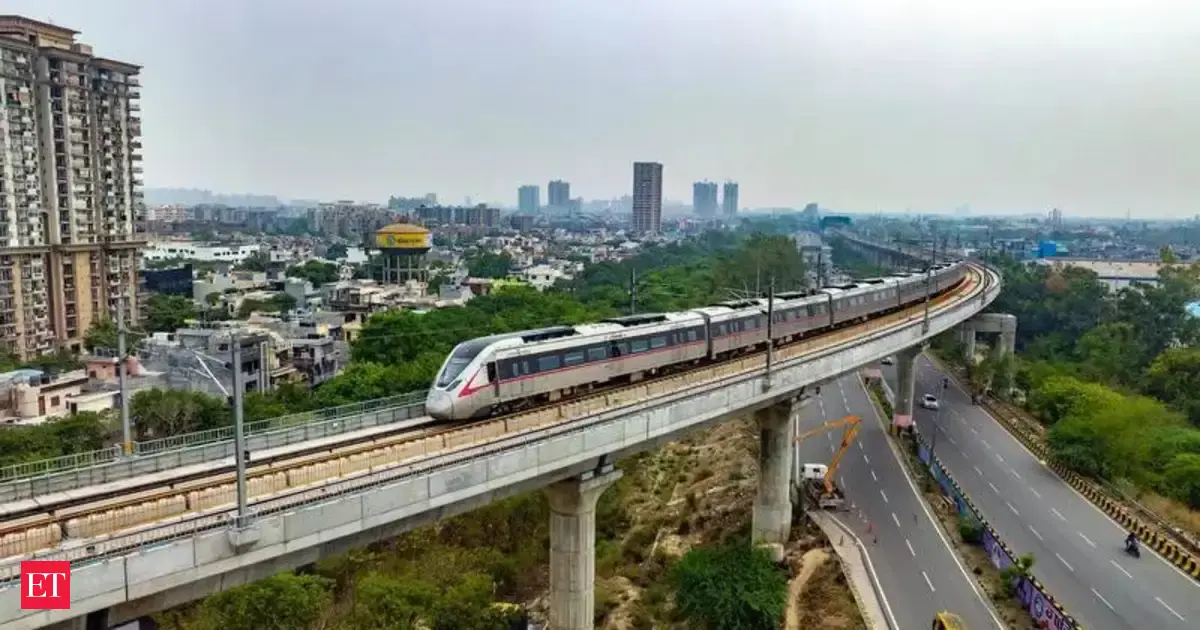
The Regional Rapid Transit System (RRTS), particularly the Delhi-Ghaziabad-Meerut corridor, is projected to revolutionize urban mobility and stimulate decentralized economic growth, according to Knight Frank. This infrastructure project is seen as a crucial catalyst for development, significantly reducing travel times. Its long-term success hinges on effective planning, strategic land use, substantial investment, and the provision of affordable housing near its stations, making it vital for competitive exam aspirants focusing on infrastructure and economic development.
Revision structure
Monthly events and exam calendar context
Static GK and one-liner notes
Quiz and mock-test revision path
Key points
Exam-ready takeaways
The Delhi-Ghaziabad-Meerut corridor is specifically highlighted for its potential to significantly cut travel time.
Knight Frank, a global property consultancy, provided the analysis on RRTS's economic impact.
RRTS is expected to act as a catalyst for decentralized economic growth, beyond just transport.
Crucial factors for RRTS's success include effective planning, strategic land use, investment, and affordable housing near stations.
Detailed analysis
Full exam-oriented breakdown
India's journey towards rapid economic growth has been inextricably linked with its urbanisation story. However, this growth has come with significant challenges: burgeoning populations in metropolitan areas, severe traffic congestion, escalating pollution levels, and immense pressure on existing infrastructure. It is against this backdrop that the concept of the Regional Rapid Transit System (RRTS) emerged, envisioning a transformative solution to connect large urban agglomerations with their surrounding regions, fostering balanced regional development. The RRTS is a semi-high-speed rail system designed to connect regional nodes within the National Capital Region (NCR) and other mega-regions. Unlike traditional suburban railways or metro systems, RRTS aims for higher speeds (design speed of 180 km/h, operational speed of 160 km/h) over longer distances, reducing travel time significantly. The Delhi-Ghaziabad-Meerut (DGM) corridor, spanning approximately 82 kilometers, is the flagship and first operational corridor of the RRTS project, being implemented by the National Capital Region Transport Corporation (NCRTC). This corridor is set to drastically cut down travel time between Delhi and Meerut to less than an hour, a journey that currently takes several hours by road. This project is far more than just an upgrade in transport infrastructure; it is a strategic initiative with profound implications for urban planning and economic decentralization. As highlighted by Knight Frank, a global property consultancy, the RRTS is expected to act as a catalyst for decentralized economic growth. By providing fast, reliable, and comfortable connectivity, it enables people to live in more affordable peripheral towns like Ghaziabad and Meerut while working in Delhi, thereby decongesting the capital and stimulating economic activity in these satellite cities. This aligns with the concept of 'counter-magnet cities' aimed at reducing pressure on primary metropolitan centers. Several key stakeholders are instrumental in the conception, funding, and execution of the RRTS. The **National Capital Region Transport Corporation (NCRTC)**, a joint venture company of the Government of India and the State Governments of Delhi, Haryana, Rajasthan, and Uttar Pradesh, is the implementing agency. The **Central Government**, primarily through the Ministry of Housing and Urban Affairs and the Ministry of Finance, provides policy direction, financial support, and critical clearances. The **State Governments** of Delhi and Uttar Pradesh are crucial for land acquisition, local clearances, and a share in project funding. **Multilateral funding agencies** such as the Asian Development Bank (ADB), the Asian Infrastructure Investment Bank (AIIB), and the New Development Bank (NDB) have provided substantial financial assistance, underscoring the project's economic viability and strategic importance. Finally, various **private sector contractors and technology providers** are involved in the construction and technical aspects, while the **commuters and local communities** are the ultimate beneficiaries and, to some extent, stakeholders in the planning process. The significance of RRTS for India is multi-faceted. Economically, it promises to unlock new growth corridors, create employment opportunities in construction, real estate, and service sectors, and boost productivity by reducing commute times. Socially, it enhances the quality of life for millions by offering a safer, faster, and more comfortable commuting option, improving access to education, healthcare, and employment opportunities across the region. Environmentally, by encouraging a shift from private vehicles to public transport, it contributes to reducing carbon emissions and urban pollution, aligning with India's climate goals. This project is a tangible manifestation of the government's focus on modern infrastructure development, as articulated in the **PM Gati Shakti National Master Plan**, which aims for integrated planning and coordinated implementation of infrastructure projects. Historically, India's urban transport evolution has moved from local suburban railways to extensive metro networks in major cities. The RRTS represents the next logical step, addressing the growing need for inter-city regional connectivity. This infrastructure push is also linked to broader themes of **governance and urban planning**, promoting Transit-Oriented Development (TOD) where urban growth is concentrated around transit hubs, making cities more sustainable and livable. The success of RRTS heavily depends on strategic land use planning, ensuring affordable housing near stations, and robust last-mile connectivity, as highlighted by Knight Frank. Looking ahead, the future implications are vast. The DGM corridor is just one of eight planned RRTS corridors in the NCR, with others like Delhi-Panipat and Delhi-SNB (Shahjahanpur-Neemrana-Behror) also under various stages of implementation. The success of these projects could serve as a blueprint for similar regional rapid transit systems in other densely populated corridors across India, fostering polycentric development and reducing the burden on mega-cities. This aligns with the vision of **Smart Cities Mission** and the broader goal of enhancing urban infrastructure. Challenges remain, including efficient land acquisition (governed by the **Right to Fair Compensation and Transparency in Land Acquisition, Rehabilitation and Resettlement Act, 2013**), ensuring financial sustainability, and integrating with existing transport networks. The legal framework for such projects often draws upon principles similar to the **Metro Railways (Construction of Works) Act, 1978**, adapted for regional scale. The constitutional basis for such inter-state projects is found in the **Seventh Schedule**, where 'Railways' falls under the Union List (List I), while 'Roads' and 'Transport' can involve both State and Concurrent Lists, necessitating close Centre-State cooperation for projects spanning multiple jurisdictions. In essence, the RRTS is a crucial pivot in India's urban development strategy, promising not just faster commutes but a fundamental restructuring of regional economies and urban living, driving towards a more integrated, sustainable, and equitable future.
How to study
Turn news into exam marks
Revise monthly events by exam family instead of reading random updates.
Pair one-liners with mock tests so mistakes become the next revision list.
Keep state job pages, calendar pages and GK packs connected in one path.